Why Our Oil Habit Is Hard To Kick

Jeff Jacoby defends crude:

“Oil may be the single most flexible substance ever discovered,’’ writes the Manhattan Institute’s Robert Bryce in “Power Hungry,’’ a new book on the myths of “green’’ energy. “More than any other substance, oil helped to shrink the world. Indeed, thanks to its high energy density, oil is a nearly perfect fuel for use in all types of vehicles, from boats and planes to cars and motorcycles. Whether measured by weight or by volume, refined oil products provide more energy than practically any other commonly available substance, and they provide it in a form that’s easy to handle, relatively cheap, and relatively clean.’’

The Limits Of Twitter

Golnaz Esfandiari sketches them:

There was no Twitter Revolution inside Iran. As Mehdi Yahyanejad, the manager of "Balatarin," one of the Internet's most popular Farsi-language websites, told the Washington Post last June, Twitter's impact inside Iran is nil. "Here [in the United States], there is lots of buzz," he said. "But once you look, you see most of it are Americans tweeting among themselves."

A number of opposition activists have told me they used text messages, email, and blog posts to publicize protest actions. However, good old-fashioned word of mouth was by far the most influential medium used to shape the postelection opposition activity. There is still a lively discussion happening on Facebook about how the activists spread information, but Twitter was definitely not a major communications tool for activists on the ground in Iran.

California’s Jungle Primaries

The Golden State has rejiggered its primary process. The two candidates with the most votes in the primaries, regardless of party, will make it on the general election ballot. Ambers looks at the consequences:

Who funded the initiative? Chamber of Commerce types, who know that pragmatic candidates won't want to alienate business interests in the state. It was opposed by activists from both parties, who believe it to be an incumbent protection measure of first order.

Seth Masket was against the proposition:

 As I've mentioned before, the research on this subject suggests that this won't do a whole lot to reduce partisanship in California's legislature, and even if it did, weak partisanship isn't necessarily something to aspire to.  Beyond that, this new law will reduce the number of minority party candidates appearing on the general election ballot.  If you like to vote Peace & Freedom or Libertarian or Green, or if you're a San Francisco Republican or an Orange County Democrat, you're not going to find many candidates from your party on the general election ballot anymore.

Ed Kilgore is also wary of the new system:

In a possible glimpse of California's political future in a "jungle primary" system, the non-partisan primary for state Superintendent of Public Instruction featured a twelve-candidate free-for-all in which the two candidates with most polarized views, retired school superintendent Larry Aceves and Democratic legislator Tom Torlakson, will apparently meet in a runoff…

“Hero or War Criminal?”

Friedersdorf deals with Thiessen's latest nonsense:

The phrase “war criminal” is loaded with negative connotations and often used pejoratively in political discourse, but that doesn’t change the fact that whether or not someone has committed war crimes is a legal question, not a moral one. A patriot is someone who loves their country. It is perfectly possible to be a patriot, to perform patriotic acts in a war, and to commit a war crime in the course of doing so. A dispassionate analysis renders the point rather obvious, which is why Mr. Thiessen’s readership at AEI should be insulted by the post. Apparently he thinks that by using loaded terms like “war crimes” and “patriot” he can write a post that makes no sense without anyone noticing.

Don’t Open Any Holes You Can’t Close

Saletan's proposal:

Of all the lessons we can learn from the BP fiasco, the simplest, and the first we should apply to offshore-drilling laws, is this: Don't open any holes you can't close. If the well site is too deep for humans to reach, drill a simultaneous relief well so you can plug a blowout promptly. If a relief well is too expensive, don't drill at all. Or you can keep robots on hand to shut down leaks. But they'll have to be better robots than the ones we're now watching.

Today's laws don't come anywhere near this standard.

The Hidden Toll

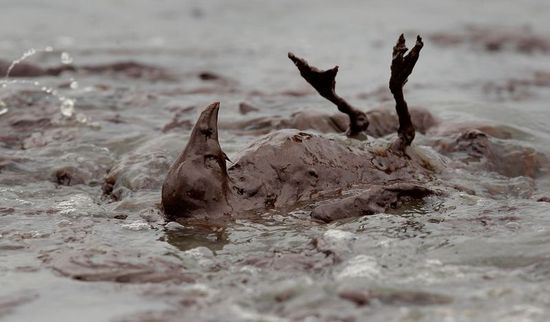
OilyBirdCharlieRiedelAP

Think Progress is keeping track of the wildlife impacted by the spill:

As of yesterday, 874 animals (birds, sea turtles, other mammals, and reptiles) had been collected dead in the affected area. Another 466 had been collected with alive, but visibly oiled. Some new pictures from the AP, including dead sea turtles, fish, and birds, as well as pelican chicks discolored by oil [are here]

John Collins Rudolf calls that the tip of the iceberg:

The number of carcasses recovered is important, as it will play a role in determining the liability BP faces under federal law. But this number should not be mistaken for the true impact on wildlife. Past history teaches that the great majority of birds that die after exposure to spills simply disappear into the ecosystem. And as Louisiana’s marshes are significantly more difficult terrain to negotiate than the beaches of Prince William Sound [during the Exxon Valdez spill], it should be no surprise that the confirmed bird death toll remains unusually low.

(Photo by Charlie Riedel/AP)