Actions And Consequences

New sanctions against Iran have passed the UN Security Council. Fisher rounds up reax. Yglesias makes a sensible point:

Something that I think is worth noting here is that sanctioning Iran isn’t just about Iran and Iran’s nuclear program. It’s about every other country on earth, and all those countries’ hypothetical nuclear programs. The precedent of North Korea makes clear that if you really want a nuclear weapon, the international community probably can’t stop you. But how many world leaders cast a glance at Kim Jong-Il and say “I wish I were that guy”? If Iran continues to refuse to verifiably disarm, we want to make sure that other leaders of mid-sized powers still feel that a price is being paid that’s high enough to induce them to make other choices.

The View From Your Recession

A reader writes:

I’m a graphic designer living near a large city in the Pacific Northwest. I graduated from college a year ago with my BA and I’ve been looking for paid work ever since. I’m originally from Australia and came here to study, so I’m still on a student visa that dictates I find work in the field of my major (design and photography) while I wait for my permanent residency to come through.

Finding work has been an exercise in the impossible. In the last year, between applying for positions in person, online, by mail, cold calling, and in many cases simply going door to door at creative agencies and trying to seek work directly from business owners, I’ve applied for about 60 positions. I’ve gotten lucky enough to score a job interview twice (without luck), and I managed a 3 month unpaid internship late last year, but it led nowhere since – surprise! – they couldn’t afford to hire me at the end of it. Right now I help a friend run her fledgling photo business just for something to keep busy – but again, it’s unpaid.

I have a strong portfolio, a good work ethic, am personable – hell, I even have the Aussie accent going for me. Ultimately it leads nowhere. My experience thus far suggests that it doesn’t matter who you are, what you’ve accomplished or what your skills are – if you were unfortunate enough to graduate or find yourself looking for work in the last two years then it sucks to be you.

The speed with which rejection comes is absolutely astonishing. Thinking along the same lines as the career counselor that was featured last week, I thought that applying in person, portfolio under arm and dressed to impress would be a good idea. Even if there weren’t any immediate openings, surely the act of being bold enough to walk in uninvited would count for something, and I could (hopefully) put a face to my name and be a first port call when something comes along. While I’m sure this works in normal circumstances, it assumes there will be job openings at some point. Thus far, that hasn’t been the case.

Most times I’ve tried this approach I’ve been rejected before I’ve even had a chance to offer a business card or show my portfolio, the reality being that most creative agencies have seen downturns of near 50% (since their health relies entirely on the health of other businesses to buy new ad campaigns and the like) and they can barely find enough work for the designers left standing. Even when I offer to work for free, on the assumption that it could lead to work later down the line, I’m still rejected on the basis that even if I was given an unpaid position, there’s not enough work for me to have anything to do!

I don’t begrudge any of these businesses their rejections of me, as most have been nice enough to review my portfolio and take a resume after explaining their hiring situation. Most of them like my work. I’m told frequently that if they were hiring, I’d be an ideal candidate.

I dropped in to see one of my professors two months back, curious to see how other graduates were doing. She’d always been particularly nice to her students, and took a keen interest in her students’ lives after graduation. My graduating class was somewhere between 30-35 students, and I was eager to find out if I was crazy, or if this was somehow normal. I found out that of my graduating class, only two of us had found work. The best part? One of those people was me – she was counting my unpaid internship. The other fellow who’d found “work” had also received an unpaid internship, but like myself, had been cut when it expired as his agency couldn’t afford to hire him either.

During my internship, I remember one of my co-workers telling me about their previous intern, an incredibly talented young woman who’d produced some of the best work they’d ever seen. My co-worker had just been to Starbucks, where said intern had served her and wished her a nice day. The sad part is after a year of looking for something, anything paid, I would relish that opportunity.

I’ve never been someone who believes that work is easy, that life will suddenly make sense after graduation or that a perfect career will drop into my lap. Getting your career in order should be a challenge. Climbing the ladder of life should take time. But you need a rung to start from, and right now there’s a lot of ladders out there without rungs.

The Science Of Fag Hags, Ctd

55935156

A reader writes:

Ahem.  Some of us prefer the term Fairy Princess.

Another writes:

I find the term Fag Hag horribly degrading to the wonderful straight women in my life. I much prefer Flame Dame or Fruit Fly.  Oh, and Lesbros is the straight guy/lesbian equivalent. 

Fruit fly? Another:

When I was in college the term for a man who predominantly befriended lesbians was "Dutch Boy," though in my experience it was more a derogatory term for such men used between lesbians.

Another:

I can relate to your remark that some girls just want to have fun. I was a single 26-year-old woman in 1974 when the disco scene was hot. I loved to dance but dreaded putting myself out as bait for a relationship I didn't want. The best places to dance without complication were disco clubs near me in Hollywood.

They were filled with gay men dancing their hearts out. I loved going there and many guy were happy to dance with me, since I wore great twirly dresses. The bathroom situation was remarkable in that "boys" and "girls" held no meaning, and I had to fight my way through men to go pee, but nobody bothered looking at me while I did so. (No doors on the stalls!)  Great memories…

Another:

Gay guys like the things we like. My gay friend went shopping with me and my 4-year-old daughter last week, and loved it – told me to give him a call the next time I go. My husband would rather have his fingernails pulled out with hot tongs, you know? So it’s fun to have a male friend who "gets" many traditionally female pastt imes (though I couldn’t talk my friend into going to see Sex and the City 2 with me!).

Another:

True: hanging out with gay men does provide the chance have fun without the possibility of sexual tension (although we can get that from girlfriends too). It's not just that, though – gay guys are still guys, and we can learn things about the way guys look at the world from our gay friends that we can't learn from women.

Another:

I just thought I'd share this Onion article from 2002 on the subject.

(Photo: Actress Kathy Griffin arrives with some Siberian Huskies at the Best In Drag Show 2005 held at the Wilshire Ebell Theater on October 16, 2005 in Los Angeles, California. By Vince Bucci/Getty Images.)

A Ship Of Fools

Gadi Taub begs Israel to come to its senses:

Today, Israel is not the belligerent party in the Israeli-Palestinian conflict. It is Israel that has offered partition, and the Palestinians who have consistently refused it. Netanyahu inherited a winning hand. He could have put a peace plan on the table, leaving the Palestinians to refuse it. He could have declared that Israel wanted to withdraw from the West Bank and would do so if its security was guaranteed by an agreement with the Palestinians or a third party. He could have offered state housing help for those who would leave the settlements even before an agreement. Instead, he mumbled something half-heartedly about two states, and then moved on to fight for enlarging settlements.

Settlements, clearly, are the keys to all this. Further settlement is what energizes the campaign to delegitimize Israel. And, for the first time since its war of independence, Israel is in real danger of destruction. Zionism’s success depended, as Theodore Herzl understood, on international recognition. It will not survive without it. If Israel clings to its settlement policy, it will sink along with its West Bank occupation.

The Internet And Politics In America And Iran

Irantwitter

Dish eminence jeune Patrick Appel points out that internet users skew white, rich, educated, and young. Age is the greatest divide:

The young are more libertarian, pro-marijuana, and less religious than the American population generally. Millennials (pdf) are gay-friendly, racially tolerant, technologically savvy, welcoming of immigrants, open to government intervention, less hawkish, more accepting of non-traditional families, less inclined to marry early, and more optimistic about the state of the state of the nation. Thus, the consensus view among American Internet users may differ substantially from the result at the ballot box. This incongruity is amplified because senior citizens, the demographic least likely to have a robust online presence, has an outsized electoral footprint. 72 percent of American 65-to-74-year-olds voted in the 2008 election while only 48.5 percent of 18-to-24-year-olds exercised that right. We are in an era when the young have the most control over the dominant cultural medium while the old have the greatest say politically.

He also looks at the Iranian digital divide:

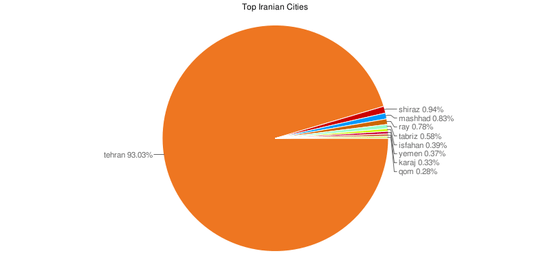
During last year's protests in Iran, Twitter was a primary means of receiving news from inside Iran. But how representative of the Iranian population were those tweeters? A few weeks after the protests broke out Sysomos found that 93 percent of Twitter users were located in Tehran, the center of the protests and one of Iranian opposition leader Mir-Hossein Mousavi's strongest bases of support.

Death And Conservatism

Decay

The Dish has had a spiritually enriching series (for me, at least) of the relationship of belief and unbelief to death, and the idea of death. But I think a deep appreciation of the centrality of mortality is also central to conservatism as I understand it. The first words of "The Conservative Soul" – "All conservatism begins with loss" – were my attempt to capture the existential realism of the conservative viewpoint and its reluctant acquiescence in all practical life as a form of inevitable and eventual failure. That is why the tersest description of a real conservative is Oakeshott's: someone who prefers present laughter to utopian bliss.

A reader notes a similar sentiment from Roger Scruton in his Gentle Regrets: Thoughts from a Life:

"The years of conflict have taught me that few will share my convictions, and that all attempts to conserve things come too late. But the philosopher who most clearly perceived this truth brought a message of peace: 'when philosophy paints its grey-in-grey, then is a form of life grown old. The Owl of Minerva speads its wing only with the gathering of the dusk.' Hegel's words describe not the view from that attic window in the Quartier Latin, but the soul that absorbed it.

It was not to change things, or to be part of things, or to be swept along by things, that I made my pilgrimage to Paris. It was to observe, to know, to understand. And so I acquired the consciousness of death and dying, without which the world cannot be loved for what it is. That, in essence, is what it means to be a conservative."

I wonder whether this is why conservatism – as opposed to pseudo-conservatism or American exceptionalism or populism or libertarianism – has had such a hard time putting down roots in America. There is something about late American capitalist culture, perhaps exemplified in the speech patterns and reflexes of Sarah Palin, that is always about progress, success, achievement, plowing through doors, seeing bright futures – even when decline is so apparent you need goggles to ignore it.

There is a core element of the tragic in conservatism. And yet America resists tragedy, denies it, moves past it, feels threatened by it. But until you have truly grappled with tragedy, you haven't fully grappled with reality.

The View From Your Window Contest: Winner #1

VFYWcontest_6-8

A reader writes:

I’ve been doing this for as long as I remember, and I’m pretty good.  But did you have to start with such a difficult and ugly picture? There are few clues in this one. I’d say it’s a view from a drug rehab halfway house in Texas or Oklahoma. Pretty cool that the inhabitant reads your blog.

We know our base. Another writes:

Canada, Newfoundland, St. John’s. Why? Assuming this photo was recently taken.  Buildings, windows, fence and trees look North American.  Flora seems to be more Atlantic side than Pacific.  Deciduous trees in background don’t have leaves.  Looks like there had been a lot of snow.  Has to be pretty far north.

Another:

The foliage looks sparse and bare, which leads me to believe that it was taken in the Southern Hemisphere – I’m guessing Victoria, Australia. That, or some drought-affected part of Central California!

Another:

The Faroe Islands. Reason: probably a high latitude judging by sky and shadow. Ivy on tree suggest north western Europe to me. No leaves on trees means far north.

Another:

Saskatchewan, Canada is my vote.  My first thought was the U.S. or Australia, but then I realized that it could be Canada as well; it’s a country with *room*.  The still-bare branches with short grass just sprouting up argue for a north-temperate zone location which favors Canada.  Of course, it could be Alaska or Russia but I’m sticking with Canada.  Europe is out.

Another:

Bratislava, Slovakia?

Another:

American window latch, American fencing and roofing. But not many leaves on those trees: either a drought or somewhere still very cold. Big prairie clouds. Pollarded tree, but a big one. I know that only from the US South. (Pollarded trees in France are smaller, garden size, not some huge pin oak or red or silver maple.) Texas? Argentina? Manitoba? But also a place with a Dish reader! Let’s say Stillwater, Oklahoma.

Another:

I’m guessing West Virginia.  The trees seem east coast US-y to me, and the locking system on the window looks comfortingly familiar.  Specifically West Viriginia, I’m sad to say, because the photo gives a sense of an area hard on its luck.

Another:

Spokane, Washington?  Pretty sure this is the States. This could be anywhere from Idaho to Nebraska to Maine I reckon. I figured I’d guess my home town since it was the first contest, and that is exactly where it reminded me of.

And then the paydirt:

Looks like my grandma’s backyard. Houses that look like sheds, signs of year-round drought, and Georgia O’Keeffe clouds gotta be Albuquerque, NM … no?

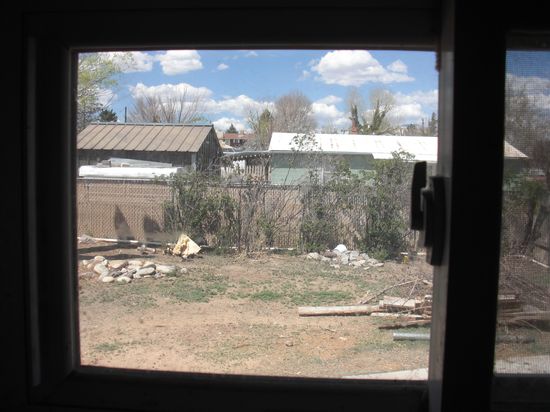
Close – Farmington, New Mexico, 4 pm. Española was the closest answer, submitted first by a reader with the initials P.L. – congrats!  And thanks to the hundreds of readers who participated. Shall we do this weekly?