In Nevada, the smaller, rural counties turned out for the far right. A harbinger for the fall?
Month: June 2010
When The Rump Votes, Ctd
Beinart thinks the GOP is "blowing their shot at a midterm landslide". Oddly, I think that would be better for them than a decisive win. Why? Because they may interpret victory this fall with victory for the Tea Party; and thereby be even more emboldened to take more radical anti-government positions. With a majority, moreover, they will have to take a position on spending cuts – and spell them out. If they are to resist any and all new taxes, the cuts will make the new British government look like the Bush administration. Which will doom them in 2012 and beyond, if Obama has any political skill at all.
And he has. Plenty.
Quote For The Day II
“Our critics don’t get it. In Jenin, we went house-to-house and sent 23 soldiers to their death. But if we’re going to be called war criminals no matter what we do, then maybe that changes our thinking,” – Michael Oren, Israel's ambassador to the US, threatening more military action less scrupulous than the Gaza bombardment.
This point just baffles:
"If the U.S. had an Israel in the Persian Gulf it might not have had to land troops in Iraq twice over the last two decades. Israel is the indispensable nation.”
Huh?
The pro-Israel lobby's latest fixation is a sudden demonization of Turkey. Eli Lake's latest really is a doozy. The only explanation for Turkey's horror at Gaza – shared by countless observers in the civilized world – is, for Eli, Islamization. Eli can write an entire article without ever referring to Israel's actions these past ten years, and using the Washington Times to send a warning to Turkey that AIPAC now sees Turkey as an enemy. And if AIPAC sees you as the enemy, who in Congress, do you think, could possibly demur?
Maybe Lolo Was Right
Blake Hounshell sees a president dreaming of his stepfather as he adapts to the use of power.
When The Rump Votes
Josh Marshall's take on yesterday's results:
I think the big story here is Nevada. Harry Reid is weak. And Sue Lowden looked like a serviceable establishment GOP candidate who could take him out. But she self-destructed and the win looks like it will go to Sharron Angle, a hard-right Tea Partier who makes Rand Paul look like a bit of a trimmer. And no, that's not hyperbole.
This is the kind of result national Republicans have been desperately hoping to avoid. And it's the price of the 'energy' Republicans have been benefiting from on the right. In Nevada, you might say, their chickens are coming home to roost.
Was Israel A Mistake?
So far, no luck on anti-Zionist columnists. And being critical of Israel does not mean you're an anti-Zionist. But a reader did note this 2006 column by Richard Cohen. Money quote:
The greatest mistake Israel could make at the moment is to forget that Israel itself is a mistake. It is an honest mistake, a well-intentioned mistake, a mistake for which no one is culpable, but the idea of creating a nation of European Jews in an area of Arab Muslims (and some Christians) has produced a century of warfare and terrorism of the sort we are seeing now. Israel fights Hezbollah in the north and Hamas in the south, but its most formidable enemy is history itself.
I was thinking recently how a Burkean could defend the establishment of the state of Israel in 1948. I'm not sure it's possible – which may say more about the limits of Burkean conservatism than Zionism. Although Jews obviously dwelled in Palestine for as long as anyone, their numbers were few in recent centuries until the grand experiment. Zionism began as an idea, another nineteenth century "ism", and was, like most radical ideas, controversial among Jews and Gentiles everywhere in its inception and since. It was radically utopian, an almost text book example of imposing an abstract concept – a settled Jewish nation after so long a diaspora – on a land already embedded with an existing geographic, demographic, religious and cultural reality.
Maybe you could see the emergence of Israel as a Burkean consequence of the Holocaust. But most Zionists are offended by this idea, and it seems to me that this makes sense as a Burkean defense of Israel for Europeans, but has little resonance for Jewish Palestinians, Arab Palestinians, Jordanians, Syrians, Persians, Kurds, and others more directly affected. I remain deeply committed to the idea of Israel, largely because the Shoah proved beyond any doubt that there was no security for Jews as a nation without a homeland. But the Burkean in me cries out prudentially against trying to coerce history – and tradition and settled populations – in this radical and sudden way.
The lesson of this, it seems to me, is not, however, that Israel should be abandoned. The lesson is that its leaders and people need to be sensitive to history, not embittered by it, however justified the embitterment might be. A Burkean could just about defend the creation and endurance of Israel (ending it now would be an even greater rupture than its beginning) but he should also be utterly unsurprised by reaction, resistance and resentment. Conservatives of all people should foresee this. When the lives and homes of hundreds of thousands are permanently and suddenly altered without their permission and against their religious beliefs, they will react. When families are still turfed out of their homes to make way for strangers of a different religious background, rage is a perfectly defensible, and rational, response. History matters, as Cohen explained:
This is why the Israeli-Arab war, now transformed into the Israeli-Muslim war (Iran is not an Arab state), persists and widens. It is why the conflict mutates and festers. It is why Israel is now fighting an organization, Hezbollah, that did not exist 30 years ago and why Hezbollah is being supported by a nation, Iran, that was once a tacit ally of Israel's. The underlying, subterranean hatred of the Jewish state in the Islamic world just keeps bubbling to the surface. The leaders of Saudi Arabia, Egypt, Jordan and some other Arab countries may condemn Hezbollah, but I doubt the proverbial man in their street shares that view.
My additional point would be that this resistance to the other encroaching on sacred ground is not a unique feature of the Arab psyche. (It is, however, horribly compounded by Islam's fetish for religious exclusivity on its own territory. This insistence on a religious monopoly on actual regions is much more repellent, it seems to me, than the Jewish people's search for a small place of their own around their historic capital. Israel, after all, does not ban Islam; Saudi Arabia bans Judaism. Between the relative land-claims of Judaism and the totalist land-claims of Islam, I'm with the Jews, both proportionally and as a matter of simple equity.)
But it is prudentially idiotic for Israel to act as if Arab resentment has no legitimacy or no justification. It is tone-deaf to create a Jewish state in the middle of the Middle East and then behave as if it had been there for ever. Israel is not France or Egypt, or even Canada. It is a young and contested idea on ancient, contested land, whose original inhabitants did not all just disappear in a biological holocaust, as in America.
It does not seem to me therefore nuts to urge a certain respect and tact from Israel toward its neighbors and the populations it displaced – even when it is not reciprocated. I'm not going to go into the long and awful history of the way in which the Arab world has treated Israel from the get-go, but I am saying that to add to the original proposition an ongoing, unstoppable colonization of a further swathe of land won in wartime is obviously against the interests of the Jewish state, and compounds and deepens the resentment from 1948 and 1967 and 1974. Not to see this context, indeed to claim that any and all grievances against Israel's existence – and, much more significantly, ongoing expansion – are entirely a function of Jew-hatred is to lose any nuance in diplomacy or human relations.
That's where the Israelis have lost me and some others. It was revealed first by how petulantly even the Kadima-led government responded to Obama's election. The Gaza war, conceptually defensible, was practically gruesome (Hamas and Israel share that blame), but the unapologetic, almost triumphalist and revengeful manner in which it was conducted and defended was and is shocking, as is the contempt for the wounded and dead on the Mavi Marmara. When your heart is hardened against the corpses of children buried in rubble, it is hardened too much. And the job of a real friend is to point this out, not to enable it.
Keep holding the mirror, Mr president.
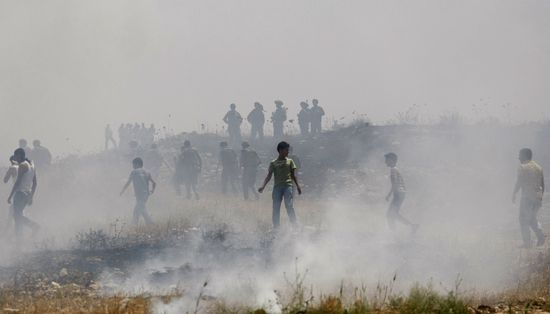
(Photo: Israeli soldiers (top C) and Israeli settlers (top L) watch from a hilltop as Palestinians villages try to put out fires after fields were set ablaze in the village of Asira al-Qiblyia in the northern West Bank on June 2, 2010. According to Palestinian villagers, Jewish settlers from the nearby Yitzhar settlement set on fire their olive and wheat fields. By Jaafar Ashtiyeh/AFP/Getty Images.)
You Need Spending Cuts?
Simon Jenkins proposes an end to Britain's entire military forces:
What do we really get from the army, the navy and the air force beyond soldiers dying in distant wars and a tingle when the band marches by? Is the tingle worth £45bn, more than the total spent on schools? Why does [Chancellor George] Osborne "ringfence" defence when everyone knows its budget is a bankruptcy waiting to happen, when Labour ministers bought the wrong kit for wars that they insisted it fight?
Osborne cannot believe the armed forces are so vital or so efficient as to be excused the star chamber's "fundamental re-evaluation of their role". He knows their management and procurement have long been an insult to the taxpayer. The reason for his timidity must be that, like David Cameron, he is a young man scared of old generals.
America has a different role, but Americans have choices too. To exempt defense from spending cuts in the next decade would be daft.
5.3 Percent
Not as many as Orly Taitz but not nothing either. You can easily mock Mickey but he's done something most bloggers don't: actually try to get votes from real people in a real election. And thereby reveal the true and enduring mass appeal of neo-post-crypto-non-paleo-pro-but-anti-Obama-liberalism.
Vaughn Walker’s Questions
A text-book study in the civic lessons of trials.
The Tyranny Of Now
Alain de Botton encourages a diet of the mind:
The obsession with current events is relentless. We are made to feel that at any point, somewhere on the globe, something may occur to sweep away old certainties—something that, if we failed to learn about it instantaneously, could leave us wholly unable to comprehend ourselves or our fellows. We are continuously challenged to discover new works of culture—and, in the process, we don’t allow any one of them to assume a weight in our minds.
Or as Michael Oakeshott said to me as his face fell when I told him I was planning on a career in journalism: "Oh dear. The need to know the news every day is a nervous disorder."
 The Dish