“It was an unfortunate deviation from my core philosophy,” – as quoted by New York Magazine. Could we have a column on that?
Month: July 2010
The View From Your Window

Ithaca, New York, 12 pm
Weigel vs Breitbart
There's a factual discrepancy here:
“Let’s not drain the blood from what happened here,” Mr. Weigel said. “Somebody hacked into off-the-record e-mails, many of them from before I went to work at The Post, and picked the ones that made me look the worst. It was a kind of opposition research, and just about anybody that happens to is going to end up looking bad.”
Breitbart claims the emails came from an internal leaker:
That leaker who destroyed Weigel’s career had agreed to the off-the-record nature of the 400-strong list; the minute the leaker went public with the material the story was no longer about Weigel but about the JournoList itself.
This seems to me to be an important distinction. Was Journo-List hacked or betrayed? And will anyone tell?
Quote For The Day
“The internet’s completely over. I don’t see why I should give my new music to iTunes or anyone else. They won’t pay me an advance for it and then they get angry when they can’t get it. The internet’s like MTV. At one time MTV was hip and suddenly it became outdated. Anyway, all these computers and digital gadgets are no good. They just fill your head with numbers and that can’t be good for you,” – the artist formerly known as Prince.
Palin For RNC Chair!
So she's not that toxic, apparently.
Obama’s Brooks Fetish
Chris Beam profiles David Brooks:
Politically, it’s clear why the White House likes Brooks—he’s the persuadable opposition. “David represents to them the sensible Republican,” says Collins. “If David is convinced, they regard that as a real bi-partisan triumph.” But the special relationship is as much about style as politics. Temperamentally, Brooks and Obama could be twins. They address crises with an almost inhuman calm—an asset at times, but also a liability when the only proper response is emotional. On this, Brooks defends Obama. “You know, people fault President Obama for being passionless sometimes, for being a little too cold,” Brooks said on PBS NewsHour in May. “But when you have a week like this, where you’ve got the Greek situation, the oil spill, you’ve got Times Square, you’ve got floods in Nashville, I think they responded with reasonable speed, but basically with a level of calmness, which is in his nature … This is a good time to have a president like Obama, who’s just steady.”
In response, Atrios notes:
We do not live in a world with Republican senators who give a shit what David Brooks thinks.
Nope. But it remains to be seen if calm, in the long run, is stronger than anger. Is suspect it is; and Obama's temperament remains his actual strength, however it works the last nerves of liberals.
Chest Pain In Afghanistan
The US ambassador to Afghanistan, Karl Eikenberry, has been skeptical of our counterinsurgency strategy and of Karzai. Peter Beinart hopes he'll keep his job:
Someone needs to tell the White House that unity is not always a good thing. Sure, if you’re pursuing a sound policy, then it is helpful for everyone to get behind it. But if the policy is fundamentally flawed, disunity is actually healthy. It means that there are people in influential positions capable of seeing those flaws, and letting others know about them. In Vietnam, for instance, there was too much unity at high levels, and as a result, it was hard to bring the bad news filtering up from the field to the attention of the people that mattered. Stamping out disunity when a policy isn’t working is like stamping out chest pain in a patient on the verge of a heart attack—you’re not solving the problem, you’re only squelching the symptoms that alert you to the problem.
Palin’s Chances
Larison is betting that Palin won't get the GOP nomination. He admits that it "is possible that the GOP will decide to immolate itself as part of an elaborate reality TV experiment, but they have every incentive not to want to do that":
If she did somehow pull it off, Democrats would spend most of the summer and fall of 2012 rubbing their eyes in disbelief at their good fortune. Even in a fairly polarized national electorate where McCain/Palin could manage to get 47% of the vote in the midst of a financial meltdown at the tail end of the second term of one of the three most unpopular postwar Presidents, a ticket headed by Palin would be hard-pressed to break 40%. Palin as the nominee would probably make 2012 the most lopsided election victory for the incumbent President since 1984.
The Ethics Of Howie Kurtz
Regardless of the merits of Patrick Gavin's complaints about the clubbiness of Howie Kurtz's CNN press show, it seems to me unethical and slimy to rebut the claims by violating a personal email sent by Gavin to Kurtz. This is not the first time Kurtz has done this.
Michael Steele Was Right
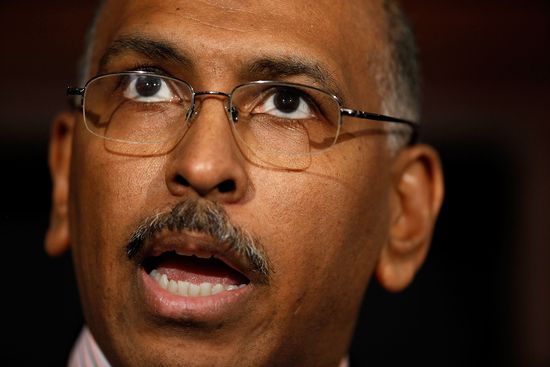
Consider the statement that gave Bill Kristol the vapors and had the neo-imperial triumvirate, McCain, Butters and DeMint, hounding him over the weekend:
"It was the president who was trying to be cute by half by flipping a script demonizing Iraq, while saying the battle really should be in Afghanistan."
This is a little cutting, but not far off. Obama has never been a pacifist; he's a Niebuhrian realist, as he keeps telling us. And in 2001, there was a clear case for removing a regime that had allowed its territory to be used by upper-class Jihadist fanatics to attack the US mainland (if only by commandeering American planes). But by 2007, it was clear that this war was failing as well, and whatever leverage we might have had there as liberators had been squandered by the Bush-Cheney administration's negligence and focus on Iraq. Any realist at that point would have seen the merits of a policy commensurate with the failed occupation of six years. And indeed Obama signaled very strongly in his campaign and first few months that he would be following a minimalist strategy in Afghanistan. His rhetoric in the campaign – that Afghanistan was the good war and Iraq the bad one – was mere rhetoric, as Steele notes. It was a cute formula for domestic political consumption that was divorced from the practical exigencies of running an empire in the graveyard of all empires. Still, one assumed the president wouldn't actually be more utopian than Bush, more dedicated to the establishment cult of Petraeus, more eager to win a war that simply cannot be won.
But last fall, we discovered that Obama was a dreamer and actually believed he could pull off – a decade late – what no invading army has ever pulled off in Afghanistan since the beginning of time. The shift came last fall with the policy review, and now we have a hundred thousand troops, dying at record rates, to implement a counter-insurgency strategy, based on the one that so glaringly failed in Iraq. (For those who believe the surge has succeeded, one must simply ask: where is the non-sectarian Iraqi government that was its stated goal? Why was Joe Biden in Iraq again this past week?) Back to Steele:
Well, if he's such a student of history, has he not understood that you know that's the one thing you don't do, is engage in a land war in Afghanistan? All right, because everyone who has tried, over a thousand years of history, has failed. And there are reasons for that. There are other ways to engage in Afghanistan."
Amen. This is, at this point, Obama's war – because it was a war of choice for him, not necessity. The scale and ambition of this madness is Obama's scale and ambition, no one else's. This war is now his war, as much as Vietnam was LBJ's. And this is not because he inherited it. He inherited a critical window to cut our losses and get the hell out, with a minimalist Biden-style strategy to minimize, if not end, the threat.
If the GOP leadership were not still controlled by the neocons eager to re-live the glory days of Bush and Cheney, the Republican party would be reprising its role as the realist reminder of the limits of government power in America and across the world. But they have long since abandoned realism for the fantasies of neoconservatism. And so we have two neo-imperial parties and a presidency reeking of fear and paralyzed in the face of the toughest decision any president has to make: conceding that a war is unwinnable on his terms before others determine it for him – on theirs'.
 The Dish