
Galway, Ireland, 8.36 am
Galway, Ireland, 8.36 am
Toby Jones profiles Saudi Arabia's King Abdullah:
While making small social and economic concessions, the king is in fact turning the clock back in Arabia, using his popularity to confront clergy and restore the kind of unchecked authority his family enjoyed in the 1970s. Although the royal family has been the preeminent political force in the Arabian Peninsula since the early 20th century, its supremacy was challenged in 1979 by the spectacular siege of the Grand Mosque in Mecca, which marked the rise of a generation of Islamist rebels. The kingdom's leaders responded by co-opting its radical critics. In doing so, they greatly expanded the power of the religious establishment.
"Thirty years on, it is this bargain that Abdullah has begun to dismantle. And he is succeeding. Indeed, Abdullah's most important domestic accomplishment so far has been the strengthening of his and his family's grip on power."

This photo was taken late at night. You have until noon on Tuesday to guess it. Country first, then city and/or state. If no one guesses the exact location, proximity counts. Be sure to email entries to VFYWcontest@theatlantic.com. Winner gets a free The View From Your Window book. Have at it.
"You may be certain that the world is heading for destruction, but it's a good thing, a moral thing, to behave as though there's still hope. Hope is as contagious as despair: your hope, or show of hope, is a gift you can give to your neighbour, and may even help to prevent or delay the destruction of his world,"- Primo Levi, 1985
Christopher Ryan and Cacilda Jethá have a new book on the evolution of sexuality. They argue – duh – that monogamy is unnatural:
Biologists distinguish sexual monogamy from social monogamy. As DNA testing has grown cheaper in recent years, we’ve learned that most species formerly classified as “monogamous” (primarily birds) are socially monogamous, but not sexually so. In other words, they form pairs that cooperatively care for that season’s brood of young, but the male may well not be the biological father. Applied to humans, we argue that a more flexible approach to sexual fidelity can increase marital stability and thus lead to greater social and family stability.
In a Q&A with the authors the open relationships of some gay couples are discussed:
First of all, they’re both men, so they both know what it’s like to be a man. They both know from experience that love and sex are two very different things, and it seems that for women the experience of sexuality is much more embedded in narrative, in emotion, in emotional intimacy. But also it’s really hard to judge what women would be like if they hadn’t been persecuted for the last five or six thousand or ten thousand years for any hint of infidelity.
Gay men in the United States have also by definition gone through a process of self-examination. The whole process of coming out is a process of integrating sexuality into your life in a way that takes courage, and it’s not something that happens naturally. I think gay people have an advantage because they’ve already gone through a process of saying: "Look, my sexuality is what it is. I’m not ashamed of it. I’m going to live openly and in accord with it." That puts them on a different level than most heterosexual people who are able to pass along and pretend that they fit into the normal parameters.
Jonah Lehrer praises the Wii:
For decades, video game designers have been obsessed with visual realism, as if the eyeball was the key to our emotional brain. But accurate graphics have diminishing returns. At a certain point, we don't need more pixels – we need more physicality. For the first time, video games are taking advantage of their specific medium, exploiting the features that other entertainments (such as movies and novels) are missing. No other form of culture, after all, depends on the verb "to play". (We play video games – we don't watch or read them.) But here's the thing about playing: it's much more captivating when the play itself is a physical act, when we play not just with the mind but with the body.
Today on the Dish, Michael Steele let slip his biggest blunder yet, Kristol flipped out, Greenwald slammed the DNC for its Rovian response, and Larison and Frum sounded off. Econ bloggers chewed over the latest job numbers, Barlett somewhat sided with Krugman, Yglesias pushed for lifting the Social Security cap, Pew provided data on how the recession is affecting us, and Alex Hart looked at whether collecting unemployment makes people lazy.
Marcy Wheeler countered the NYT's defense of its torture policy and Greg Sargent took a swipe at the paper. WaPo FAIL here. Deborah Newell Tornello sketched out a sexist double standard in Palin coverage, Josh Green analyzed her latest numbers, and Trig talk caught on. Andrew pegged tea-partiers as secular fundamentalists.
In assorted commentary, Bob Wright pondered withdrawal from Afghanistan, Annalee Newitz predicted a rise in male nannies, Jessica Dweck delved into the decline of fag hags, Chris Orr eulogized M. Night Shyamalan's career, and Andrew wondered whether people should pray for Hitchens. Readers pushed back against another who complained about taxing the rich, others swarmed Thiessen for slamming soccer as socialist, and still others chimed in regarding gay eugenics.
Malkin Award here. Kickass cat video here. MHB here, VFYW here, and FOTD here.
Thursday on the Dish, Garrett Epps relayed Kagan's response to marriage equality, Adam Serwer picked up on her philosophy, and Bernstein wasn't so sure. Andrew asked if the Israeli-Palestinian relationship was apartheid and aimed both barrels at the NYT over torture. Greenwald piled on.
Sharron Angle finally talked to the media – about church-state separation – while a Tumblr transposed her and other Christianists' words with Christ. Palin-Johnston spat here. More Trig discussion here and here. More Palin here. Andrew returned fire to Breitbart and shared his thoughts Hitch's diagnosis
Frum grasped for an approach to a double-dip recession, Leonhardt stayed positive on the bad job numbers, and Rory Stewart remained gloomy over Afghanistan. Drum wanted to nudge Social Security into solvency, Free Exchange was afraid of soaking the rich, Allahpundit predicted Obama's cooperation with Republicans, and a reader dissented over Andrew's support of lifting the cap. Alan Simpson pointed out Reagan's multiple tax hikes.
Mark Liberman took down the "Obama is first female POTUS" meme and a reader helped. Dan Zak glimpsed at the end of gay history and Alyssa Rosenberg looked forward the new Jersey Shore. Readers added to the thread on in utero gay therapy and another defended porn. Malkin Awards here and here. More dog love here. Tumblr fun here and a dose of Simpsons here. MHB here, VFYW here, and FOTD here.

(Timothy A. Clary/AFP/Getty)
Wednesday on the Dish, Kagan yucked it up with Senators, punted on the Twilight question, and went back on her word. The British government moved on torture, a new study proved that the NYT rarely used the term with the US, and the first hurricane seemed to do some good in the Gulf. Andrew challenged Breitbart on his offer to pay $100K for Journolist.
Prop 8 update here. Drug War coverage here and here, and police state watch here. A reader didn't buy the Palin clone's shtick. More on Palin here and here. More Trig talk here, here, and here. The Stranger and Jim Burroway looked at efforts to change sexuality in utero.
Frum addressed his apostasy, Bob Bennett scrutinized his own side, and Continetti criticized Beck. Noah Millman went another round on Afghanistan, McArdle countered Dylan Matthews on Social Security, Dana Goldstein put the conflict mineral trade under the microscope, and Gene Demby noted the end of rubber rooms. A reader demanded evidence showing that porn is detrimental and another critiqued the MSM. Cup coverage here and here. MHB here, VFYW here, and FOTD here.
Tuesday on the Dish, Palin shut out even conservative bloggers, Sharron Angle tried to hide her real views on abortion, and the Palin campaign model metastasized. Taibbi pwned Lara Logan, Pareene called out an LA Times blogger, a CNN reporter chose access over reporting, and a reader nailed the insecurity of MSM reporters. Friedersdorf wanted to drop the topic of Trig, readers disagreed, and Bernstein went another round. Douthat defended himself on Afghanistan. Empire watch here.
In Cup coverage, Dayo Olopade saw a surge in pan-African pride. More soccer fodder here, here, and here. The Economist examined the blackmailing of journalists' opinions, Fallows explored the end of privacy, a reader wondered why anyone trusts the secrecy of email, and Greg Marx explained the necessary intimacy of blogging. John Hawkins didn't think Frum was sufficiently conservative and Frum replied.
In other commentary, Gail Dines baited Douthat with porn, Tony Woodlief praised parenting, Free Exchange suggested that the gays could make better parents, and Dylan Matthews balanced Social Security. Hewitt Award here, a recession view here, and a glimpse at guerrilla gardening here. MHB here, VFYW here, and FOTD here. The latest Window View winner here.

Bali, Indonesia, 7 am
Monday on the Dish, Andrew spoke ill of Senator Byrd, readers dissented en masse, and Nick Gillespie pushed back. Due credit to Byrd on the Iraq war here. Andrew fisked Douthat over reasons to stay in Afghanistan, called out Cantor on the deficit, and commented further on the Weigel-WaPo row. Dave spoke out. Dissension in the Vatican here. Get your Palin fix here and a huge dose of Trig-gate here.
The nationalism of the World Cup explored here, here, and here. More Cup coverage here, here, and here. The blogosphere slowed down and the iPhone's phone continued to falter.
In assorted commentary, Kristol hearted Obama on Afghanistan, George Will invoked Vietnam, Joel Wing checked in on Iraq oil, Marc Lynch addressed the Islamic threat, and Beinart looked past the Tea Party to see the government's success. Laura Freschi tackled the source of food aid, Hale Stewart worried about housing, and Greg Beato was barraged by ads. Robert Stacy McCain had some wise words on the stigmatizing of reporting by conservatives, TNC talked journalist discourse, and Politico accidentally spoke the truth on access. A reader compared McChrystal and Barry Bonds and another called out conservatives who demonize libertarians.
Hewitt Award here and Malkin here. Hathos here. MHB here, VFYW here, and FOTD here. Andrew punted on the female orgasm.
— C.B.
Mark Larson reflects on learning of a friend's death over Facebook:
Coming from a generation that grew up with Facebook and lived in a world in which relationships weren’t official until they were on the social networking site, in a strange way finding out about a friend dying in war via Facebook made it more real. You could still go to his profile and see the pictures he’d posted of the nights he spent out before deploying or the hundreds of posts on his wall from grieving friends trying to send a message one last time. In this way such a profile acts as a public memorial, and a welcome one, since its existence reminds all those in his social circle precisely what is at stake in a war that has zero effect on their day-to-day lives.
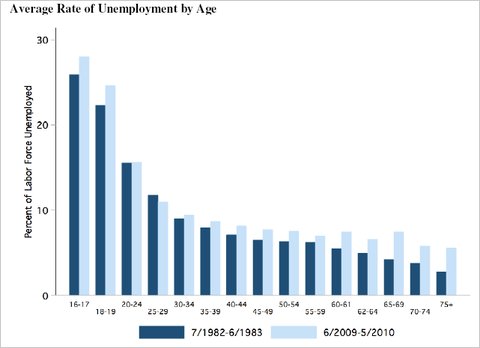
Leonhart finds a study comparing the current downturn to the 1982 recession:
Strikingly, for nearly every age group the unemployment rate is higher today than it was during the worst of the early 1980s recession.
And DiA isn't impressed by the Obama administration's attempt to put a positive spin on today's underwhelming job report:
The average voter is most likely to have job opportunities as a ready heuristic about the state of the economy, not the manufacturing production index. For the White House to frame a fairly depressing report about people's lived experiences as a sign of "continued healing" strikes one of those dissonant notes that we thought Barack Obama, the great communicator, would avoid as president.
 The Dish