Waiting On Innovation, Ctd

Noah Millman's moves the ball down the field. His re-framing of the global warming/innovation debate should be read in full. Ezra Klein's contribution:

The example I've been using to show the limits of techo-optimism has been the BP spill. We could've stopped it from happening, but we couldn't reverse it once it happened. And we know a lot more about managing oil spills than about manipulating the atmosphere. But reading Atul Gawande's article on dying brought another example to mind: cancer.

Cancer, of course, has been a long-term problem. For decades now, we've put an enormous amount of money into researching cures and treatments. We've thrown our best minds at the problem. And we've made some remarkable advances. But not nearly enough of them. Insofar as we've been waging a war on cancer, there's a very good argument that we're losing, and it's not clear when, or whether, we'll turn it around.

Virtues And Vices

I stand corrected. A reader writes:

You wrote: "I pray for the hope that is one of the three cardinal virtues."

The four Cardinal Virtues are Temperance, Prudence, Justice, and Fortitude.

The three Theological Virtues are Faith, Hope, and Charity.

The seven Heavenly Virtues are Chastity, Temperance, Charity, Diligence, Patience, Kindness, and Humility and they oppose the Seven Deadly Sins of Wrath (Anger), Greed, Sloth, Pride, Lust, Envy, and Gluttony.

Temperance and prudence: how good to be reminded of these core virtues in an age where they have all but disappeared from our polity.

Cameron Takes On Pakistan’s Two Faces

So much for the notion he simply flatters his audiences. He is just aware that Turkey is not in the same league as Pakistan in the support for and export of Jihadist terror:

The prime minister initiated the row this morning in a speech to Indian business leaders in Bangalore, when he spoke of his horror at the 2008 terrorist attacks in Mumbai for which Delhi directly blamed the Pakistani authorities.

Cameron came close to endorsing that view when he said: "We cannot tolerate in any sense the idea that this country is allowed to look both ways and is able to promote the export of terror, whether to India or Afghanistan or anywhere else in the world.

"That is why this relationship is important. But it should be a relationship based on a very clear message: that it is not right to have any relationship with groups that are promoting terror. Democratic states that want to be part of the developed world cannot do that. The message to Pakistan from the US and from the UK is very clear on that point."

Quote For The Day

"Of course I have [had sex with men]. I'm an actor for fuck's sake. I've played with everything and everyone. I love the form and the physicality, but now that I'm in my thirties, it doesn't do it for me. I'm done experimenting but there's plenty of stuff in a relationship with another man, especially gay men, that I need in my life. A lot of gay men get my thing for shoes. I have definite feminine qualities and a lot of gay men are incredibly masculine. A lot of people say I seem masculine, but I don't feel it. I feel intrinsically feminine. I'd love to be one of the boys but I always felt a bit on the outside. Maybe my masculine qualities come from overcompensating because I'm not one of the boys," – Tom Hardy, star of Inception.

“They” Ctd

A reader writes:

It might be worth pointing out to the knuckleheads who are protesting the building of a mosque near Ground Zero that there's been a Japanese Shinto Shrine very close to Pearl Harbor for a very long time.  I'd also be willing to bet that there are German Lutheran churches in NYC close to where German submarines were sinking US merchant ships in WWII.  Somehow the Greatest Generation managed to deal with these things.  Why can't we?

Another writes:

Lost in all of the pseudo-patriotic posturing and puffing by Gingrich, Palin et al., is the fact that it is against Federal Law for the City or State of New York to attempt to prevent the use of the buildings in question for religious (including Islamic) purposes absent a compelling government interest in preventing that use.  The Religious Land Use and Institutionalized Persons Act ("RLUIPA"), (U.S.C. § 2000cc-1 et seq.), section 2(a)(1) states that:

"No government shall impose or implement a land use regulation in a manner that imposes a substantial burden on the religious exercise of a person, including a religious assembly or institution, unless the government demonstrates that imposition of the burden on that person, assembly, or institution–
(A) is in furtherance of a compelling governmental interest; and
(B) is the least restrictive means of furthering that compelling governmental interest."

In other words, if the City of New York tried to oppose the use of the building in question as a mosque or other place of religious assembly, it would have to demonstrate a compelling interest in why it should be able to do so. And even it it can show a compelling interest, it must also show that preventing the use is the least restrictive way of furthering that interest.  In terms of constitutional law, that is the highest possible hurdle to placing a restriction on the practice of religious and is practically impossible to do.

It is ironic that RLUIPA was pushed through largely by Christian groups to prevent local governments from placing zoning restrictions on churches.  Of course, they only meant it to apply to Christian churches, not those others.
Placing Bets, Ctd

Balko and Les Bernal have finished off their debate on the legality of gambling. Here's part of Balko's closing argument:

Any number of our day-to-day decisions can have indirect repercussions on lots of other people. If you're going to argue that we should prohibit gambling because problem gamblers might go into debt, causing hardship on their families, or requiring them to seek publicly funded social services or welfare, you could make similar arguments for banning everything from unprotected sex, to laying on the beach, to rock climbing, to investment banking, to pie. There are people who enjoy all of these things to excess, or with an insufficient appreciation of  their risk. Some indirectly harm others or require publicly funded medical care or assistance as a result. But we don't talk about banning them. (At least not yet!)

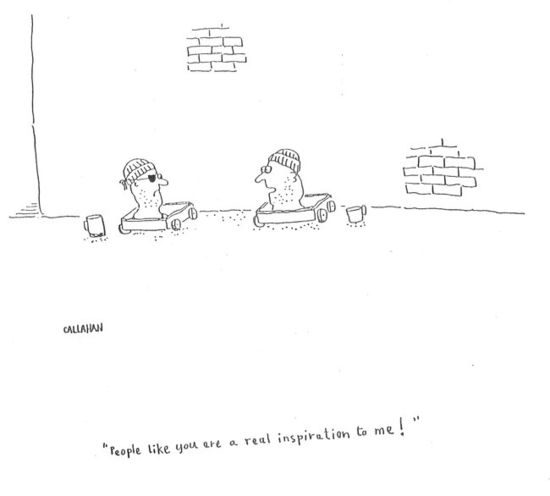
Cartoon Of The Day

28callhanimgC-popup

The mordant genius, John Callahan, is dead at 59. NYT obit here. Video of him here. The quality I loved about him was not just his extraordinary humor, but his indifference to his p.c. critics:

Callahan's quadriplegia was occasionally raised in defense of his more beyond-the-pale strips, particularly his frequent strips making a gag out of being in a wheelchair or otherwise disabled. But to make that argument — to point and say, "Well, he's ALLOWED to make fun of that" — misses the point of Callahan. He didn't care what he was allowed to say. Heck, I thought the guy was amazing, but there's a good third of his strips that I can't even read without shriveling in embarrassment or feeling my face flatten into a grimace of disapproval. And that taboo shattering was the point of Callahan. He was capable of funny yet innocuous gags when the spirit so moved him. But he was an artist who could make even his most fervent fans recoil in horror, and what's more, he wasn't afraid to do it.

After the jump, he sings "Lost In The City":