Waiting On Innovation

Douthat sketched out the conservative case against cap-and-trade yesterday. Leonhardt takes issue with one of Ross's parallels:

[Douthat's case is that] just as ingenuity came to the rescue in the past, allowing people to use resources more efficiently than they ever had before, it could do so again — providing us with ways to emit far less carbon for every dollar of gross domestic product. And I — like many others, I imagine — would be thrilled if that were what the future held. But I think there are two big reasons to doubt that we’re on another Ehrlich-Simon path when it comes to global warming.

The first is basic economics. When the problem is resource scarcity, companies and individuals have a powerful incentive to become more efficient. It keeps their costs down. Mr. Simon understood this, and it’s the fundamental reason he won the bet.

But global warming is different. The fact that carbon emissions are warming the planet doesn’t make it more expensive to produce those emissions. So companies do not have an ever-increasing incentive to emit less — the way they would if the problem were, say, a lack of oil. Global warming doesn’t solve itself the way that resource scarcity does.

The second reason is the data: it's far more robust on global warming than on predictions of future resource scarcity. My view is that a small but steadily increasing carbon tax is a modest way to help accelerate energy innovation and guard against the possibility of quite drastic shifts in temperature caused by climate feedback loops. I also find a pure human cost-benefit analysis lacking when it comes to something like the health of the planet. But then that's my Catholic side coming through, I guess. We have a moral duty for proper stewardship, in my view, not relentless exploitation until disaster strikes. And I fail to see why such prudence is now regarded as un-conservative.

The Other Affirmative Action, Ctd

A reader writes:

I'm a big believer in expanding class-based affirmative action.  But I think one important step that should also be taken is the ending of legacy admissions at private schools, colleges, and universities. 

The fact that the children of America's elite are given an opportunity to get an Ivy League education, and the prestige that goes with it, even though they may be less qualified than other applicants is one of the major flaws in any claim that the U.S. is, or ever has been, a true meritocracy.  The child of a Harvard graduate should be treated no differently than the child of a high school dropout when Harvard makes its admission decisions, if merit truly is the basis for those decisions.

I don't think there's necessarily an easy way to simply ban legacy admissions.  But we could condition the receipt of federal funding on an agreement that a parent's status as a graduate of a school will not be a factor given any consideration in the admissions process.

Another writes:

While I generally agree with Beinart's sentiments, the way he frames them does more to reinscribe distinctions between red and blue Americans than challenge them.

The only reason I can discern that Harvard is brought up in these discussions so frequently is that people seem to believe that students who are unable to get into Harvard are disadvantaged in some way, as if going to Oklahoma State University or Texas A&M is the booby prize for not lucking out in the affirmative action lottery. In spite of what the makeup of the current Supreme Court suggests, it's not necessary to attend an Ivy League institution to have a great education.

More ability to speak across the red-blue divide would be a wonderful thing, and three cheers if Harvard decides to be more equitable in their admissions. But why don't we see Beinart calling upon the scions of Ivy League elite to enroll at schools outside of the Northeast? Or does the promotion of dialogue only go one way?

The reason behind this seems to be that very few people outside of what are not so endearingly termed the flyover states actually believe you can get a decent education in any of them. Instead of combating this prejudice, Beinart reinforces it, suggesting that the best way to promote dialogue is for red-staters to gain access to blue state power networks. How much more effective would it be if the people in power stopped rewarding only those people who come from familiar networks?

Another:

During my sophomore year of college (2006), I was involved with a group that promoted issue-driven dialogue and we were able to get representatives of the campus organs of the two parties to organize an event discussing affirmative action. Our Republicans completely blindsided the crowd by arguing for a class-based version. Even as a liberal, I found their arguments compelling. It may not have popular support right now, but I could certainly see a younger generation of conservatives promoting these sorts of alternatives.

How To Rebuild Neoconservatism: Palestine

One of the more appealing aspects of neoconservatism in the wake of 9/11 was its belief – utopian in retrospect, idealist at the time – that the only way past the pathologies of Jihadism was some kind of model Arab democracy that could pave the way for others to follow, thereby draining the Arab desert of the autocracy that breeds terror. We know what happened in Iraq – about as catastrophic a failure as one can imagine. The face-saving patch-up is still unraveling before our eyes, as al Qaeda (which did not exist in Iraq before the invasion) still shows an ability to kill and maim and murder and intimidate fellow Sunnis at will. The end-result of an invasion that led to the deaths of countless thousands and removed no WMD threat may well be far greater influence for Iran in the region and a lawless Sunni desert where al Qaeda retains a foothold. Meanwhile, the latest neocon fantasy is an alliance with Sunni Arab dictators in order to launch a war against Shiite Iran's nuclear facilities, thereby both inserting the US into one of the oldest theologico-political disputes in human history and deepening the alienation of Muslims on the street toward the little and big Satans of their imagination. I cannot think of a greater boon to Islamism than an atatck on Iran, or a more powerful way to cut the Green Movement off at the knees.

But the concept of a model Arab democracy is still latent within the cynical circles of the pro-Israel wing of neoconservatism. So let me pose a question: where is there a fledgling Arab state whose leaders are now focusing on the humdrum details of housing and economic development and better policing? Where is the state that could be used to show the benefits of cooperation with the West – as opposed to the brutality of Hamas?

It's sitting right there on the map just to the East of Israel proper. Its leaders want more autonomy, its population is showing signs of economic vitality, Europe, Russia and China would be eager to join the US in aiding and helping the nascent state, and it would help resolve one of the core issues fueling Jihadism worldwide: the Israeli occupation and colonization of the West Bank.

And yet it is a visceral stance of the neocons that the radical Israeli settlements, which prevent any such state from emerging, must remain. Or rather that no pressure should be brought to bear on Israel to freeze or curtail let alone reverse them. The result is a walking away from an obvious experiment that brings the positive and liberal aspect of neoconservatism to the fore. And I ask you: what else that is actually doable would transform the region more than this?

In the end, I fear, the neocons' paranoia about Israel's security – which apparently required the deaths of so many civilians in Gaza and demands the daily humiliation of so many Muslims in the occupied territories – renders any such game-changer moot. My view is that a neoconservatism that wasn't rooted and founded in the ideology of Greater Israel would leap at this chance. And support for a real, democratic, Muslim Palestinian state on the West Bank is the acid test of neoconservatism's broader principles.

So far: fail. But maybe some will see the folly of their current stance and move tioward a more constructive engagement. Is neoconservatism just about Israel? Or is it about Israel, America, democracy and a future where Jihadism is defused in the war of ideas as well as defeated in the heat of a long and arduous battle?

Yglesias Award Nominee

"Although he now denies that lots of informal — and some formal — coordination took place on Journolist, to his credit listserv founder Ezra Klein was a force for moderation. He stopped others from organizing a weekly message, stopped people from organizing open letters on Journolist (after they did so on one occasion), wouldn’t let those currently working in the government on the list, and seemed more reasonable than many in his remarks," – Jonathan Strong, Daily Caller.

The View From Your Window Contest: Winner #8

Vfyw-contest_7-24

Readers are starting to get scary-good at this game. One writes:

Alright you bastard. This is the first one that looked familiar to me but only in a general way. I can’t make out any specific clues, even when zooming in Photoshop. Sicily is as close as I can get. I can’t see as how anyone gets closer than that, even using Google Maps/Google Earth as has been done previously.

Another writes:

The cobblestone courtyard indicates it’s not North America and the 1728 (or 1723?) inscription on the fountain indicates it’s probably not South America either. Also, there’s that peaked roof in the background.  That’s French (well, there’s a neighborhood like that in Long Beach, CA, but that’s not Long Beach).  So it feels southern French to us, because of the tile roofs. Something Provencal.  It’s not Corsica, as the mountain in the distance isn’t big enough.  My wife and I are going with Marseilles.

Another:

Not many clues to go on here. 1728? Nothing much happened according to Wikipedia. I’m not an expert but the blue car looks like a Peugeot, suggesting perhaps a French-speaking country. The pointy building behind the corrugated roof is reminiscent of central Europe. It also appears to be rather mountainous. So I’m going to guess St. Etienne, France.

Another:

This one isn’t as easy as last week’s.  I lean towards Europe, though the cloud cover seems to indicate it is not Mediterranean like I would have liked to guess.  The mountain in the background indicates a rough terrain, perhaps the Basque region?  I glanced into any 1728 references of Basques, and came up with possibly Spain, specifically Azpeitia – maybe the Sanctuary of Loyola?

Another:

I think this is a view from inside the University of Havana, Cuba, overlooking a fountain commemorating its founding in 1728.  (I looked up other 1728 establishments, but somehow I don’t think this one is the Swedish Academy of Sciences in Uppsala.)

Another:

Western Europe for sure, but the architecture looks wrong for UK/Ireland. Also quite certain it’s not Benulux, Scandinavia, Iberia or anywhere near the Alps … which leaves us the big three.  It doesn’t look dry or semi-tropical enough for Italy or southern France. The parking sign is definitely not a German one, and the license plate seems to be yellow (also not German).  So, best guess: Sedan, France.

Another:

I recognize many aspects as familiar but I couldn’t place the location … then I saw the pattern of the paving tiles!

I lived for 5 years or so in Northern Germany, as a street musician. I sat on, stood on, and stared at this exact pattern of paving the whole fucking time. I even took a photo of the pattern to use as a background for the back cover of a CD I produced. Does it help me? Not likely. It’s Germany, I’m sure of – the tall roofed house, the street sign and lamp, the masonry – but even then these styles are common throughout that part of Europe. Hmmm. I’ve spent far too long on this already so I’m going with Hildesheim.

Another:

Not a lot of internet research or anything, but this looks an awfully lot like a little Plaza that I wandered into when I was exploring Cusco, in Peru.

Another:

The stonework and window treatments suggest a Venetian influence.  The tile and mountains make me think Croatia.  Could this be the old town in Korcula?

Another:

This jumped out at me as looking a lot like where I took my honeymoon – Porto, Portugal.   I actually looked at my pictures from the Porto Se Cathedral, but could not confirm that this was it.  I was going to try Google Images, but that sorta takes the sport out of the contest, no?

Another:

Just a guess here since I don’t have the time to do the satellite analysis. The fountain looks typically Swiss, as do the mountains in the background. It all seems to be facing east, so I’m guessing Neuchatel.  I happen to be living in Switzerland right now, so I am probably biased towards seeing Switzerland everywhere.

Another:

Salzburg, Austria? The cobblestone pattern, courtyard aesthetic, date on the parkitecture, and solidity of the buildings walls suggest Europe – the orderly painted parking lines urge me toward the north.  The restoration of the building evident suggests perhaps a rebuilt German city.  But the yellow paint from where the photo was taken reminds me of the Salzburg.  And while the distant relief seems perhaps too low and the turquoise roof tops that are also distinctive in that city are absent, I’m sticking to my initial guess.  And since your obsessive readership will no doubt nail this down to the precise GPS latitude and longitude, I’ll guess somewhere near Mozart’s home on the western bank of the river in the hopes of being close enough.

Another:

This photo was taken in Lausanne, Switzerland, from a building overlooking Rue Cité-Devant at approximately 2/3 of the way from the Cathédrale to the Château Saint-Maire.  The view looks westerly past the Gymnase de la Cité toward the Palais de Rumine and the Place de la Riponne.  Coordinates approximately 46° 31’25.85 N, 6° 38’07.79 E.

Correct! Another reader was even more impressive:

This one was tough to crack, but there are bunch of clues that help narrow it down. First, the combination of an obviously European landscape, the yellow road paint, style of cobbles, white license plates on the car, design of the speed limit sign and lamppost all suggest Switzerland; the architecture (both close-up and in the distance) and roof tiles further narrow it down to the French-speaking part.

Definitely not Geneva: I live there and there isn’t anywhere that looks like that. The angle and length of the shadows suggests that the photographer is facing somewhere between West and North – which would make it likely that the hills in the background are the Jura mountains, which rules out Neuchatel. Basel and Bern don’t have the right topography in their old towns to get the landscape, and Yverdon is too flat.

Which leaves Lausanne. The fact the photographer wasn’t facing South was a bit of a head-scratcher for a while. Nevertheless, with a little help from Google maps, it’s possible to pinpoint the exact location: it’s taken from a West-facing first floor window (2nd floor in U.S. terminology) at the Amis de la Cité building on Rue Cité-Devant 11bis, Lausanne. Google map here.

More impressive still:

I found a photo of the window from which the picture is taken:
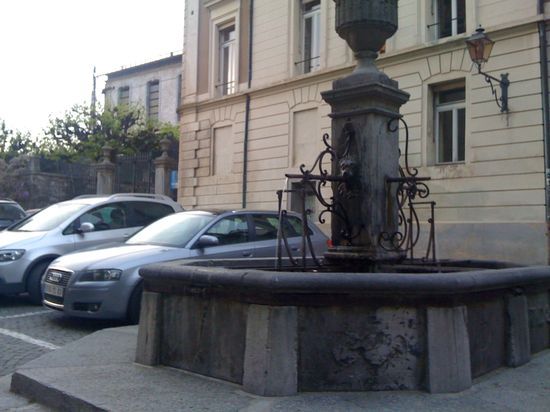
View of the 'view from your window' window

Another ups the ante forevermore:

I am an Australian living in Switzerland and have enjoyed your blog for several years. My family has been enjoying the VFYW contest and we were delighted to see one in our part of the world.  The architecture was clearly Swiss Vaudois, the mountains looked more like the Jura than the Alps, the height of the city made it most likely Lausanne, and the street looked like it was in the lanes behind the Cathedral.  So it was a good excuse to take my visiting parents for a Sunday drive and go VFYW hunting. Sure enough we had guessed correctly and found the fountain:
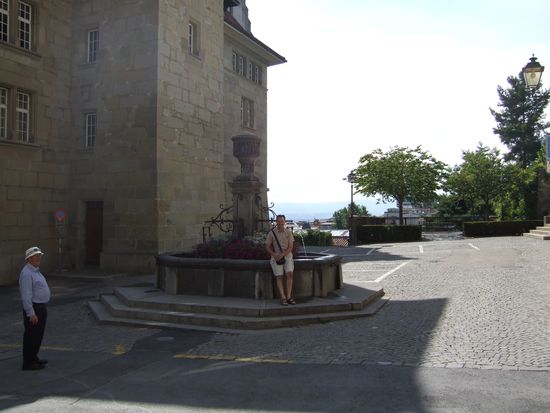
Parents Visit_969

Thanks for a fun afternoon.

Thanks to you!  Despite these impressive feats of Dishness – and 11 correct guesses in all – we just have to award the photo book to this couple (how could you not?):

It’s Lausanne, Switzerland! Just today I was walking there with my wife. It’s on a road called Rue Cité-Devant, which goes from the back of the beautiful Cathedral up to the Castle. Really a must-see. It’s a picture taken from Rue Cité Devant #12 it would seem. The mountains in the back are the Jura mountains.

I knew I wanted to marry my wife when she and I stopped at that very fountain for a sip of water last year!

I love this contest!
Good News, Everyone?

Contra Noam Scheiber, McArdle has a long post against Elizabeth Warren. Megan doesn’t like how Warren uses data:

If we’re going to have a consumer financial protection agency, I want one that has a keen eye to the empirical evidence on consumer welfare–not one that makes progressives most happy by reinforcing their prior beliefs.

Cowen is leery as well, with a provocative analogy.

America’s Fiscal Doom

Sometimes it takes an outsider to see what's staring us in the face. His core message, it seems to me, is a clear one. Anyone who wants to cut the debt and restore fiscal balance in America would be insane to vote Republican this fall. Why? Because they have still not abandoned supply-side economics, which was taken to its logical extremes under Bush and Cheney. Money quote:

First, if Republicans win the mid-terms in November, as seems likely, they are surely going to come up with huge tax cut proposals (probably well beyond extending the already unaffordable Bush-era tax cuts).

Second, the White House will probably veto these cuts, making itself even more politically unpopular.

59f8 Third, some additional fiscal stimulus is, in fact, what the US needs, in the short term, even though across-the-board tax cuts are an extremely inefficient way of providing it.

Fourth, the Republican proposals would not, alas, be short term, but dangerously long term, in their impact.

Finally, with one party indifferent to deficits, provided they are brought about by tax cuts, and the other party relatively fiscally responsible (well, everything is relative, after all), but opposed to spending cuts on core programmes, US fiscal policy is paralysed.

I may think the policies of the UK government dangerously austere, but at least it can act. This is extraordinarily dangerous.

The danger does not arise from the fiscal deficits of today, but the attitudes to fiscal policy, over the long run, of one of the two main parties. Those radical conservatives (a small minority, I hope) who want to destroy the credit of the US federal government may succeed. If so, that would be the end of the US era of global dominance.

The destruction of fiscal credibility could be the outcome of the policies of the party that considers itself the most patriotic. In sum, a great deal of trouble lies ahead, for the US and the world. Where am I wrong, if at all?

I do not think he is wrong at all, I'm afraid, although I hold out hope that the sheer scope of the crisis and the rhetoric of the tea-partiers might make the Debt Commission's proposals feasible. I favor more spending cuts than tax hikes in such a grand bargain, but if the GOP cannot raise taxes at all (under the loopy notion that revenue would thereby be reduced) and if the Dems cannot tackle Medicare and are too spooked by Fox to cut defense, then we're truly screwed.

But Wolf's irony is well-taken. The Republican party has long prided itself on strong national defense and conservative economics. In fact, their recklessness in foreign adventurism has destroyed the deterrent effect of American power for a generation, while their fiscal policies have hollowed out this country's core fiscal health that we have almost no room for maneuver.

And yet slogans and amnesia still seem to be winning against arguments and data.

What A Palin Endorsement Can Do

Some data:

When we polled New Hampshire in April we found Ayotte's favorability numbers with moderates on positive ground at 32/27, something very unusual for a Republican candidate. Now in the wake of the Palin endorsement that is no longer the case- 27% of moderates see Ayotte favorably while 46% see her unfavorably- a 24 point drop in her favorability spread over the last three months.