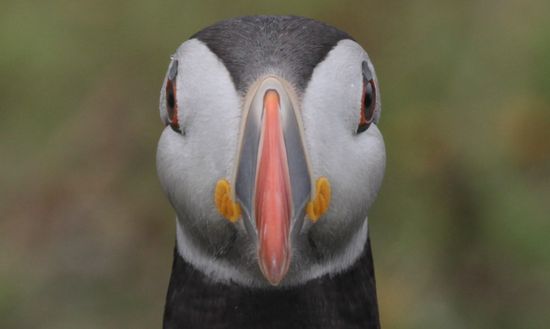
An adult Puffin watches from the cliff tops on Skomer Island on July 20, 2010 in Pembrokeshire, Wales. The island, which has the biggest Puffin colony in Southern Britain, plays host to over 10,000 Puffins, who come from April to the end of July to breed. The small island, off the coast of southwest Wales and managed by the Wildlife Trust of South and West Wales, is one of the most important and accessible seabird breeding sites in Europe and has become a Mecca for wildlife and bird lovers. By Matt Cardy/Getty Images.
When you compare the sins of Mel Gibson (racism, threats of violence and rape, sexism, allegedly punching his girlfriend while she held their child) to the crimes of Lindsay Lohan (doing drugs, drunk driving, being generally unprofessional) it seems clear that one of them has had to work a bit harder to become infamous. And men seem to have more avenues open for rehabilitation: Just look at all the adoration reserved for Robert Downey, Jr. and Mickey Rourke, men whose struggles with alcohol and drugs are well-known and readily forgiven. Last year, at the Golden Globes, Mike Tyson took the stage to help director Todd Phillips accept the Best Picture – Comedy award for The Hangover. His name was applauded, and loving jokes were made at his expense: You'd never know the man was a convicted rapist. The stories of badly behaved women, on the other hand, tend to end in obscurity or early death. The most a girl who's made some unfortunate choices can hope for, it would seem, is to become a joke, along the lines of Elizabeth Taylor.
Oakland is doing the utterly predictable, and contemplating factory farming of a taxable crop. When politicians view something as a revenue source, they want more of it, and they are prepared to get in bed with any businessman who can make that happen. Most significantly, if it’s a source of tax revenue they are perfectly happy to provide security for those businessmen, which means that you get the sort of businessmen who don’t have their own street gangs and hitmen.
The news that China may now be the world biggest energy customer comes based on analysis by the International Energy Agency (IEA). According to the IEA, China overtook the U.S. in energy consumption sometime last year.
I am as far from Mel Gibson’s theological and political world as one can get. He is quite obviously a deeply troubled man with extreme views. But I think calling the Passion of the Christ an “attack on the Gospels” goes a little far. For one thing, I’m pretty sure you would never refer to “The Last Temptation of Christ” that way, even though that film takes far more liberties with the Gospels than Gibson does. And let’s not forget it is the Gospels themselves that contain lines like “His blood be on us and on our children.” A director should be allowed to make whatever interpretation of Jesus they want without being lynched, from the Left in Gibson’s case and from the Right in Scorsese’s. And let’s be totally frank here: the Passion’s depiction of a Roman crucifixion was spot on.
I majored in Latin so I feel fairly qualified to speak on this. People on the outer reaches of the Empire condemned to execution by the Romans were not treated nicely. Roman guards flogged their victims senselessly before putting them on the cross. It was a sport to them, similar to the cruelty shown by the Nazis in the camps.
I think you can question making a film about several sentences in the Gospels. You can question whether God wants us to live that horror of the crucifixion in such a visceral way. But you can’t say that Gibson is inaccurate in depicting a barbarism that occurred millions of times over throughout the outer edges of the Roman Empire.
Another writes:
Should we re-evaluate the Passion now that we see the person who made it in a more revealing light? Maybe, but maybe not. You never cared for it, but two of the more decent, caring and yes, liberal Christians I know saw it and were deeply moved (I never saw it myself). Separating the art from the person is always a tricky business at best and impossible at worst.
Another:
When I first read your description of the Passion, I just assumed that you didn’t like it because it depicted the torture and execution of Christ too graphically. But then I thought about all of the depictions of other forms of torture that you have posted on your blog, and now I’m at a loss as to why you hate the film so much. If the crucifixion really was that bloody and violent, then isn’t re-creating it as Gibson did the most honest way of driving home the message of the cross? I honestly don’t see it being any different from you publishing pictures from Abu-Ghraib (or photos of dead children in Gaza, which you continueto post over reader objections). Is there some other reason you seem to despise the film?
The point is that the extreme violence that Gibson added is not in the Gospels, and the treatment of Jesus as depicted would have killed any human long before Gibson’s endless pornographic violence reached its conclusion. It was a sadistic fantasy, with barely a word about Jesus’ message of love and forgiveness. Here’s a link to my impressions immediately after seeing the movie in 2004. Money quote:
The whole movie is some kind of sick combination of the theology of Opus Dei and the film-making of Quentin Tarantino. There is nothing in the Gospels that indicates this level of extreme, endless savagery and there is no theological reason for it. It doesn’t even evoke emotion in the audience. It is designed to prompt the crudest human pity and emotional blackmail – which it obviously does. But then it seems to me designed to evoke a sick kind of fascination. Of over two hours, about half the movie is simple wordless sadism on a level and with a relentlessness that I have never witnessed in a movie before. And you have to ask yourself: why? The suffering of Christ is bad and gruesome enough without exaggerating it to this insane degree. Theologically, the point is not that Jesus suffered more than any human being ever has on a physical level. It is that his suffering was profound and voluntary and the culmination of a life and a teaching that Gibson essentially omits.
One more example. Toward the end, unsatisfied with showing a man flayed alive, nailed gruesomely to a cross, one eye shut from being smashed in, blood covering his entire body, Gibson has a large crow perch on the neighboring cross and peck another man’s eyes out. Why? Because the porn needed yet another money shot.
Dan Ariely wants to know why we have paid more attention to the BP spill than other environmental disasters:
Here are a few characteristics that might differentiate the BP oil spill from the destruction of the Amazon. First, it is a singular event with a precise beginning. Second, while the tragedy was ongoing (and we are not yet sure if it has ended or not) it seemed to become more desperate by the day. Third, we have a single organization that we can villainize. In contrast, in the Amazon, there are many organizations and individuals at fault, both in the countries where deforestation is occurring and abroad. And fourth, the Gulf is so much closer to home (at least for Americans).
Here's one example of how stress destroys the body. Elissa Epel, a former grad student of Sapolsky's and a professor of psychiatry at UCSF, has demonstrated that mothers caring for chronically ill report much higher levels of stress. That's not surprising. What is surprising is that these women also have dramatically shortened telomeres, those caps on the end of chromosomes that keep our DNA from disintegrating. (Women with the highest levels of stress had telomere shortening equal "to at least one decade of additional aging.") When our telomeres run out, our cells stop dividing; we've run out of life. Stress makes us run out of life faster.
Your dissenting reader could not have actually read the site he linked to. S/he uses it to support a possible bipolar diagnosis for Gibson, saying "his behavior – certainly his rage – is actually rather common in the manic phase of unmedicated (or self-medicated) bipolar disorder." But on the linked site it says: "Anger or rage are not typical symptoms of bipolar disorder. While certainly someone might exhibit rage while in a manic phase of bipolar disorder, it is not a symptom one could draw conclusions from." The expert continues to question the validity of a bipolar diagnosis:
Re: Gibson's self-absorption – "Focusing on one’s own feelings and how another person’s behavior affects us is not a sign of bipolar disorder." Re: Gibson's warped perspective – "Such a discrepancy in perspective or connection to reality can be a sign of a psychotic break — but it’s not a typical symptom of bipolar disorder." Re: Gibson's threats to kill Grigorieva – "This is not a symptom of bipolar disorder, but could be connected to someone who is under the influence of alcohol or drugs."
The linked-to expert essentially comes up with a more likely explanation for all of Gibson's behaviors than bipolar disorder: drug and alcohol abuse. If you are going to argue that Gibson is bipolar, this is definitely not the website to direct people to. And so what that Gibson "admitted" to being bipolar? How better to excuse unacceptable behavior than to claim mental illness?
Another writes:
I agree about the need for police intervention. However, I do think the diagnosis of bipolar disorder is relevant to domestic abuse. I've had relatives with bipolar disorder. Some swung between mania and depression and were not abusive. However, one was diagnosed as "rapid cycling mixed." This person had periods of mania and depression and also a mixed state (simultaneously manic and depressed) that manifested itself as anger/agitation. In the mixed state (which gradually became the more constant state), this person became viciously abusive, irrational and increased his drinking.
The correct extended-release mood stabilizer transformed him into a different person. In fact, the transformation was so startling it made me reconsider everything I ever believed about nature versus nurture and personality. Jail time is likely the only way to force Gibson onto the proper meds.

 The Dish