Quote For The Day

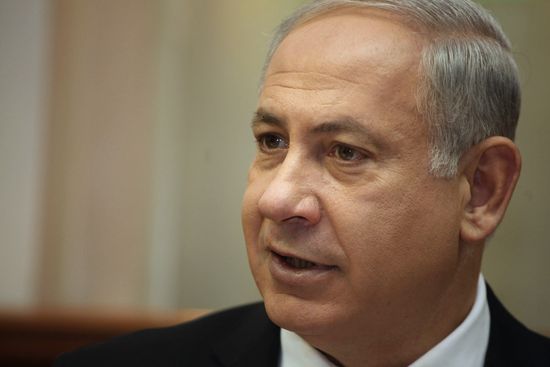
BIBIGaliTibbon:Getty

“I know what America is. America is a thing you can move very easily, move it in the right direction,” – Binyamin Netanyahu, in a just-released and secretly taped private meeting in 2001. He also reveals his approach to the Palestinians:

“beat them up, not once but repeatedly, beat them up so it hurts so badly, until it’s unbearable.”

And so Operation Cast Lead makes more sense, doesn't it? He also describes how the notion that the Palestinians destroyed the Oslo process was a cover for his own sabotage:

Netanyahu exposed the naked truth to his hosts at Ofra: he destroyed the Oslo accords with his own hands and deeds, and he's even proud of it. After years in which we were told that the Palestinians are to blame, the truth has emerged from the horse's mouth.

And how did he do it? He recalled how he conditioned his signing of the 1997 Hebron agreement on American consent that there be no withdrawals from "specified military locations," and insisted he choose those same locations, such as the whole of the Jordan Valley, for example. "Why is that important? Because from that moment on I stopped the Oslo Accords," he boasts. …

He calls then-U.S. President Bill Clinton "extremely pro-Palestinian," and says the Palestinians want to throw us into the sea. With such retrograde beliefs, no one can convincingly argue that he wants an agreement.

Netanyahu wants and has always wanted total Israeli control of the West Bank for ever, and believes in using the United States as a means to advance Israeli interests in the Middle East, whether they conform to US interests or not. Any administration that believes, as Obama patheticallly just said he did, that Netanyahu is “ready to take risks for peace” is engaged in naive fantasies. The man has contempt for America, seeing his country's prime ally not as a country to be supported and engaged, but a country to be pushed around and lied to. So when will Obama stand up for his own country against this charlatan?

Now remember: Netanyahu is increasingly a moderate compared with his coalition partners. 

(Photo: Gali Tibbon/Getty.)
Romney And The Women

Steve Kornacki reviews the record:

Three times in his relatively limited political career Romney has found a woman standing between him and his political goal. In each case, he ended up getting what he wanted — but it was always awkward, ugly and downright nasty, with cries of chauvinism and sexism along the way. The man just does not know how to look good while competing with a woman.

Conservatives4Palin, her de facto communications team for 2012, is already crying sexism – over the anonymous staffer spat last week. I think almost anyone can defeat Romney, a hologram of a politician defined only by ambition and great hair. Palin would destroy him.

Maybe Josh Was Right

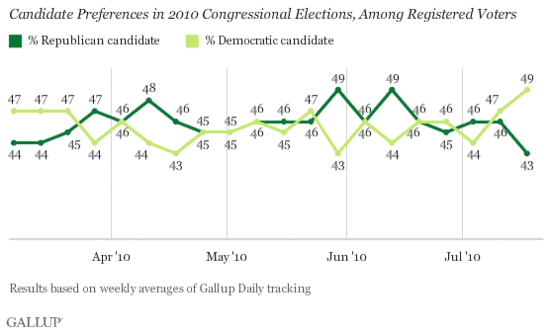
It is unwise to discount the intelligence of the American people – a trait more endemic among liberals than conservatives. The latest Gallup generic poll is striking – because it suggests that voters in the end may vote on substance not spin and ideology:

35do5ca8jkuuzlyxemcfsw

Maybe this is a blip. Here's Pollster's poll of polls (sans Rasmussen):

Of course, removing Rasmussen removes the one advantage Rasmussen has – of accounting for the enthusiasm of the older, whiter, Republican voter. And on that score, we have a real triumph for the anger chorus of FNC:

Gfpbmvap8eqq6fuc8hfhpw

If we are to remain a polity that is actually interested in addressing pressing problems (which the GOP plainly isn't), then the Democrats need to start generating reasons for their base to show up this fall. The Clinton model is simple: you begin to turn the insurgents into a potential government.

You provide a choice: immigration reform or mass deportation? a peace process in Israel/Palestine or a civilizational war with Islam?; abandoning the long-term unemployed or finding a way to keep them afloat?; war with Iran or containment?; more settlements on the West Bank or a negotiation to get rid of them?; repeal or keep health insurance reform?; repeal or keep financial re-regulation; tackle climate change or deny it's happening? ratchet up the war on drugs or relax laws against pot? continue to demonize gay couples or find a better way to integrate them into society? propose some serious long-term tax-and-cut compromises to deal with the debt – or keep playing the partisan blame-game?

These are real questions. When it comes to a choice – as opposed to a mere protest – things can shift. The momentum in an era of high unemployment, weak growth and massive debt is with the opposition. The reasonable case, in my view, is with the imperfect Democrats and the presidency of Obama. 

What, in my view, Obama needs to do is remind people more and more that the policies the GOP are proposing are indistinguishable from the Bush-Cheney era: on taxes, on spending (the tea party still can't say what it will cut), on the wars, on religiously-dominated politics, on debt, on immigration, and so on. And he should remind people that this Congress, by any measure, has been the most substantive in recent memory.

They got things done.

The Flip-Side Of Meritocracy

Douthat examines it:

Part of the problem with meritocracy is that it homogenizes in the name of diversity: It skims the cream from every race and class and population, puts all of the best and brightest through the same educational conveyor belt, and comes out with a ruling class that’s cosmetically diverse but intellectually conformist, and that tends to huddle together rather than spreading out to enrich the country as a whole. This is Christopher Lasch’s lament in “The Revolt of the Elites” — that meritocracy co-opts people who might otherwise become its critics, sapping local communities of their intellectual vitality and preventing any kind of rival power centers from emerging.

Well, yes. But what's the alternative? Keeping the able down? Or recruiting a more diverse meritocracy, as Ross suggests, one that ensures that the rural and traditional populations are not excluded from the elite? I favor the latter on both moral and pragmatic terms. The question then becomes: what skills make one a member of the elite? And if they are increasingly centered around intellectual innovation, then the elite will be increasingly diverse, but also, one imagines, smaller.

Smart Sanctions

Drezner is skeptical of them:

The comparative advantage of smart sanctions is that they appear to solve several political problems for sender countries.  Smart sanctions really do reduce the suffering by civilian populations.  Because they are billed as minimizing humanitarian and human rights concerns, they receive only muted criticism from global civil society.  Because they do not impede significant trade flows, smart sanctions can be imposed indefinitely with minimal cost.  They clearly solve the political problem of "doing something" in the face of target state transgressions.  What they don't do is solve the policy problem of coercing the target state into changing its policies.

Adventure Is Out There

Robin Hanson observes:

Watching Journey to the Center of the Earth, I noticed yet again how folks seem to like adventure stories and games to come with guides. People prefer main characters to follow a trail of clues via a map or book written by someone who has passed before, or at least to follow the advice of a wise old person.

…relative to fiction, real grand adventures tend to have fewer guides, and more randomness in success. Real adventurers must accept huge throws of the dice; even if you do most everything right, most likely some other lucky punk will get most of the praise.

Dead, Not Resting

Now that cap and trade has turned stiff, Bradford Plumer pages through the other items in the energy bill:

For now, it looks like the only cap that can pass through the Senate would be watered down and do more harm than good. So we're left with the combination of EPA Clean Air Act regulations—which, first and foremost, will shutter a lot of older coal plants and prevent new ones from being built—along with a grab-bag of subsidies and regulations that would ramp up renewable power and tamp down on energy waste. That's not a recipe for the long-term transformation of the U.S. economy. And it's not going to be the sort of thing you can use to sign an international climate treaty. But in the short run? Sure, a strong energy bill plus the EPA could make a fair bit of progress. But so much depends on the gritty details. And no one knows how those will shake out yet.

Revisiting Liberaltarianism

E.D. Kain looks at the prospects of a liberal-libertarian alliance:

I think the real obstacle to a libertarian-left alliance is the labor movement. In the UK that movement has its own party. Here, the Democrats are the nominal representatives of labor. I think for libertarians this will be a major hurdle. I see a Cameron-like Republican party emerging before I see a real reformation of public worker unions.