The Nate Silver Model

Using the Silver-Zogby spat as a starting point, Jim Manzi details how "538 has created a real business model problem for pollsters":

Silver intelligently combines multiple polls to make more accurate predictions than are usually achieved by any one individual pollster. On one hand, the math of this is irresistible – in the real world, voting models often work. On the other hand, it would be pretty uncomfortable for a pollster to combine his own results with various competitive poll results to achieve equivalent accuracy (or at least to do so transparently). So, the pollsters do all the tedious work to collect and analyze the data, and then Nate Silver comes along and creates all this value with it in a way that is hard for the pollsters to duplicate. You can see why this situation might upset the pollsters.

The Daily Wrap

Today on the Dish, bloggers reacted to the WaPo's big feature on the police state. Andrew's take here. He also tackled the Christianists over Mel Gibson, replied to Frum on the state of the conservatism, threw up his hands at the GOP over spending, and kept his eye on Israel's campaign against Turkey.

Palin coined a Bushism and inspired a Twitter meme. Gallup had her in the lead for 2012, Blumenthal explained disparate polling, and a reader illustrated her immense clout in congressional races. Levi and Bristol made bank. More Palin drama here, here, and here. Andrew responded at length to Weigel's refudiation of Trig-gate, noted Cameron's wife's refusal to fly pregnant, and offered a belated take on the Levi-Bristol engagement. Sprung countered Weigel on Palin's need for policy chops, Chait realized the GOP can't contain her, and Goldblog glowered at her assault on the Ground Zero mosque.

Chris Good and TNC covered the departure of racist Mark Williams, the Brits leaked the latest withdrawal date from Afghanistan, Marc Lynch discussed our ever-possible bombing of Iran, Greenwald kept the heat on the NYT over "torture," and Bruce Bartlett dropped his jaw at the GOP's fantasy over the Bush tax cuts. Surge fail update here and here. California cannabis update here and here. Alex Ogle reported on a cash incentive program to lower AIDS in Africa and Chris Blattman worried about the drug trade there.

Noah Millman came around on marriage equality and Virginia Postrel talked glamour. Cailey Hall watched soldier music videos and Alexis Madrigal meditated over a YouTube bullying case. MHB here, VFYW here, and a young Sully face here.

— C.B.
Bombing Iran, Ctd

Marc Lynch notes a series of articles suggesting the US is considering taking military action against Iran. The case against force:

While I've been critical of parts of the administration's approach to Iran, overall Tehran has become considerably weaker in the Middle East under Obama's watch.   Much of the air has gone out of Iran's claim to head a broad "resistance" camp, with Obama's Cairo outreach temporarily shifting the regional debate and then with Turkey emerging as a much more attractive leader of that trend.  The botched Iranian election badly harmed Tehran's image among those Arabs who prioritize democratic reforms, and has produced a flood of highly critical scrutiny of Iran across the Arab media.  

Arab leaders continue to be suspicious and hostile towards Iran.   The steady U.S. moves to draw down in Iraq have reduced the salience of that long-bleeding wound.  Hezbollah has been ground down by the contentious quicksand of Lebanese politics, and while still strong has lost some of the broad appeal it captured after the 2006 war.   Public opinion surveys and  Arab media commentary alike now reveal little sympathy for the Iranian regime, compared to previous years.  And while the sanctions are unlikely to change Iran's behavior (even if there is intriguing evidence that highly targeted sanctions are fueling intra-regime infighting), they do signal significant Iranian failures to game the UN process or to generate international support.    In short, while Iran may continue to doggedly pursue its nuclear program (as far as we know), this has not translated into steadily increasing popular appeal or regional power. Quite the contrary.  

Parenting In The Age Of Internet Punks

The online teasing of a trash-talking 11-year-old girl gets uglier and uglier.  Alexis Madrigal has a poignant take on the enraged reaction of her father (now removed from YouTube but preserved in Internet parody):

[Y]ou know, there was a time when these kinds of threats worked, and maybe it was a good thing. Words like that from a dad just might put a scare into some cruel 13-year-olds on a mission to ruin some kid's life for fun. In the old days, dads could handle harassment of their little girls. They'd pick up the phone line and yell at prank callers. They'd show up at schools and tell some kids to back off.

Parents want to protect their children, but a precondition of that is being able to know what or who the threat is. Father and daughter alike are now living inside one of those nightmares where the thing that's out to get you remains perpetually just out of sight and reach.

FROM. HER. FATHER. Those words used to mean something. Mostly it meant, "I'm a full-grown man and I'm willing to use physical force to stop you from hurting my kid, you punk kid." But who is the man in this video going to scare? Everyone knows his threats are empty, that he's bluffing and helpless. And he does, too, which must make it all the more enraging.

Top Secret America, Ctd

Julian Sanchez is worth reading:

If we were getting this little value for our money in any other sector, you’d find no shortage of legislators eager to make the issue a personal crusade—but investing time and resources in ferreting out inefficiency in a Special Access Program is likely to be a costly endeavor with little promise of a self-congratulatory press release as a reward for one’s trouble.  And that’s on the generous assumption that legislators are in a position to provide much more than oversight kabuki: Intelligence briefings, as many have complained, are typically minimalist affairs where no documentation is provided and note-taking is forbidden. In practice, legislators need to rely on the specialized expertise of a handful of cleared staffers who, even when they’re allowed to attend briefings, are spread gossamer thin. The intelligence agencies themselves are happy to paint any moves toward accountability as efforts to “handcuff” them—with little danger of being publicly gainsaid—and we’ve got 1,931 private firms with a vested interest in keeping the sluice gates jammed open.

Ke$ha Brings The War Home

Cailey Hall forms a theory about soldier music videos (several examples at the link):

These videos may not be as "real" as the shaky camera footage of embedded reporters (most recently on view in Restrepo), but they somehow feel more immediate. Yes, movies like Restrepo and The Hurt Locker make a concerted effort to depict soldiers in their down time, goofing off—but there's the inevitable Heisenberg effect. Being acknowledged observers, we change the dynamic. But watching these videos, we get to be in on the joke. It's the closest many of us get to being allowed into the soldiers' world. And so watching a group of camo-clad soldiers pop, clown-car style, out of a Porta-Potty and lip sync to "Ice Ice Baby," while waving around AK-47s and dancing against the bleached, barren backdrop of their concrete-enclosed compound becomes unexpectedly compelling.

Pot’s Coattails, Ctd

Josh Green harshes the mellow:

From what I've read of the literature, there does seem to be some fairly compelling evidence that the anti-gay marriage initiatives had an effect in areas with heavy concentrations of Protestant evangelicals. That would imply that the effect of marijuana initiatives on Democratic candidates would be strongest in areas with heavy concentrations of pot supporters–i.e., blue states like California, but probably not red states. Sorry to be a buzz kill.

Chart Of The Day

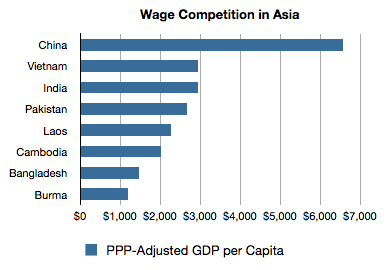
Asianwages

Via Yglesias. Ryan Avent rounds-up expert reactions to this trend. Here's Stephen Roach:

According to research published in the Monthly Labour Review of the US Bureau of Labour Statistics in April 2009, compensation of Chinese manufacturing workers was only $0.81 per hour in 2006—just 2.7% of comparable costs in the US, 3.4% of those in Japan, and 2.2% of compensation rates in Europe. While these figures are now out of date by nearly four years, they underscore the magnitude of the gap between China and the developed world—and how difficult it would be to close that gap even under the most excessive of Chinese wage inflation scenarios.