The Economist provides a map.
Month: July 2010
Now: 2014
The latest date for possible withdrawal from Afghanistan is leaked in Britain – with a caveat that troops will remain to train Afghan forces thereafter.
Chart Of The Day
HIV And Race
Catching up on news from last week, here's Niall Stanage's criticism of Obama's new HIV/AIDS strategy:
[Obama] drastically downplayed the importance of race, referring to it not at all in his introductory statement to the strategy, and giving it only the briefest of mentions in his White House remarks.
This evasion verges on the indefensible. To speak of the HIV/AIDS crisis and not give due emphasis to the vast racial disparities that characterize it is absurd. African-Americans number around half the people currently living with HIV or AIDS in the U.S., despite representing only about 13 percent of the total population. Almost 40 percent of those who have died from AIDS in the U.S. have been black. The rate of AIDS diagnoses is approximately ten times higher among blacks than among Caucasians. A black man in the U.S. has a one in 16 chance of becoming HIV positive in his lifetime, compared to a one in 104 chance for his white compatriot. For women, the figures are even more shocking: one in 30 for a black woman compared to one in 588 for a white woman.
Back From Bear Week
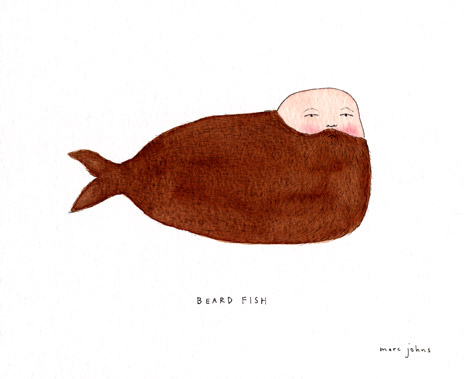
It was a lovely break, beautiful weather, a town full of hairy bearded men … and I came down with a bout of bronchitis. It always happens when I take a break from a long period of intense work: I get sick. My lungs are pretty useless and in this heat and with mold spores and pollen everywhere and my asthma kicking in … it was inevitable. Still, I did get some time to hang with a couple of great friends and managed a bike ride and a trip to the beach (all of which I probably shouldn't have done). My little garden – which was an overgrown jungle a month ago is slowly yielding to my labors. No one taught me the simple therapeutic joys of gardening. There's no going back now.
A mountain of thanks to David Frum and Dave Weigel who revealed why they are such stars of the Internet. I was amused at the blowback they got from even agreeing to blog in this space. Apparently, my views on Israel make me anathema to many (it seems no one can just disagree, they have to ostracize), and my determination to get some basic information from a public figure about a highly contentious episode in her life also renders me beyond the pale for many. I'll deal with Dave's Trig stuff tomorrow.
But for now, more thanks to Chris and Patrick who are the backbone of this site. As for me, it's great to be back, even though the lungs are still wheezing and the bears have all disappeared into that great, pudgy hairy expanse called America. But the beat goes on …
See you tomorrow morning.
The Mark Levin-Conor Friedersdorf Show, Ctd
by Chris Bodenner
Before I submerge back to underblogging, I can't resist sounding off on my favorite Frum post of the week:
Watching the exchanges between Conor Friedersdorf and Mark Levin is like watching a boy toss stones at a caged rhinoceros in the zoo.
Or watching a Spanish-speaking dude argue with an ibex:
I now brace myself for one of Levin's patented nicknames (with a name like "Bodenner," I'm making it easy for him).
The Deeper Dish
by Chris Bodenner
A reader writes:
I was cleaning a couch today when I extracted A View From Your Window from between the cushions. Photography isn't my taste, but I purchased it (pre-ordered, actually, at the non-discount price) in the hope that you would commission "It's So Personal," "Cannabis Closet," or other collections of reader essays.
Has there been any progress on that front?
Yes: slowly but steadily. The Dish requires three people working unhealthy hours just to keep the blog humming, so finding chunks of time to tackle offline projects is tricky. The late-term abortion testimonials have been compiled and edited, and the Cannabis Closet – a much larger, more comprehensive collection (including scores of emails never posted) – is nearly complete. The Dish is getting some long-awaited help very soon, which will allow the book projects to take off in a hurry.
I wish I could be more specific, but just wanted to remind everyone that we are still very much committed to the endeavor. Thanks to our reader and others for their enthusiasm and patience.
Those Not Tempted, Ctd

by Patrick Appel
A reader writes:
A minor point, but you wrote something that still drives me crazy: "they didn't have a hard time abandoning religion because, for whatever reason, they never got much out of it in the first place. "
This makes an enormous assumption about atheists: that they were once religious or were raised in a religious household. This simply isn't true in more and more cases. I didn't even know what religion was until I went to elementary school, where it seemed prima facie silly to my 6 year old eyes. I've come to a much more nuanced view the more I've studied religion (and as an atheist, I try to understand religion as much as possible), but I never abandoned religion. It never abandoned me, either. Religion has just never entered my life in any plausible or meaningful way, which is why it isn't something I feel the need to wrestle with myself. Though as an artist, it is clearly a philosophy I must wrestle with in order to understand the vast majority of western art, but it's not something I bring into my home-life.
I take my reader's point about the impossibility of the non-religious from birth giving up something they never had. But this reader's argument actually enforces what was intended as my central point: that projecting our own theological struggles, or the lack thereof, upon others often muddles exchanges between believers and non-believers. Another reader is in related territory:
Patrick states that lots of atheists just don't seem to care about questions of "ultimate purpose" and that this is pretty much the equivalent kind of situation of vegetarians who just never really liked meat.
I personally find this to be a very apt analogy and it does seem to describe my own version of agnostic atheism in that I have never really felt that my religious upbringing (liberal roman catholic in the US) really spoke to me, and thus I've never felt that I was "rejecting" something, but more like I just wasn't interested in it.
However, later on, Patrick then seems to slip back inside the kind of religiously-framed mindset that perturbs so many atheists (myself included). He states, "Whatever religion's failings, and there are many, it is one of a handful of institutions that compels us to contemplate unanswerable questions. The new atheists mostly neglect questions of meaning, probably because they and their followers don't obsess about those questions to the degree the devout do."
Although there are certainly a bunch of rhetorical caveats in that statement, it still strikes me as rather biased. In my experience, religion doesn't actually seem to compel most of its adherents to ask or contemplate these deep existential questions or to consider the source of meaning in their lives. Many, many, many religious folk don't ask these questions because they don't think they need to be asked–at least that's the reaction I get when I've asked them such questions and they don't really have any thought out answers to them.
Now, of course, there are some deeply thoughtful thinkers that contemplate the question of "meaning in our lives" who are religious, but then again, there are many other thoughtful thinkers who aren't religious who also contemplate how meaning is created without any religious assumptions put into the mix. To imply (perhaps unintentionally…) that the question of "meaning" is always tied to the issue of "ultimate purpose" is to frame the question in a way that is already biased in favor of religious approaches to the problem and which doesn't allow for the fact that there are many different ways to find, create, and understand the concept of "meaning" in each of our individual experiences.
To conclude, I'd like to go back to Patrick's analogy about vegetarianism. As I noted before, I agree with his analogy that for many atheists, their relationship to supernatural entities is very much like vegetarians who never actually liked meat. It's just not something that they ever felt any need for. However, Patrick's subsequent statements about "ultimate purpose" and questions of meaning take this a step further and seem to be like a person saying that these vegetarians who never liked meat don't really seem to care about protein(=meaning), because protein is mainly a meat-thing. The implied and assumed support for this position is that because meat-lovers obviously consume a lot of protein through their meat, and meat is disproportionally made out of protein (although there's a lot of fat in there too!), then only meat eaters really care about protein and know about protein. It is then regularly assumed and even often explicitly stated that the non-protein focused vegetarians are just not really able to talk about protein at all. Furthermore, because of the lack of centrality or dominance of protein in all vegetarian food, it is assumed that they lack competence or interest in the issue of protein.
In real life, as in this analogy, this position is just silly. The point here is not that atheists don't care about meaning–but that they mostly all have a very different foundation for creating and understanding "meaning" in their lives. Just as vegetarians can point out that there are many different kinds of protein that you can get through different non-meat foods (with the resultant scoffing and smirking by many meat-eaters about how obviously silly these vegetarians are for not just eating meat to get their protein…), atheists can easily and, in my experience, do easily point to a variety of different sources of meaning in their lives that don't revolve around religious experience. These expositions by atheists (or vegetarians), then seem to be ignored out of hand as not really being valid because the framework for understanding meaning (or protein) is so totally and implicitly understood in religious (meat eaters') terms and concepts.
Thus, if you want to help make the debate more comprehensible to both sides of the group, one needs to be more careful about how you frame the questions and terms. Religious groups don't control the question of meaning any more than meat eaters control questions of protein consumption. While it may certainly be true that religious groups do spend a relatively greater amount of their time focused on this topic (just as meat does have a lot of protein in it!), that doesn't give them ultimate or exclusive competence in this area.
I agree wholeheartedly with the reader. A couple readers made this argument:
Patrick writes:
"Whatever religion's failings, and there are many, it is one of a handful of institutions that compels us to contemplate unanswerable questions."
I don't think religion makes anyone contemplate unanswerable questions because each religion dictates that its god is the answer to all questions, in fact, all problems. Christianity, in particular, squelches contemplation of unanswerable questions. Take, for instance, the acceptance of Jesus Christ as a real person who walked the earth — in what Christian church does everyone attend in which any number of attendees are encouraged to contemplate whether Jesus really existed at all? None. Of course, the Christian religion requires the existence of Jesus or the religion wouldn't exist, yet the unanswerable question is why nearly two billion people around the planet accept as their figurehead a person who had no documented existence outside of the Christian bible itself.
Perhaps Patrick meant something else in this sentence because I do not see religion compelling us to contemplate unanswerable questions. It does the opposite. Religion indoctrinates, and with indoctrination comes blind acceptance. With blind acceptance, contemplation dies.
I have been able to contemplate far more about everything in life by escaping religion.
A reader takes the debate in another direction:
In my experience, the most outspoken atheists come from very religious families (a product of living in the South) and are fairly reactionary in the rejection of their parents' religion. As an atheist that was exposed to many religions but not one more than the other, I do not share their anger or feelings of betrayal. What frustrates me is when religious people assume I have not contemplated the same things they have when I state I am nonreligious/atheistic/etc. (my religious background: my grandmother is Orthodox Christian, my grandfather's family is Muslim, my cousin is Jewish lives in a Muslim country and is a practicing Buddist, my Uncle is a devout Baptist, and my family's circle of friends are Presbyterians, Quaker, New Age, Jewish, and Catholic….in addition, my father encouraged my sister and I to read many holy texts as well visit churches, mosques, and temples for services). It is assumed I just reject, because if I contemplated, surely I would believe. Or it is assumed I have not had transcendent experiences that they have. Or have not opened my heart (the must infuriating) as they have.
At the same time it is also frustrating to be among atheists who just reject religions without an ounce of curiosity to understand their history or texts. Even though one rejects religions and gods, one can still be enriched by studying them, and that does not speak at all towards their alleged divine inspiration. It is perfectly possible to actively engage the religious material around you, reject it not out of anger but because you feel you have a dedication to follow the truth as you see it. My personal belief is that the world functions just as one would expect as if there were nothing divine, and thus it is up to the individual to create a personal purpose (as there is no universal purpose that takes humanity into consideration) with the amount of freewill that we are able to exercise. As for what keeps my moral code from devolving into chaos, that is my family and friends. There is no greater hell than having the people you love stop loving you because of your actions.
"Whatever religion's failings, and there are many, it is one of a handful of institutions that compels us to contemplate unanswerable questions." I am curious what other institutions you refer to. It seems to me that it is life itself that compels us to contemplate, not the institutions that demand we do. There are plenty of religious non-contemplatives (many Christianists!) that do not heed the call to look inward (and outward) as some of their teachings wish they would. And many religions do not appreciate non-traditional interpretations of their dogma, so they value the study of theology more than personal contemplation (unless personal contemplation is an effort to accept their dogma).
"The new atheists mostly neglect questions of meaning, probably because they and their followers don't obsess about those questions to the degree the devout do." I agree with this statement, and the majority of your post if one were referring to only atheist blogs/forums/comments/angry emails. Many of us nonreligious battle with these questions without ever invoking the divine. Or sometimes we do invoke the divine, but realize that answer gets us further from the truth. While many of us nonreligious folks do not always agree with the approach of our fellow outspoken atheists, we understand the importance of being vocal and unashamed of our beliefs. We are who we are, and let us be heard for our differing morals and worldviews are as valid for consideration as those who believe.
I wish we could all keep Montaigne in mind when we have our zealous spells; "All I say is by way of discourse, and nothing by way of advice. I should not speak so boldly if it were my due to be believed."
A final reader:
To speak for myself, and pretty much every other atheist I have ever met or been acquainted with, it is most certainly not the case that we don’t care about “ultimate meaning” or “ultimate purpose”. It’s that we recognize such a thing does not exist. If it did exist then it would be rather important, but it doesn’t. Meaning in the manner in which it is being employed in discussions like this one is a value judgment, and is as such entirely 100% subjective. EVEN IF you were to accept the hypothesis that some form of deity existed, and EVEN IF you were to declare that in that case the meaning that entity declared for you was the one you chose to adopt, that would change nothing. You would simply be adopting someone/thing else’s meaning for yourself instead of embracing your own… which still doesn’t make meaning or purpose universal.
Atheists do not neglect questions of meaning. We simply do not think any such questions can be resolved by an appeal to some supernatural (and whenever it is sought, absent) higher authority and abdicating our own need to define and take responsibility for the meaning of our own lives. My life has plenty of meaning thank you very much. I simply did not require it be imposed upon me by an external source.
This will be my last post for the week. Andrew should be back later tonight. Thanks to David Frum, Dave Weigel, Chris Bodenner and all the readers for a fantastic week. Until next time.
Face Of The Day
by Chris Bodenner
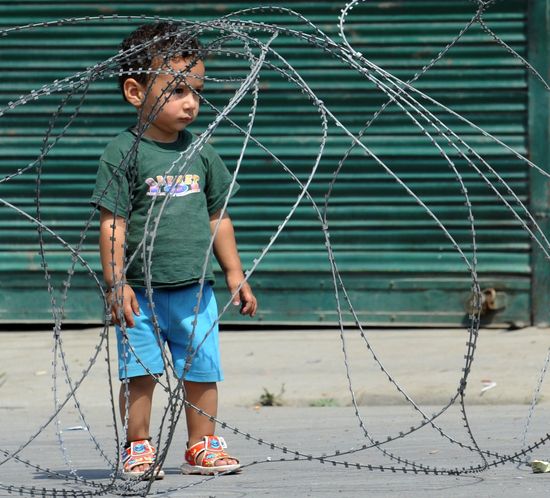
A Kashmiri child stands besides a stretch of barbed wire during a curfew in Srinagar on July 18, 2010. A security lockdown and a general strike called by separatists crippled life in Indian-ruled Kashmir after a brief calm returned to the region. Early Sunday, thousands of police and paramilitary forces moved into the streets of Srinagar, Indian Kashmir's summer capital, warning residents not to venture out of their homes. By Rouf Bhat/AFP/Getty Images.
Should We Pray For Hitch? Ctd
by Patrick Appel
Hitchen's own thoughts:
I think that prayer and holy water, and things like that are all fine. They don’t do any good, but they don’t necessarily do any harm. It’s touching to be thought of in that way. It makes up for those who tell me that I’ve got my just desserts [sic]… I wish it was more consoling. But I have to say there’s some extremely nice people, including people known to you, have said that I’m in their prayers, and I can only say that I’m touched by the thought.
(Hat tip: Douthat)
 The Dish