The Gays and the Jews

by David Frum

I'm late getting to this WSJ oped by Jamie Kirchick, but it has important truths about subjects of intense interest to AndrewSullivan.com readers:

Earlier this month Madrid celebrated its annual gay pride festival, reputed to be the largest in Europe. …

The municipality of Tel Aviv had originally planned to sponsor a float in the Madrid parade. But Spain's Federation of Lesbians, Gays, Transgenders and Bisexuals revoked the invitation following Israel's raid on the Gaza flotilla that ended with nine dead pro-Hamas activists.

"After what has happened, and as human rights campaigners, it seemed barbaric to us to have them taking part," the Federation's president, Antonio Poveda, explained. "We don't just defend our own little patch."

Mr. Poveda chose to ignore the video evidence supporting Israel's account of self defense. But even if Israeli soldiers were at fault, why Israeli gays should be made to answer for the actions of their government was something that Mr. Poveda never bothered to explain.  …

Like so many other democratic values, when it comes to gay rights Israel is an oasis in a sea of state-sanctioned repression, a "little patch," to use Mr. Poveda's words, that he and his comrades ought to defend. Gays serve openly in the Israeli military. While gay marriages can't be legally performed in Israel, the government grants gay couples many of the same rights as heterosexual ones and recognizes same-sex unions performed abroad. Many Palestinian gays seek asylum in Israel. …

This boycott will divide two minority communities that ought to be allies. One would be hard-pressed to find a country that oppresses its gays and treats its Jews well, or vice versa. From Nazi Germany to the modern Middle East, societies that persecute Jews will get to homosexuals eventually – if they haven't been dispensed with already. This is a lesson that gays ignore at their peril.

How Politically Toxic Is Cutting Spending?

A reader writes:

The single best thing you can do to reduce federal spending is to refuse to link to articles that claim it would be easy, especially politically easy that don't actually specify any specific cuts. For almost 50 years, we've heard exactly the same thing, we can cut spending by cutting unspecified waste, fraud and abuse, it will be easy and we'll get to it when we get into power. For 50 years, you've gotten no cuts in spending at all.

Politicians really do have a good sense of what will be politically feasible. There was a Medicare fight in the 1980s that probably gave control of the Senate to Democrats. There was a Medicare fight in the 1990's that probably stopped the Gingrich revolution. The arguments about health care reform that cut where arguments about Medicare cuts and death panels and that argument may doom Democrats in Congress. Maybe cutting spending is worth it, but it will be hard.

I agree that cutting spending will be hard, and I should have said as much. But refusing to link to articles you disagree with is no way to refute them.

Chart Of The Day, Ctd

by Patrick Appel

A reader writes:

I'm not bisexual, but the logic of this statement seems faulty:

"This suggests that bisexuality is often either a hedge for gay people or a label adopted by straights to appear more sexually adventurous to their (straight) matches. "

What the chart suggests is that a bisexual person often is searching for a relationship with one particular sex. That is all. It does not say that the person is not attracted to the another sex. This is a subtlety that I think is often missed, but that I have heard expressed with some frustration. Being bisexual does not mean that you don't have a preference at a given time. I think you should make this point, since you are posting a dubious assumption. Let us assume that a bisexual person has a particular preference at the time they use this message board. I would expect their messages to reflect this.

A bisexual OkCupid user provides a more detailed answer:

I just read the post with the chart about bisexuals on OkCupid messaging only one gender.  As a bisexual, and one who uses that site on and off, I thought I would share my experience.

I believe human relationships can go in many different ways, and sexuality can be more complex than we wish.  I'm not anti-label, but I feel labels should be descriptive, not prescriptive, and we should recognize one label can mean a great many things.

When I am asked about my orientation, I simply say 'bisexual.'  It rings true to me.  Having said that, I am more attracted to masculinity, so I usually end up talking much more often to men on OkCupid, but there is the occasional masculine woman.  I have bisexual friends who say their attractions across genders are evenly split, and other who are like myself, where there is a preference, but we acknowledge there are exceptions, whether we've dated people outside our preference or not.  I know some other bisexuals who may be romantically inclined to one gender, and more sexually inclined to another.   For example, when I first started the process of coming out, a friend confided in me she was bisexual as well.  She never dated another woman before, but it was such a big part of who she was, she felt the need to come out to her parents about it.  She's happily married to a man.

I'll also note that as a female to male transsexual who is open to the world about my past, I've noticed people tend to feel more comfortable telling me things about their sexuality they may be more hesitant to say otherwise, for whatever reason.  I'm guessing it's because being a transsexual is such a personal thing to be open about, it helps people open up some: my gender identity stands out a lot more than my sexual orientation, as I'm usually perceived to be straight, as in an attraction to women.  It's amazing how many people have come up to me and confided in their bisexuality.  These people have been seen in society as nelly gay men, happily married straight women, nerdy straight guys, even some family of mine.   I ultimately don't care what my partners identify as, but I usually feel more comfortable dating other bisexuals because bisexuals tend to face a lot more misconceptions in society, and there's a lot less to explain to another bisexual.  There's an attitude out in the world that says to 'pick a side,' so I feel a lot of people who are bisexual don't usually show it.  I've heard a old bad joke which I feel is still a common attitude: 'If you're bi, you're by yourself."  In the end, regardless if we have a strong preference or not, I think people who identify as bisexual want to acknowledge that in the end, gender isn't as big of a deal in our partners.

Your mileage may vary, of course.  These are my own thoughts on the topic, and though I do identify as bisexual, I believe there's so much diversity in that label, another bisexual's experience may be totally different from mine.
South Park Macho, Ctd

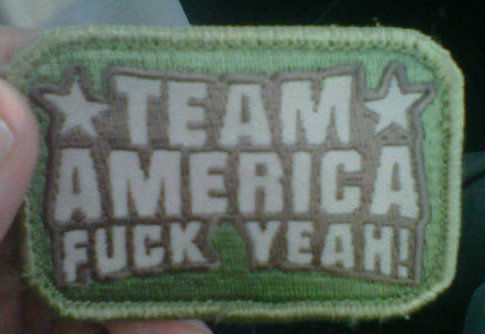
TeamAmerica

by Patrick Appel

Ambinder provides more evidence of the military's fondness for Trey Parker and Matt Stone:

Not only is Hastings' vignette [during his profile of McChrystal] true, but the "collection" of people who identified themselves with Team America had a special patch made for their service. (It was created for them by a small company somewhere in  Missouri.)   Here, for the first time, is an image of the patch that cemented the camaraderie of Team McChrystal.

The Daily Wrap

Today on the Dish, BP finally stopped the leak and Argentina became the tenth nation to legalize same-sex marriage. Sharron Angle showed her cards on her media strategy, Jean Howard-Hill called out the GOP for blank-checking the Tea Party, and TNC sided with the NAACP.  Patrick compared two new polls on Palin, Litbrit rebutted Weigel over Trig, readers piled on, and Chris Rovzar saw everything work out for Bristol.

Weigel examined the comparison between militias and the New Black Panthers, checked in on Alvin Greene, looked at how Hayek is making a comeback, downplayed the Mama Grizzlies video, broke down the polling on Al Gore, scratched his head over Politico's coverage of him, and filed another dispatch from Unalaska. Frum received kindergarten insults from Mark Levin.

Eli Lake reported on how US espionage delays Iran from getting a bomb, Elizabeth Weingarten observed the decline of polygamy in Saudi Arabia, Veronique de Rugy argued the political upside to spending cuts, Andrew Gelman reviewed the politics of stimulus, and James Capretta scrutinized Obamacare over the cost curve. Dana Goldstein and Tracy Clark-Flory wondered if we're getting free birth control, Julian Sanchez mulled over liberaltarianism, Erik Voeten covered nudges, and Ryan Avent followed up on manufacturing.

The monogamy thread continued here, here, and here. Other readers sounded off on eating habits and another on budget cuts. OKCupid exposed faux bisexuality. Xeni Jardin found some tragically comic illustrations on DADT. Incredible parking garage here. Cool ads here and here. MHB here, VFYW here, and FOTD here.

— C.B.

What’s the Mission? A Bleg

by David Frum

Andrew last week generously linked to an article of mine explaining the evolution of my political thinking.

But the thing I’d most like to discuss in this week of cross-posting at Andrew’s site is: where do we go from here? What’s the mission?

And – maybe even more urgently – how do we express that mission in the clearest and direct way?

Here’s my own elevator pitch describing what I’m trying to develop in my writing and political work:

“A reality-based, culturally modern, socially inclusive and environmentally responsible politics that supports free markets, limited government and a peaceful American-led world order.”

But that’s kind of a mouthful, isn’t it?

So question to all the mighty brains who read Andrew’s site and FrumForum: can you help me do better? 

Dueling Polls

by Patrick Appel

Time says I don't need to worry about a Palin presidency:

Obama clobbered Palin, 55%-34%, in a hypothetical 2012 matchup that should have Democrats salivating.

PPP on the other hand:

Obama's numbers in our monthly look ahead to the 2012 Presidential race are their worst ever this month. He trails Mitt Romney 46-43, Mike Huckabee 47-45, Newt Gingrich 46-45, and is even tied with Sarah Palin at 46.

So Obama is either tied with Palin or leading by 21 points. Glad we cleared that up.

The Exaggerated Power Of Nudges

by Patrick Appel

This NYT op-ed by George Loewenstein and Peter Ubel argues behavioral economics is no panacea.

The policy implications from many behavioral economics studies are often relatively pain-free from a political perspective. For example, they suggest that simply giving consumers a bit more information can encourage them to eat healthier, save energy, and make better health care choices. The problem, Loewenstein and Ubel assert, is that these solutions often have only tiny effects compared to the size of the problem they seek to address. Ultimately, changing relative prices is much more likely to meaningfully impact behavior deemed socially undesirable. So, making healthier foods cheaper is much more important than labeling unhealthy food. Meaningful reductions in CO2 emissions require increasing the cost of traditional sources of energy. Giving people more information about their energy consumption helps a little at the margin but should not be thought of as a solution to the problem. The op-ed has many more examples.

Cowen's verdict:

I don't agree with a number of their examples, but I do agree with their overall point.

Face Of The Day

102896767_

by Chris Bodenner

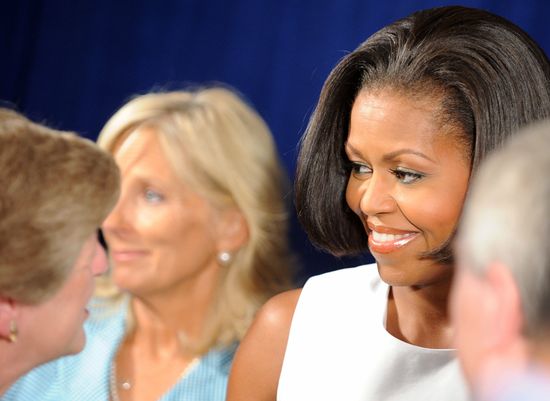
First lady Michelle Obama and Dr. Jill Biden greet guests an event about the Affordable Care Act at George Washington University Hospital on July 14. Hospital employees also attended this event, including Inger Mobley, left, Clinical Manager of the Breast Care Center. Obama pointed out new regulations in the Affordable Care Act that will require new health plans to cover the cost of preventive screenings for diabetes, high cholesterol and high blood pressure.  By Leslie E. Kossoff-Pool/Getty Images.

BP Stops The Leak?

by Patrick Appel

This is great news. In not so great news, Bradford Plumer looks at the damage done:

This doesn't mean the oil-spill disaster is over. There's a lot of crude bobbing along in the Gulf right now: Scientists estimate that between 92 million and 182 million gallons have gushed out into the ocean since the Deepwater Horizon platform first blew up back in April. BP is still using dispersants to break up the oil and send it down to the sea floor, even though no one quite knows how the chemicals might affect marine life in the area. And note that oil's still washing ashore, and Bobby Jindal's artificial "barrier islands," which were supposed to protect Louisiana, are now crumbling.