One Year To Advance 12 Miles

A gripping – and often distressing – report from the frontlines of the war with record fatalities after a decade:

More here. Money quote from reporter Sean Smith's diary:

20/06/2010 I'm in Dand district, near Kandahar city. I'm with the US army and we're supposed to go out at 8am to talk to locals, to do the hearts-and-minds stuff. The problem is that the Afghan national army who are with us don't speak Pashtun; they only speak Dari. So the Americans end up doing all the talking through a translator – which is missing the point of what we are supposed to be doing. The American medic passes out in the heat and is sick twice. It's over 50C.

22.06.2010 Road-opening ceremony. It was in one of the little villages where they are paying Afghans to build roads. We drive off the tarmac in case of IEDs. When we get there, there are lots of young men standing around with brand-new blades and picks, paid for by the Americans. They have clearly never been used. There's no new road. The governor has even come down from Kabul to make a speech. We only stay 15 minutes because the whole thing is rubbish. The lieutenant colonel is very angry.
How The Older Half Lives

Jon Michaud is concerned:

People are putting aside less in savings for old age now than they have in any decade since the Great Depression. More than half of the very old now live without a spouse, and we have fewer children than ever before—yet we give virtually no thought to how we will live out our later years alone. Equally worrying, and far less recognized, medicine has been slow to confront the very changes that it has been responsible for—or to apply the knowledge we already have about how to make old age better. Despite a rapidly growing elderly population, the number of certified geriatricians fell by a third between 1998 and 2004.

Fundamentals

Bernstein revisits the 2000 election. He thinks that the state of the economy played a large role:

For better or worse, what political scientists have found is that voters have very, very short memories; the models that work best only look at election-year economic factors.  So Gore apparently got little credit for the boom years.  Moreover, what seems to matter isn't unemployment, or general economic growth, but changes in real disposable income.  And as it happened, GDP growth continued through 2000, but growth in real disposable income stalled that year, heading into the 2001 recession.

The Bush Tax Cuts Fight

Howard Gleckman sizes up the party politics:

Stalemate means the Bush tax cuts expire for everyone. For most households, that will feel like a tax increase—an outcome favored by a handful of budget wonks but very few real people. Democrats believe this will give them the leverage they need to force the GOP to deal. Republicans, by contrast, feel they’d be able to blame the ruling Democrats for failing to tackle the pending tax hike.

My best guess is that, in the end, Congress will extend the Bush tax cuts for all but the highest earners. And it will probably do so for a year or two. But after watching Congress fail to address the expiring estate tax last year, no outcome would shock me.     

The Daily Wrap

Today on the Dish, Congress encouraged war against Iran, the GOP continued to flail on fiscal issues, Cameron took on Pakistan, a reader explained the real reason behind his support for Turkey, and the Israeli army knocked down a Bedouin village. The oil spill didn't appear as bad as once thought.

Andrew sized up the midterm elections and tore into a WSJ op-ed on the fiscal crisis. Ambinder looked to November, Friedersdorf fingered the practical perils of partisanship, Josh Green backed Elizabeth Warren, Michael Singh cheered up Green Movement supporters, and Exum had some final thoughts on Wikileaks' latest.

Basil Marceaux campaign coverage here and here. Malkin award here. NOM watch here and here. "Death panels" had legs. Palin didn't appear to have them in New Hampshire. A Trig link here

Remaining mosque talk here and here. Another big installment of the energy innovation debate here. More on the affirmative action debate here and here. Andrew Hacker tackled tenure, Nate Silver pwned Mark Penn, and Balko finished off his debate on gambling.

The Dish eulogized cartoonist John Callahan. Circumcision comic superhero here. More Who-mania here and here. Startling celebrity sex quote here. MHB here, VFYW here, and FOTD here.

— C.B.

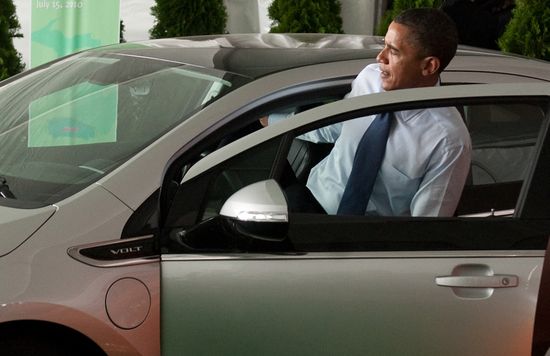
The Rebirth Of The Electric Car? Ctd

VOLTSaulLoeb:Getty

Daniel Gross isn't fazed by the Volt's price tag because he thinks it will come down. A parallel:

When the automobile age dawned at the turn of the 20th century, cars were toys, luxury products and status symbols for the rich to race and tool around in. They weren't affordable for the overwhelming majority of Americans. In 1903, most car companies were "turning out products with steep prices of $3,000 or even $4,000," writes Douglas Brinkley in Wheels for the World: Henry Ford, His Company, and a Century of Progress. In 1903, about 12,000 cars were sold in the United States The following year, Henry Ford introduced his Model B "at a startling $2,000." Now, the Bureau of Labor Statistics' inflation calculator only goes back to 1913. But $3,000 in 1913 is worth about $66,114 today. This BLS report suggests that average family income in 1901 was about $750. Any way you slice it, cars were very expensive.

(Photo: US President Barack Obama gets out of an electric Chevy Volt following a groundbreaking ceremony for Compact Power's new advanced battery factory in Holland, Michigan, July 15, 2010. The plant will build batteries for electric vehicles including the Chevrolet Volt and Ford Focus. By Saul Loeb/AFP/Getty.)