by Patrick Appel
Intergalactic disputes on the #6 train:
by Patrick Appel
Intergalactic disputes on the #6 train:
by Dave Weigel
That's Ari Melber's why-didn't-I-think-of-it phrase to describe the ratio of media attention Sarah Palin receives to the supporters inspired by what she does. His test case: the "Mama Grizzlies" video, which spliced audio of her speech to the Susan B. Anthony List with video of her meeting with activists, and inspired coverage unheard of for a YouTube video not starring Osama bin Laden or Chris Crocker.
In the week since it was first posted on Palin’s Facebook page, which boasts over 1.8 million backers, the video has drawn 368,000 views. Yet despite her large following, only 33,000 people watched the video via Facebook, according to YouTube statistics. That means only one out of ten viewers found “Mama Grizzlies” through Palin’s social network — and under 2 percent of her Facebook community watched the video. So who did watch “Mama Grizzlies”? Mostly traditional news readers and Palin detractors. Almost a third of all views came through an article on Yahoo! News, for example, while ratings for the video ran almost two-to-one for “dislike” over “like.”
“The bulk of the views seem to come after it had been covered in the mainstream media,” observes Pete Warden, a social media analyst who has studied Palin’s Facebook strategy. “She is still reaching a lot more people indirectly through the media than through Facebook and Twitter and the other direct channels,” added Warden, a former engineer at Apple.
Yes, even the lowest estimate for how much attention this video got from Palin fans has her drawing in more than, say, the latest Tim Pawlenty joint. But there was one real story in the "Mama Grizzly" launch — Palin, after 18 months of winging it, had brought on some new staff to boost her new media clout. This put her several steps ahead of where she was three months ago and several steps behind where possible 2012 candidates like Pawlenty and Mitt Romney are. Cue: Hours and hours of coverage and analysis.
Gist: Palin is good for copy. She's not the only celebrity that the press invents bogus narratives about to justify its coverage. But maybe a little more sanity about the importance of her every move is in order.
by Chris Bodenner
If you're not familiar with the phrase yet, a primer.
by Dave Weigel
Today's Alvin Greene news — every day, there's Alvin Greene news — concerns a local baseball team taking up the Democratic Senate candidate on his idea of selling miniature figurines of himself to boost South Carolina's economy.
With all the talk earlier this year of a "Mr. Liberty" statue at nearby Patriots Point, the RiverDogs already planned to give away miniature "Mr. Liberty" statues to the first 1,000 fans in attendance Saturday for their minor league baseball game against the Augusta GreenJackets. In January, an Atlanta-based group proposed a male counterpart of the Statue of Liberty to stand guard over Charleston Harbor. The proposal was rejected by Patriots Point officials, and later by North Charleston officials. Reacting to Greene's plans for economic development, the Charleston ballclub has decided to place Mr. Greene's face on these figurines.
At what point did the ballad of Alvin Greene become less of a story and more of a Festival of Fools, with the unemployed candidate playing the Quasimodo role? I think it came after the Democrats, led by Rep. Jim Clyburn (D-S.C.), dropped their conspiracy theories about Greene being planted somehow by fiendish Republicans. They did so quietly, after the circus had moved on, not wanting to admit that the claims were based on nothing but confusion about why a man with so little money would blow $10,000 on a Senate bid — as if assorted kooks and nobodies didn't do the same thing every four years in order to call themselves "presidential candidates." (At CPAC 2007 I found myself seated once next to Susan Doocey, a perfectly nice woman who informed me that she was running for president, which got everyone else to back away from her. And Ray McKinney, a smart under-the-radar GOP candidate for Congress in Georgia, started in politics by running a stunt 2007 White House bid.)
With Democrats no longer going after Greene, though, the story was over. Why, then, do reporters keep heading to South Carolina to profile the guy? Do they expect him to say something profound, or admit that he lied about how he got on the ballot or… you know, make news? What was the point of the talented Katharine Q. Seelye wasting two hours with Greene in order to get him to make inscrutable comments about Nidal Hassan?
I'm not telling people what to publish. I'm genuinely curious about what the news value is when it comes to Greene — if there's any value other than the one the Weekly World News used to consider when it published photos of BatBoy. Sometimes it feels like there are three quick-bake kinds of candidate reporting — catch the rising star, catch the falling star, and "hey, check out the freak."
by Dave Weigel
Andrew Farrant and Edward McPhail pose the question in "Does F.A. Hayek's Road to Serfdom Deserve to Make a Comeback?"
You can pay for the article, which argues that Hayek was making a doomsday argument about social insurance that, later in life, he backed away from. Or you can read Barkley Rossner's summary of the current thinking here, grappling with the book's newfound Amazon.com domination in the wake of its endorsement from Glenn Beck.
Many observers, perhaps most prominently Paul Samuelson in a bunch of his Principles texts, saw Hayek as promoting a "slippery slope" argument, that any move towards a welfare state by the US or UK or other western democracies, would put them onto "the road to serfdom," which, of course, history has shown to be a bunk argument, even if the tea partiers are now invoking Hayek to repeat it along with Limbaugh and Beck. Hayek himself, with Caldwell agreeing, have argued that this is a misreading of RTS, and that Hayek was really focusing on the dangers of Soviet-style command central planning, with Hayek writing angry letters to Samuelson about this matter.
Whatever Hayek meant, it's best to read "The Road to Serfdom" as a rhetorical exercise that can ground your thinking about the motivation behind socialist policies. It's worst to think of it as a playbook for how this stuff plays out — i.e., passing social insurance leads inexorably to tyranny. And it's easy to whine about Glenn Beck pounding home the wrong lesson by having his viewers buy the book. But let's remember who these viewers are. They already think that modest social insurance of the type a European Christian Democrat party might introduce is going to bring about serfdom. Sending these viewers to a non-crazy (that is, non-Skousen) text is one of the best public services Beck has performed.
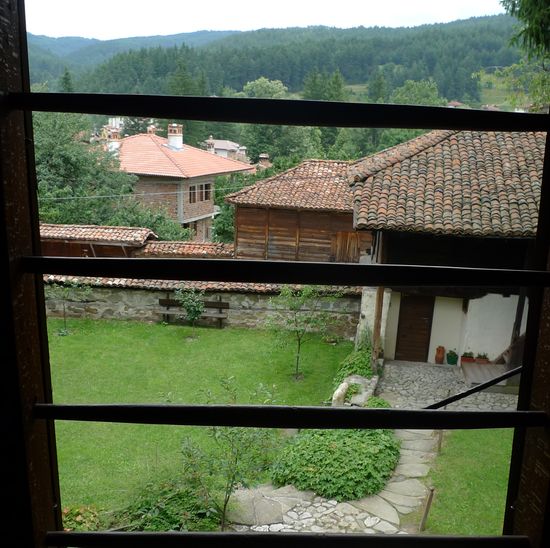
Koprivshtitsa, Bulgaria, 1.15 pm
by Patrick Appel
Elizabeth Weingarten reports on polygamy's decline in Saudi Arabia. Apparently "a group of young Saudi men are launching a campaign to trumpet [polygamy's] benefits, and to encourage other men to take a few more wives":
"Polygamy's time is over," said Thomas Lippman, an adjunct senior fellow at the Council on Foreign Relations. "People can't afford polygamy in Saudi Arabia anymore." While Saudi Arabia is known for its oil riches, many middle class families are living below the poverty line. Per capita income in Saudi Arabia is less than half of what it was in 1980, and the country's housing shortage has made the cost of purchasing a home unaffordable for most. Women, Lippman explains, are expensive. Each wife, for example, requires a private driver who must be paid for and housed.
"Between the resistance of the women, and the economic realities," Lippman says, "I think this campaign is unlikely to get legs."
by Patrick Appel
This is largely true:
The most prominent authors are inundated with such manuscripts, far more than they can ever read, especially if they hope to get on with their real job — which is, of course, writing their own books. Many have adopted a blanket no-blurb policy, and most of these will at least occasionally wind up departing from that policy, usually for personal reasons. They might do it for a good friend or a former student, or as a favor to their editor or agent.
So when publishing people look at the lineup of testimonials on the back of a new hardcover, they don't see hints as to what the book they're holding might be like. Instead, they see evidence of who the author knows, the influence of his or her agent, and which MFA program in creative writing he or she attended. In other words, blurbs are a product of all the stuff people claim to hate about publishing: its cliquishness and insularity.
Stephen Fry's strategy:
I was having lunch with my literary agent yesterday and I said, mostly as a joke, that I had it in mind to blog a confession. I would publicly admit that I read fewer than one in twenty of the books to which I gave approving quotes for dust jackets and blurbs. My agent was shocked. Whether he was shocked that I might plug books I hadn’t read, or shocked that I could contemplate owning up to such a crime, I cannot be entirely sure.
I hasten to add that it isn’t true. The plan, as I told my agent, was to make this confession as a way of getting publishers off my back. It may sound ungracious, but I get asked so many times a week to read book and supply quotes for them that I’m getting a bit fed up. Not because I don’t like reading, nor because I don’t like being sent books, though mostly of course, I am sent proof copies rather than the finished article. No, what I’m fed up with (and it is my contention that I am SO not alone in this) is seeing my name on the fronts, backs and flaps of books saying things like “a beautifully paced, unforgettable thriller”, “a magnificent feat of imagination”, “a delicately realised and vividly felt journey through memory and desire”, etc etc. Yuckety, yuckety, yuck. Pukety, pukety puke.
(Hat tip: Ezra)
by Dave Weigel
Marshall Kirkpatrick's write-up of the strategy behind Old Spice's guerrilla YouTube campaign — one that comes after they hired video comedy dada-ists Tim and Eric to record even crazier videos — leaves you with a less grimy feeling than the usual advertorial. Yes, even after you read this disclaimer:
Disclosure: Wieden + Kennedy is an occasional consulting client of the author's. But this story was too cool to abstain from telling just because of that.
Well, I'm not a consulting client of anyone, and I adore the concept — a handsome, arrogant character answering basically anyone who 1) sends him a question he 2) has time to answer. Simultaneously, the Morlock "I'll click on anything" side of the Internet and the Eloi "I only read Boing Boing on my iPad" side decide that it's funny, and indulge the joke. It churns for a day. It wins a place in meme history. And now that we know the joke, it's over. These concepts are approaching the lifespan of fruit flies while getting us closer and closer to the phony interactivity of Max Headroom. As deodorant concepts go, that's fairly exciting.
by Patrick Appel
Contra Larry Arnhart, who contends that "a Darwinian science of human evolution supports classical liberalism", PZ Myers argues that "to suggest that the science of evolution supports a specific view of the narrowly human domain of politics is meaningless":
Evolution gives us only very general rules for our species. Adapt to the environment, or die. Change is inevitable. No matter what our species does, it will eventually change or die. It’s not necessarily the most uplifting of messages, but there are encouraging lessons within it. Diversity is unavoidable, providing many different avenues our species could follow, and also, that our happiness does not have to descend from our biological limitations; we often work against our predispositions, because the elements of our inheritance that may have worked for a savannah ape must often be expanded upon and redirected to make a modern urban ape thrive. Evolution does not incline us to classical liberalism, it is just one of many options that evolution allows.
 The Dish