Reflections on the Jim Bunning presidency

by Dave Weigel

Brian Beutler reports and ruminates on the failure of Democrats (at this point I could use a shortcut key to type those three words) to do what seemed like it would be easy — shame the GOP into going along with unemployment insurance extensions or "jobs bills."

Democrats would have to take significant legislative steps right now to lower unemployment (let alone to keep it from growing). But there's no easy way for them to do that, so instead, with a double-dip recession threatening, they're taking an incremental route.

"President Obama will continue to press Congress to extend unemployment benefits and pass commonsense measures to strengthen our economic recovery – like extending unemployment insurance and COBRA, supporting our clean energy economy, providing aid to state and local governments, and saving the jobs of thousands of teachers," reads a statement from Obama's top economic adviser Larry Summer's today.

Contrast that with the assessment of Obama's chief political adviser, David Axelrod, who this weekend shrugged off the idea that we'll be seeing much, if any, job-growth legislation this year.

"Well, I think it's true that there's not a great — there's not a great desire [on Capitol Hill], even though there's some argument for additional spending, in the short-run, to continue to generate economic activity," Axelrod sighed. "There's not a great appetite for it."

I think this all comes back to Democrats surrendering on the economic argument since, really, day one of the Obama presidency.

Now, some of this happened out of necessity — until Al Franken and Arlen Specter joined the Democratic conference, literally everything they wanted to do was subject to filibusters. But from the outset, Democrats confronted a Republican Party that argued for tax cuts and pure, Schumpeter-style creative destruction of failing industries with… well, with what? The stimulus was a mish-mash of spending plans that sounded good and tax cuts that Republicans asked for them didn't vote for. The jobs bills were shrunk to get Republican votes, then they didn't. Democrats believed that deficit spending was the way to dig out of the recession but they apologized for it, and tried to cover it up. You had the president talking to Christina Romer about spending multipliers, then heading on to TV to say the government needed to tighten belts just like American families did.

Was it ever possible for Democrats to win this argument? No, their policies weren't going to work the way they promised, they knew it, and they picked the easy road of bashing Republicans over the hard road of trying to explain why short-term deficit spending and tax hikes down the road worked where tax cuts didn't.
Would Hayek Vote For Obamacare? Ctd

by Patrick Appel

A reader writes:

As an American living in Singapore for over 20 years, I'd like to comment on Will Wilkinson's statement that the reason behind its health care efficiency and ability to successfully deliver quality health care to all at a reasonable cost is entirely due to competitive markets at play.  Perhaps he should investigate how heavily involved the Singapore government is in the local health care sector – from owning hospital groups that compete with the private sector, directing retail prices for doctors, ensuring low cost drugs are available, mandating individual health accounts and restricting how they can be used, etc.  While there are veneers of private sector activity and free markets at play, the Singapore government is well in control of everything that happens in this area.  I for one would welcome this level of involvement by the US Government in the American health sector but suspect the Tea Partiers and their ilk would go completely insane at the thought.

Last Words

by Patrick Appel

Charles Simic reviews Robert Elder's Last Words Of The Executed:

“Don’t let it end like this. Tell them I said something,” Mexican revolutionary Pancho Villa worried in his dying moments. It is universally believed that if you care to be remembered by posterity, you better have something memorable to say in your last moments on earth. “I only regret that I have but one life to lose for my country,” Nathan Hale, an American spy convicted of espionage by the British in 1776 famously said. History books of every country are full of such heroic examples; most of them, including this one by Hale, of doubtful veracity. What makes this book different is that people we encounter in its pages are almost exclusively unknown and forgotten. Their final thoughts can be touching, angry, funny, and, at times, unforgettable and original.

The screwing of John Stagliano

by Dave Weigel

If you've been missing Richard Abowitz's dispatches from the obscenity trial of John Stagliano, correct your error and check in. Things are getting especially interesting, and especially disgraceful on the prosecution's side.

The prosecution revealed that the case began when the Los Angeles Police Department Vice Squad sent themselves to the porn industry's biggest annual convention, Adult Entertainment Expo, in my home town of Las Vegas in 2007. Left unaddressed was why California law enforcement was working so far outside its jurisdiction, particularly given that Southern California is the production center of the porn industry. Similarly revealing was that after deciding to target Stagliano, whose residence and business do fall in L.A. County, Los Angeles police chose not to investigate him, and instead contacted the FBI's obscenity crew to step in. 

Defense attorney Paul Cambria in his opening statement suggested an explanation. The movies in question, he noted, "do not contain illegal sex acts." There were no depictions of force or violence. Every participant was a consenting adult. In other words, since Stagliano was not violating any California laws, the local vice squad, rather than respect his right to keep working legally, chose to punish him by tipping off the feds.

That contact was the catalyst that ultimately lead Special Agent Bradley to go "undercover" to order Milk Nymphos and Storm Squirters 2 from Stagliano's distribution company so that the DVDs would cross state lines (from Maryland to D.C.) and therefore enter the FBI's jurisdiction. Now, three years later, the government is offering arguments about the director's choice of close-up shots as evidence of a crime.

The Reasonoids have more.

The Market For Mistakes, Ctd

by Patrick Appel

A reader writes:

I don't think that classical economists would make the argument that the market never gets things wrong, but they may have a different take as to why mistakes get repeated/aggregated and what to do about them.  In the subprime mortgage example given, classical economists would point to three market problems – information asymmetry, agency problems and government intervention.  Information asymmetry shows up when investors buy mortgage pools, but have no idea about the underlying credit-worthiness of the borrowers.  Agency problems arise when the mortgage broker offering the mortgage has no downside exposure to default.  Government intervention makes it all possible when Fannie and Freddie implicitly back the debt with the taxpayer's future income streams.
 
Anti-market types will search for solutions in more regulation. Market disciples would call for a break-up of Fannie and Freddie and increased information availability regarding the mortgages in the pools.  We had plenty of regulations and regulators on the job already, and they couldn't get past Barney Frank and his gang. So going forward, this market disciple would prefer we go with the approach of increased information and less government involvement.  Of course, we are getting exactly the opposite.

Unalaska journal, part II

by Dave Weigel

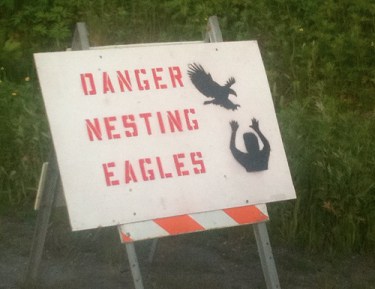
UNALASKA, AK — I took this photo yesterday on some winding road or another on the way to Summer Bay. This is a real sign, and it's one of several that warn Unalaska denizens of the threat posed by bald eagles. Sure, you think bald eagles are majestic. You don't see them more frequently than any other animal in your city, and you don't see them digging through trash and dumpsters. (Honestly, the image of a bald eagle dumpster-diving, feathers matted with waste, is un-erasable. It's like walking in on Uncle Sam as he's on the john.)

On the way out to the island, a few of my co-passengers laughed at my enthusiasm. "You can see all of Dutch Harbor in a day," said one guy making his semi-annual trip out here to work for Caterpillar. Indeed, you can. Thanks to a fire that took out a Chinese restaurant earlier this year, you can count the number of eateries on two hands. The airport has a bar, as does the hotel, as does a sports joint, and that's it, thanks to a "Footloose"-style crusade against drinking that occurred here last decade.

This isn't the place I'd pick for a moral crusade. Crime is so unheard of that it's common to leave your keys in your car, and it's not unheard of to leave your house unlocked. The only resistance I've met from an authority figure here was polite disapproval for bringing an empty soda into a museum. (I threw it out.) But this isn't some podunk town. Yesterday, I sat down to work in the same room as some kids recording a radio show for KUCB. As they edited songs on a Mac, one kid asked me what kind of iPad she had, because she'd just bought her own and was digging it. An hour later, inside that museum, a woman saw me using my ostentatious Steve Jobs word domination device and asked if wireless was working. Convinced that it was, she opened hers up. That's two expensive toys on an island with less than 4000 people, where the Internet is so slow that you can't watch Netflix and five-minute YouTubes can take 30 minutes to stream.

Not that constantly loading up a computer and trying to watch "The Girl With the Dragon Tattoo" is the best way of spending time here. The sun shone yesterday until close to 1 a.m., and the time before it set was well spent climbing up Bunker Hill, named for the many surviving bunkers built during World War II to gird for Japanese invasion and bombings. They're some of the sturdiest structures, still, in a place where the highest recorded winds have gone up to 200 mph — roof-tearing, house-collapsing nightmare weather.