The Daily Wrap

Twitter : Nate Henn: working with history....si ..._1278996812216

Today on the Dish we welcomed our two guest-bloggers for the week: David Frum and Dave Weigel

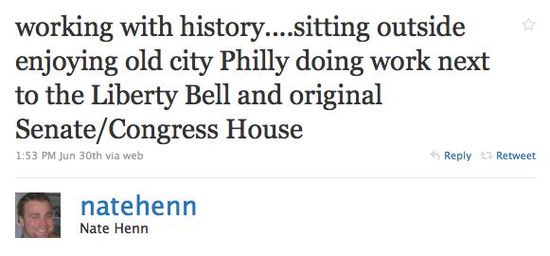
Weigel honored Nate Henn, the American who died in the World Cup bombing (and who happened to grow up with Weigel in Delaware). He also filed a dispatch from Anchorage, featured a new profile on John McCain, undermined a right-wing myth about the New Black Panthers and Obama's DOJ, gave a platform to a conservative critic of the GOP's fiscal record, and dug up a bit of trivia about a popular Weekly Standard cover.

Frum highlighted the dire financial markets, talked inflation and deflation, noted welfare reform in Australia, showed how Obama is ignoring a Supreme Court uproar in his hometown, bristled at the president for bringing up his middle name to explain Israeli mistrust, invoked his grandfather in a post on Christian Zionism, summed up the controversy between a FrumForum blogger and NewsRealBlog, pointed out the success of aggregators, and took a jab at the publishing industry.

In Palin news, her path to the nomination got much clearer (though she floundered on "The Factor" for the second time). San Francisco tried to ban the sale of pets. DOMA update here. Mariah Blake's expose on the medical supply industry is a must see.

In assorted commentary, Dayo Olopade celebrated the progress Africa displayed this World Cup, Nate Silver slammed the Pentagon for surveying servicemembers on gaydar, William Galston was gloomy about the Dems prospects this fall, Bernstein assessed Palin's chances in '12, and Larison compared her to Giuliani. Beinart thought Obama was no FDR, TNC tackled the fear felt by cops, Joe Keohane explained how our biases shape the facts we receive, Felix Salmon defended minimum wage laws, and Patrick circled back to one of his pet topics, the kidney trade. A comprehensive update on Social Security reform here. Recession view here. A great case of journalism here.

Creepy ad here. A quick laugh here and a longer one here. MHB here, VFYW here, and FOTD here.

— C.B.

(Video profile of Nate Henn here. Above is his last published tweet.)
Why you don’t see people booing John McCain

by Dave Weigel

Joe Hagan keeps up New York's remarkable record of turning every profile into a mini-"Game Change" of revealing quotes and moments with this monolith on John McCain. The moment that's getting the most attention comes which McCain gets irritated at Scott Brown for his advice on how to win elections (my guess: "run against Martha Coakley"), but there's hardly a dull graf in this thing. For example:

By setting himself up against [former congressman and free money from the government pitchman J.D.] Hayworth, McCain was locked into a fight for the tea-party vote—essentially a race to the right, one in which McCain would be hobbled by his past positions. There was intense internal debate among McCain’s advisers in the fall of 2009 about whether McCain should even appear at a tea-party rally. McCain’s chief of staff, Mark Buse, was terrified of McCain getting booed off the stage and having the image go into cable-TV rotation. Until March, his advisers repeatedly refused to let McCain appear at one.

This is savvy, isn't it? The first McCain rally of this campaign that got major video coverage was the one Sarah Palin appeared at. No chance of boos there, so reporters had to settle for anecdotes of bored tea partyers walking out as the senator talked. And McCain is not alone here. I'm informed that Republicans haven't encouraged Michael Steele to speak at a tea party because they know he'll be booed, and that the video of this will outlast cockroaches and Twinkies. This is a good call — Rep. Bob Inglis (R-S.C.) never overcame the video of tea partyers heckling him for his TARP vote. And as much as the McCain of 2009-2010 deserves tea party support for digging in against the Obama agenda, he voted for TARP when he was in a unique position to stop it, and he'll never be forgiven for that.

How Fear Infects

by Patrick Appel

TNC connects the Oscar Grant case to the cop who pulled a gun during a snowball fight:

"Fear" is the common defense for officers who abuse the state-sanctioned right to brandish lethal force, excusing everything from the killing of Amadou Diallo to pulling a gun in the middle of a snowball fight. The question, however, remains–If you scare this easy, why are you a cop?

My old friend Julianne Hing has the best write-up on the Oscar Grant verdict, by far. Adam Serwer is in the same ballpark as Ta-Nehisi:

Times change, but the radioactive fear of black people, black men in particular, has proved to have a longer half-life than any science could have discerned. This is not a fear white people possess of black people — it is a fear all Americans possess. It makes white cops kill black cops, it makes black cops kill black men, and it whispers in the ears of white and nonwhite jurors alike that fear of an unarmed black man lying face down in the ground is not "unreasonable." All of which is to say, while it infects all of us, a few of us bear the brunt of the suffering it causes.

Why Your Publisher Won’t Answer Your Email

by David Frum

Those of us who work even occasionally with the quaint world of publishing often wonder: why is it that our publishers are so hard to reach? Partly it is our own fault for attempting to use email rather than typing out our communications on an IBM Selectric and posting them in the US Mail, the way they did in the good old days. 

But there is also this additional impediment, as a literary friend explains:

It's summer, and publishers take the summer off, starting about April 15 and resuming shortly after Labor Day. They work hard through early September until the Jewish holidays, which they observe for the full three weeks from Rosh Hashonah to Shemini Atzeret. Columbus Day and Thanksgiving pretty much wipe out October and November, and December is of course gone to Christmas.

Their offices are open at greatest length for a couple of weeks in each of January, February and March before they shut down again for the summer, as noted, in April.

Face Of The Day

102821740

by Chris Bodenner

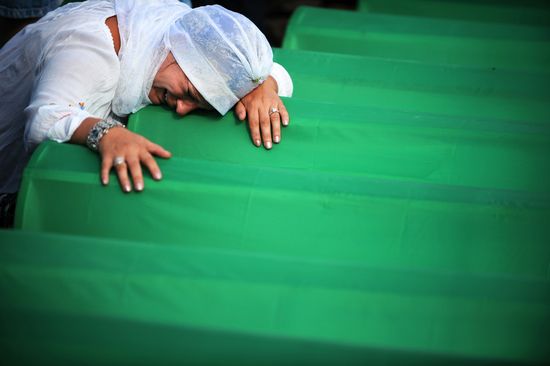
A Bosnian woman mourns over the coffin of a relative during preparation for mass burial at the Potocari memorial cemetery near Srebrenica on July 11, 2010. Sunday marked 15 years since the Srebrenica massacre of nearly 8,000 Muslims by Bosnian Serbs, the darkest episode of the violent break-up of Yugoslavia. By Dimitar Dilkoff/AFP/Getty Images.

Why Obama Isn’t Another FDR

by Patrick Appel

Beinart's pithy argument:

The more fundamental difference between the Obama era and its New Deal and Great Society predecessors is this: Back then, progressives did not define the left end of the political spectrum. In the 1930s and 1960s, America featured honest-to-goodness alternatives to capitalism, home-grown radical movements that scared the crap out of the American establishment and sent some of its denizens scurrying into arms of reformers like FDR and LBJ. Because our entire ideological spectrum has shifted right since communism’s collapse, reforms that once looked like centrist compromises now look like the brainchild of Chairman Mao.

How Bias Bends Fact

by Patrick Appel

Joe Keohane's article on the fact that "facts don’t necessarily have the power to change our minds" is making the rounds:

These findings open a long-running argument about the political ignorance of American citizens to broader questions about the interplay between the nature of human intelligence and our democratic ideals. Most of us like to believe that our opinions have been formed over time by careful, rational consideration of facts and ideas, and that the decisions based on those opinions, therefore, have the ring of soundness and intelligence. In reality, we often base our opinions on our beliefs, which can have an uneasy relationship with facts. And rather than facts driving beliefs, our beliefs can dictate the facts we chose to accept.

This is one reason why we post so much material on neurology, cognitive biases, and psychology. And it is why Andrew post opinions 180 degrees from his own. Good blogging requires reading pundits you hate. Systems, such as markets or the scientific method, are generally more reliable than individuals. In keeping with that, the Dish attempts to be more a system through which information is processed rather than a final product.

Young Guns (go for it)

by Dave Weigel

This is really just trivia, but if no one else has pointed it out — is it unusual for three members of the House Republican leadership to write a book inspired by, and using the same photo as, a 2007 Weekly Standard cover package? I assume somebody (hopefully Justin Raimondo) could make an amusingly tortured case about what this reveals about the Power of NeoCons; I choose to think that the Standard simply nailed it. Its 2007 pieces still sound right today. Fred Barnes on Eric Cantor:

"We do a very poor job of selling our ideas," Cantor told me. "We've got to get better at connecting our solutions to the problems people face." Worse, many of their ideas are stale. "There's a tendency for those inside the Beltway to look at the established sources of ideas," chiefly the Washington think tanks, he argues. "I want to talk to people in the real world."

And so he did, after a fashion, although his big outreach project was shuttered in its infancy.

CS Lewis on the Non-Threat of Inflation

by David Frum

Richmond Federal Reserve President Jeffrey Lacker is poised to snuff out inflation with higher interest rates, according to the WSJ:

Rate hikes aren’t imminent, but they are getting closer, the official said. “I have been saying that I am waiting for the time when growth is strong enough and well enough established that it will be clear we need higher rates,” Lacker said. “I don’t think we are there yet,” although he also said “we are getting to a time period where it’s going to be a more and more cogent question” as to when tighter policy will be required. …

Lacker said the Fed must be vigilant about inflation, and that he expects the core inflation rate to gradually drift back toward 1.5%, as he noted the relatively stability of inflation expectations. He warned “we are capable of causing inflation when the unemployment rate is relatively elevated,” so the Fed must continue to monitor the situation closely.

Meanwhile, back on Planet Earth, we are menaced by the much more ominous and more difficult to redress threat of deflation, according to John Makin.

U.S. year-over-year core inflation has dropped to 0.9 percent–its lowest level in forty-four years. The six-month annualized core consumer price index inflation level has dropped even closer to zero, at 0.4 percent. Europe's year-over-year core inflation rate has fallen to 0.8 percent–the lowest level ever reported in the series that began in 1991. Heavily indebted Spain's year-over-year core inflation rate is down to 0.1 percent. Ireland's deflation rate is 2.7 percent. As commodity prices slip, inflation will become deflation globally in short order.

How can this be? CS Lewis nicely explained today's inflation illusion in his "Screwtape Letters":

We direct the fashionable outcry of each generation against those vices of which it is least in danger and fix its approval on the virtue nearest to that vice which we are trying to make endemic. The game is to have them running about with fire extinguishers whenever there is a flood, and all crowding to that side of the boat which is already nearly gunwale under.