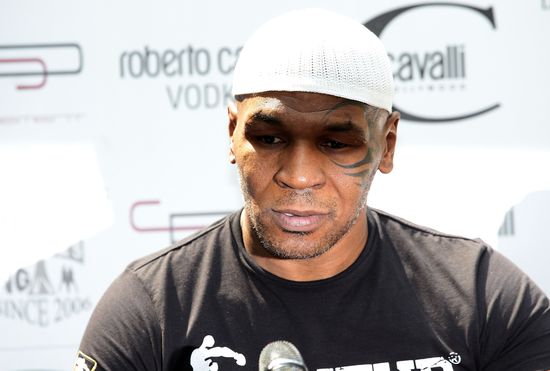
Mike Tyson attends a press conference held at Just Cvalle Cafe on July 9, 2010 in Milan, Italy. By Vittorio Zunino Celotto/Getty Images.
Mike Tyson attends a press conference held at Just Cvalle Cafe on July 9, 2010 in Milan, Italy. By Vittorio Zunino Celotto/Getty Images.
Yes, he's scared of Iran. But here's part of the interview that Jeffrey Goldberg did not highlight:
YOUSEF AL OTAIBA: For [Obama] to really make progress on the Iran issue and to deal with extremism and to deal with terrorism in the region, to deal with radicalized home-grown terrorism in the U.S., you need to address the [Israel-Palestine] peace process. That is the one core issue everyone tends to blame, and that's what the people hang all their problems on. Well, the Palestinians are, you know, they are — they don't have a country, they are abused, they are oppressed, and the U.S. always sides with Israel. So the sooner U.S. appears to be objective and impartial and create a Palestinian state, we take that argument away from everyone, and that is in everyone's best interest.
JEFFREY GOLDBERG: Why would that stop Iran from developing a nuclear weapon?
OTAIBA: It won't stop. It will get you all the Arab countries more aligned on containing Iran because now they use Palestine as an excuse, and the Palestine issue is a deep political problem. And I'm not saying it's only the U.S.' fault, I'm saying it is as much Israel and Palestine's fault for not making any progress on it themselves. But lack of their kind of commitment, the U.S. needs to step in and say, you need to do this. And you need to do this for your sake, for our sake, and for the region's sake.
Manzi replies to Ezra Klein:
When thinking about time after 2100, we have, in cartoon terms, two choices: (i) simply treat it as unknowable fog, or (ii) attempt to guess. I think that if we take the first choice, then we simply try to forecast through the next century, and let future generations worry about the world beyond 2100 (though I’ll point out that it is a very unusual political debate in which we call trying to manage the entire world for about the next 100 years as “short-termism”).
If we take the second approach, how far out do we try to guess? The Nordhaus economic calculations that I cited in my post as formal attempts to compare odds-adjusted costs versus benefits actually extend out for 250 years. That is, they consider expected costs and benefits to about 2250. Therefore, Klein’s point is really about potential damages beyond 2250,not 2100. That’s a long way off.
This doesn’t mean that I don’t care about problems that might occur hundreds of years from now, just that I don’t care much about current predictions about those problems.
Andrew Leonardyes explains how AC use increases global warming, which increases temperatures, which increases AC use:
There's no doubt that high temperatures translate immediately into increased burning of fossil fuels — and, inevitably, increased concentrations of greenhouse gases released into the atmosphere. This year is on track to be one of the hottest years in the historical record. If fossil fuel consumption is contributing to a warmer world, then our efforts to cool ourselves are only going to make matters worse.
And there are still quite a few people in China and India and elsewhere who do not yet have air conditioners — but intend to get them. Wanna save the world? Invent a low-power home cooling mechanism.
Keith Hennessey explains the Republican position on extending unemployment benefits.

Dayton, Ohio, 12 pm
A reader writes:
As a budding scientist who has been involved in the HIV field, it is rather frustrating to see media reports of the latest breakthrough in research without a full understanding of the findings and their significance (not that the medical establishment is not complicit … we put out these press releases in order to justify continued research money). As you are well aware, the field had been fraught with repeated false hopes and, after more than two decades of trying, we are no closer to a preventative vaccine than when we first started.
These findings today do not really change this fact. The same group has previously described another such neutralizing antibody but have been unsuccessful in their attempts to elicit this response in other individuals (this is the premise of a vaccine). The very fact that the vast majority of people fail to mount a significant immune response against the virus (unlike we do to most other pathogens) suggests that a vaccine may not even be possible in the first place. Pharmaceutical therapy, for better or worse, will remain our best response to this disease for the foreseeable future.
That being said, without any signs of the disease abating, research like this cannot be discounted. Just don’t expect results any time soon.
I don't. The Dish has long been dismissive of the search for a vaccine against HIV, but this did seem like a positive development. Another writes:
Thanks for that piece of news, Andrew. It actually brought tears to my eyes. I keep forgetting how much we suppress those hopes for a cure, then I read something like that and there's this flame, this glimmer of promise and I'm suddenly in tears. We forget how much that hope for a cure means to us, and how much we've pushed it aside and filed it away.
Right now I'm in this perfect storm of unemployment, heathcare crisis and AIDS.
Since I am, according to some, too lazy or drug-addled to find work, I've had to choose between my COBRA payments and my med copays and Dr. visits. I chose my COBRA payments for fear of that dreaded insurance lapse that would kick in pre-existing exclusions and not getting that all important certificate of coverage for my next (hopefully) job. Since I actually have a home (not sure for how long) and not totally homeless and destitute (yet) I don't qualify for a lot of help. Even if I did now, the state of GA, like many states, now have a Ryan White waiting list to get meds. Even my discount med cards from the drug companies didn't help enough to make them affordable.
So I'm waiting, waiting, waiting – so much has to fall into place, IF I can get a job in the next month or so, and IF they have good benefits, and IF the timing is just right, I might just be able to keep my insurance and go back on my life-saving meds. IF in the next month or so, I don't, I"m hitting several walls, my unemployment running out, my COBRA ending, foreclosure, bankruptcy. That's hoping too that after almost a year off my meds now, that I'm not blindsided by some totally preventable HIV related disease that would put me in the hospital and suddenly make any hope of this turning out well fly right out the window.
I have an older brother who is a wealthy retired executive from Philips, and very much a ditto head. They can't see giving me money since they would just be "enabling" me and keeping me from really looking a job (yes he really said that, almost a verbatim FOX talking talking point). Being a Christian though he did help me rewrite my resume. He keeps saying "just get private insurance" and even "just start my own company" but he hasn't a clue. With my meds running at $10,000 a month and having HIV/AIDS, I'm uninsurable through private health insurance, he doesn't understand that and almost refuses to believe it.
To address a lot of the current bashing of the unemployed: I'm a sharp hard working guy. I had the highest SAT scores in my class, I was pre-med at Wake Forest, two years ago I was making almost $60,000 a year, running an entire print production facility and doing it well. I've worked in consulting firms, F500 marketing departments, I have a killer resume. Yet…
So thanks again for that article. I do still hope. I've been in this crisis from the beginning, HIV+ back before there was even a test or a known cause. I had a partner who was only months ahead of me in progression, yet for every new drug that he just missed being able to take advantage of, I was able to. So our paths that at one time seemed to be almost lockstep veered apart and he died some 20 years ago and I'm still kicking around (I hope). I would just be crushed though that after living the miracle that being a 20+ year long-term survivor entails, that because of seemingly mundane things like a job and health insurance it might all be for nothing.
A reader writes:
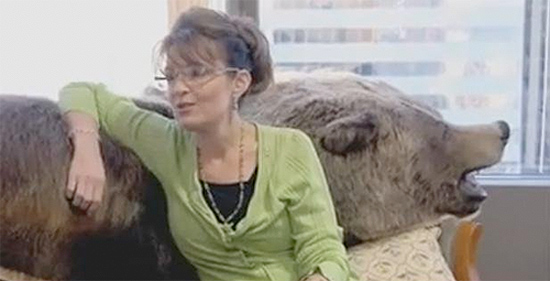
No one I know of has yet really pointed out how ridiculous Palin's whole "Mama Grizzlies" spiel is. When she became governor, one of her first acts was to submit a piece of legislation titled the "Active Management – Airborne Shooting" bill. Ostensibly authored by Palin with her name on it, the bill sought to legalize for the first time in our state's history the airborne shooting of bears as part of her predator control advocacy. You can read more about it here.
Beyond that, Palin completely politicized our Alaska Department of Fish and Game by creating a leadership position for family friend Corey Rossi, who is now the Director of the Division of Wildlife Conservation. Rossi was a strong advocate and proponent of bear snaring.
After Palin appointed him, he got a new regulation passed that allowed for the first time in our state's history the snaring of black bears west of Anchorage, even though it was well known that grizzly bears (including sows with cubs, or cubs) would be caught. And sure enough, ten percent of the bears caught last summer in snares were grizzly bears.
Palin's continued use of this Mama Grizzly theme is ironic and hypocritical because she more than anyone has seen to it that grizzly bears, including mama grizzlies and their offspring, will be killed in Alaska. In fact, Rossi is now working to push a new state law this fall that would allow for the public snaring of both black and grizzly bears in the Alaska interior, outside any formal predator control plan. Palin fully supports this.
She's a phony on almost everything.
The Dish prefers these pink elephants to Palin's:
Ryan Grim surveys the state's congressional delegation on Proposition 19 and gets three yays from Democrats and a wavering nay from a Republican:
Three may not seem like a high number, but it represents the most public support that legalization has garnered from a single state's delegation — and it signals the effect that ballot initiatives can have on advancing the public debate over marijuana policy. Many of the rest of the Democrats in the delegation said they were open to supporting it.
The California NAACP recently endorsed Prop 19, "citing dramatic racial disparities in marijuana
arrests." Scott Morgan picks up on Josh Green's reporting that marijuana initiatives may help Democrats:
The mere notion that state-level marijuana reform efforts can impact national politics is a healthy dose of leverage and legitimacy for our movement. When political pundits begin speculating about our ability to bring out voters, that sends a message to politicians in a language they understand. For decades, the Democratic Party has remained shamefully silent on marijuana policy — despite overwhelming support for reform within its base – all because party leaders persist in clinging foolishly to the 1980's mentality that any departure from the "tough on drugs" doctrine is political suicide. What now?
 The Dish