DOMA Reax

MARRIAGEDCAlexWong:Getty

You can read the rulings here. Jack Balkin thinks they will be overturned:

I am a strong supporter of same sex marriage. Nevertheless, I predict that both of these opinions will be overturned on appeal. Whether one likes it or not– and I do not– Judge Tauro is way ahead of the national consensus on the the equal protection issue. I personally think that discrimination against gays and lesbians is irrational, but a federal district court judge– who must obey existing precedents, and who is overseen by a federal judiciary and a Supreme Court constituted as they currently are–is in a very different position than I am.

Perhaps more importantly, his Tenth Amendment arguments prove entirely too much. As much as liberals might applaud the result, they should be aware that the logic of his arguments, taken seriously, would undermine the constitutionality of wide swaths of federal regulatory programs and seriously constrict federal regulatory power.

David Kopel agrees:

Balkin is right to point out that the new federal health control law could be found unconstitutional by any court which applies the Tenth Amendment as seriously as did Judge Tauro.

Dale Carpenter:

On the whole, I don’t think Gill is one of the stronger judicial opinions supporting SSM.  Its reasoning is too cursory.  It doesn’t rely on the more obvious and to me more defensible argument: that discrimination against gays and lesbians is constitutionally suspect, deserving strict scrutiny.  And unless reversed by the First Circuit, Gill could turn out to be a short-lived and expensive victory for SSM when it reaches the Supreme Court (assuming the Prop 8 case doesn’t get there first).

Adam Serwer:

Balkin writes that the ruling is "way ahead of the national consensus on the the equal protection issue." Probably. As Gabriel Arana reported, that's certainly a concern moving forward with Perry v. Schwarzenegger. But the window of time during which Democrats equivocate by supporting civil unions instead of marriage equality is coming to a close — at some point soon those politicians sitting on the fence are going to have to pick a definitive side and risk the political consequences of either alienating the LGBT vote or their other, more religious core constituencies. That may happen before there's a genuine "national consensus" in favor of marriage equality.

A key question is whether the Obama administration will appeal the ruling, and, as Jake Tapper reports, they probably will.

Jillian Weiss:

The effect of the decisions will probably be put on hold during the course of the appeal.

The decisions only affect sections 2 and 3 of DOMA — the federal benefits part. It does not require interstate recognition of marriage equality. People married in Massachusetts will still get no respect in Florida.

The decisions also only affect people in Massachusetts, though that could expand on appeal. The decisions are probably not retroactive, so that people who paid extra taxes or were denied federal benefits based on DOMA will probably not be able to get their money back. 

Ampersand:

I think this decision puts the folks who have been saying “let the states decide,” while really opposing marriage equality, in an interesting position. The ruling says that the Federal government has to respect state decisions on this — even if a state decides to recognize same-sex marriages. Now most of those folks will have to come up with some rationalization to explain why when they said they wanted the states to decide, they didn’t mean that they wanted the states to decide.

Timothy Kincaid:

Taken together, it seems clear that Tauro finds that a distinction based on marriage is permissible. But one that is based on sexual orientation is not. This would seem to suggest that because states can determine marriage laws (Commonwealth), it can either allow or refuse same-sex marriage (until otherwise restricted). So those legally married same-sex couples in Massachusetts, Iowa, Connecticut, Vermont, New Hampshire, Washington DC, New York and Maryland and some 18,000 couples in California would be married in the eyes of the federal government while those in civil unions or domestic partnerships would not.

I have now read Hadley Arkes' response. I'd like to quote it, but it doesn't seem to grapple with the issues at all. It relies on definitional arguments about "marriage" – arguments that have actually already been resolved in Massachusetts and upheld by its legislature, governor and Supreme Judicial Court. And there is no discussion as to why a state should be prevented by the federal government from providing full equality to its citizens, without violating core principles of federalism. Arkes seems to imply that because the federal courts struck down miscegenation bans, the federal government can enforce – against state law – inequality for gay citizens and non-citizens. Maybe you can understand his case better.

It seems to me that, however this plays out in the courts, the reasoning in these cases, and the principles they inject into the discourse, are helpful. It does seem to me bizarre that I am married in both my places of residence – DC and Massachusetts – and my marriage license is identical to every other straight couple's. But the federal government – in a way unique in its entire history – refuses to acknowledge these clear state licenses solely on the basis of the fact that I'm gay.

The federal government is both refusing to recognize what it always recognized, and creating a two-tier system where gay couples are officially designated as worth less under the law than straight ones. And this is the position of the Obama administration. And they say they are pro-gay. They aren't. They like us kept very firmly in our place. And they will now argue in the courts that second class citizenship for two percent of the population is a principle they embrace and will continue to advance – even when the states have decided otherwise.

That's their prerogative. But they're full of it. Their position on marriage is about as coherent as their position on Afghanistan.

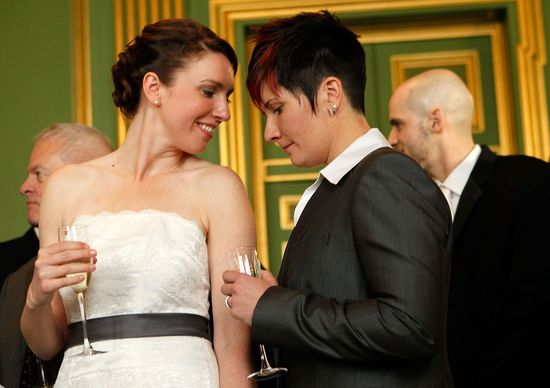
(Photo: Same-sex couple Alexandra Khalaf (R) and Amy Sokal share a monent after they exchanged vows during a group wedding March 20, 2010 at the Andrew W. Mellon Auditorium in Washington, DC. Ten same-sex couples participated in the mass wedding after the nation's capital became the sixth place in the nation that recognized same-sex marriage. By Alex Wong/Getty Images.)

The Evolutionary Case Against Monogamy, Ctd

A reader writes:

As someone who's lived in an open marriage for the last 8 years but have never had sex with anyone else but my wife since we met, I thought our experience might shed light on the actual experience.

I was 38 when we married. I'd been married before and saw that marriage implode over one issue: Trust. (Which had nothing to do with infidelity. There was none).

When we got together we agreed that this, more than any other thing, would destroy the marriage.  So we talked about trust and talked about our sex lives and our proclivities and came to the conclusion that yes, we might well be tempted to sleep with someone else. After all, we're only human.

So we established some simple rules.

If either one of us feels we just have to sleep with someone else, we can. But we have to tell the other spouse. And we have to tell the person in question that we are married and plan to stay that way. AND, (this is the big part) either of us gets veto power with no questions asked.  If I want to sleep with someone my wife despises, she can say no and vice versa.

Eight years and neither one of us has been with anyone else.  But it's taken a strain off the relationship that I think most people never even know they experience until they don't have to.  I don't want to sleep with anyone else. I want to sleep with my wife. But if some pretty girl wants to, and I'm so inclined, it's awfully nice to know that I can.  I just don't get to lie about it.

It's a great way to live and it's a great way to be married. I adore my wife. I cannot imagine what it would be like to live without her.  If her having a brief fling with some guy is going to be that important to her, I'm willing to swallow my ego and let her do her thing.  Because, after all, insisting on monogamy even when it makes your spouse unhappy or even at the cost of dishonesty (the REAL killer of marriages) isn't really love at all. It's possession.

The Unstoppable Sarah Palin

Chris Matthews sees Palin inflicting an "early knockout" in the primaries. Larison, still betting against her, argues that the GOP establishment will quash her candidacy:

Palin and Mondale are alike in that they represent the face of the party as it was when it was defeated, but they are quite different in their sources of support. Mondale was the candidate of the party establishment and important interest groups, and Palin has made a point of aligning herself with every possible anti-establishment, insurgent campaign she can find.

Contra Kornacki, Bernstein finds the comparison off:

Yes, Mondale got clobbered — but he was clobbered by a popular incumbent president boosted by a strong economy.  Under those circumstances, it didn't really matter who the Dems ran; when the electorate is happy with the incumbent, there's not very much the out-party can do about it.

Kornacki responds. Ken Silverstein wagers that she doesn't even have a shot at the vice presidency. Of all these, I trust John Ellis' judgment the most. Yes, he's Bush's cousin, but his insights are always worth reading. I think he's dead on here:

As the Republican avalanche of 2010 builds — and I saw a poll the other day of a Democratic-leaning state Senate district on Long Island where the "right track" (8%)/"wrong direction" (83%) was unlike anything I had ever seen — Palin has smartly positioned herself as the champion of the conservative counter-revolution. By December, she will almost certainly be the de facto front-runner for the GOP presidential nomination.

By the time the Establishment GOP wakes up to this reality, it may be too late for them to do anything about it. Their view of Palin is that she's useful to the party because she can help keep "the Tea Party types inside the tent." And maybe she can serve coffee while she's at it. Palin's view is that (1) "the Tea Party types" are the party, (2) she is their standard bearer and (3) anyone who thinks "the Tea Party types" are there to lick envelopes and knock on doors should think again. They're there, she asserts, to take back their party and to take back their country.

"She's too stupid" is what the Establishment GOP really thinks about Sarah Palin. "Good-looking," but a "ditz." This is unfertile ground, since Palin can turn the argument on a dime and say: "They drive the country into bankruptcy, they underwrite Fannie and Freddie, they bail out Goldman Sachs, they fight wars they don't want to win, they say enforcing the immigration laws is silly and they call me stupid! I'll give you a choice: you can have their smarts or my stupidity, which one do you want?" A large number of GOP presidential primary voters will take Palin's "stupidity" in a heartbeat.

Know fear.

Freezing Yourself

Kerry Howley brushes up on cryonics, i.e. low-temp preservation of individuals for future reanimation. Robin Hanson, among those profiled in the piece, explains his enthusiasm for the practice:

I’m pro cryonics not because I’m pro all-med-no-matter-what, but because its cost benefit seems favorable – a >5% chance of decades more life for a few tens of thousands of dollars.  And this isn’t at all about immortality, the odds of which are far lower, but mainly about more decades of healthy interesting life.

Eat Your Vegetables

Dan Ariely wants to know why so much of his produce goes bad. One obvious reason:

I suspect that one of the main culprits is the produce drawer in the refrigerator.  Most refrigerators have a special drawer designed to hold produce, usually located at the bottom of the fridge.  The drawer is often just barely opaque and for some reason difficult to open. Because of these “features,” when you open the fridge door, you look straight ahead, to the leftover lasagna or apple pie (and their convenient position) come to mind, leaving the carrots and nectarines hidden and forgotten in the vegetable drawer.

A World Without Cash

Scott Adams imagines one:

When you eliminate cash, you also eliminate a lot of crime. Criminals need cash to stay off the radar. In a cashless world, drug dealers and crime syndicates could try to set up fake businesses to launder their revenues, but it wouldn't work. Imagine setting up a fake dry cleaner, for example. The government could easily determine whether that business is buying the type and quantity of dry cleaning supplies typically needed, and whether the profit margins are at industry norms. All of that information would be available through the tax records. A drug dealer could pretend to be a consultant, but even then you expect a digital trail for buying printer ink, business travel, and the like. Perhaps the drug dealer's address and educational level would be tip-offs too.

Not Even Civil Unions, Ctd

Governor Lingle twists the knife:

For those people who want to makes this into a civil rights issue, and of course those in favor of the bill, they see it as a civil rights issue. And I understand them drawing that conclusion. But people on the other side would point out, well, we don’t allow other people to marry even — it’s not a civil right for them. First cousins couldn’t marry, or a brother and a sister and that sort of thing. 

Not so fast:

Later in the segment, “Joe from Silver Spring, Maryland” called in and pointed out that in Hawaii, first cousins actually can get married. Lingle said that she had no idea whether or not that was true in the state she governs.