A pollster dust-up.
Month: July 2010
Obama And Afghanistan: Pragmatism Or Amoralism?
Andy Bacevich pulls no punches:
Obama’s supporters were counting on him to bring to the White House an enlightened moral sensibility: He would govern differently not only because he was smarter than his predecessor but because he responded to a different—and truer—inner compass. Events have demolished such expectations. Today, when they look at Washington, Americans see a cool, dispassionate, calculating president whose administration lacks a moral core.
The case for pragmatism, especially after the ideology-drenched years of Bush and Cheney, is a powerful one. On issues like the bank bailout (wildly successful) or health insurance reform (a messy but important advance) or balancing short term demand with long term austerity, we need pragmatism. But there are some areas where that instinct can come to seem unwise.
Sending young men to risk their lives is one of them; refusing to live up to core Geneva Conventions requirements – like investigating and, if appropriate, prosecuting those guilty of war crimes is another; ditto civil rights, where pragmatic politics is never enough. I have no reason to believe that the decision to elevate the Afghanistan war into the biggest gamble in nation-building and permanent occupation wasn't made in good faith. But the case for a face-saver like the failed "surge" in Iraq is far more persuasive in terms of domestic politics than it is in terms of strategic and military sense. And now Petraeus is in control, the war has total backing from the Washington establishment.
Which means young Americans will be dying in Afghanistan well into Obama's second term, if he has one.
“Moms Just Know When There’s Something Wrong”
A entirely content-free, argument-free, slogan-dominated, identity-politics-driven movement is afoot. Palin is leading it, as her new web ad demonstrates, even as Washington continues to deny that she has any larger political ambitions:
She has now neutralized the main threat to her, Levi. She has already neutralized the terrified press corps, who cannot and will not withstand far right bullying to expose the fraudulence and danger of this populist just-make-shit-up maven. In fact, they're more eager than ever to placate the far right.
When you combine a long, jobless recession, spiraling debt, and a world where all of American military power can no longer defeat even 500 Jihadists … you can see the appeal of this fantasy. At least I can. The nomination is hers to lose.
If California Legalizes Marijuana …
Will the price go down?
The Policing Of The Discourse

Froomkin was fired for opposing torture a little too passionately; Weigel was forced out because his private emails revealed he was not acceptable to the partisan right; Frum is cut off from conservative blogads funding; Moulitsas is barred from MSNBC for criticizing Joe Scarborough; and Octavia Nasr is fired for offending the pro-Israel lobby over a tweet expressing sadness at the death of a Hezbollah leader. Nasr subsequently elaborated on her tweet in a nuanced piece that ran on CNN.com. It reads like an honest piece of journalism to me. Money quote:
I used the words "respect" and "sad" because to me as a Middle Eastern woman, Fadlallah took a contrarian and pioneering stand among Shia clerics on woman's rights. He called for the abolition of the tribal system of "honor killing." He called the practice primitive and non-productive. He warned Muslim men that abuse of women was against Islam.
That was still not enough; and she is let go after twenty years of work for CNN.
Notice a pattern here? We're all on notice, I guess. I'm extremely fortunate to work at a place where open exchange of views and ideas is valued, not penalized.
Chart Of The Day
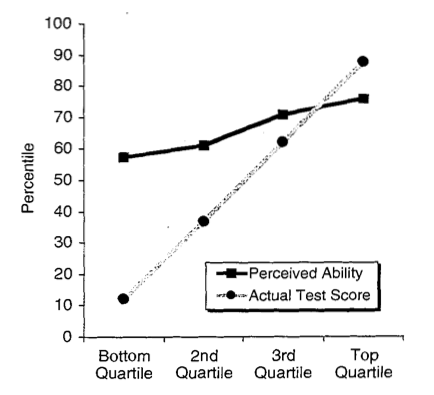
Tal Yarkoni takes another look at the Dunning-Kruger effect:
This is one of the key figures from Kruger and Dunning’s 1999 paper (and the basic effect has been replicated many times since). The critical point to note is that there’s a clear positive correlation between actual performance (gray line) and perceived performance (black line): the people in the top quartile for actual performance think they perform better than the people in the second quartile, who in turn think they perform better than the people in the third quartile, and so on. So the bias is definitively not that incompetent people think they’re better than competent people. Rather, it’s that incompetent people think they’re much better than they actually are. But they typically still don’t think they’re quite as good as people who, you know, actually are good. (It’s important to note that Dunning and Kruger never claimed to show that the unskilled think they’re better than the skilled; that’s just the way the finding is often interpreted by others.)
(Hat tip: Tyler Cowen)
A New Study Says …
Wilkinson and Ezra Klein wrestle with which research papers to trust.
The Real Afghanistan Debate?
Exum sketches it:
Despite all the anger and emotion in current debates over U.S. and allied Afghanistan strategy, few are arguing for a complete and rapid withdrawal. Michael Cohen, one of the current strategy's critics, linked to several alternate strategies for Afghanistan on his blog the other day, and none argue for a complete withdrawal. The real debate, in other words, revolves around how quickly we can transition to a lighter footprint.
Taxing The Sugary Stuff? Ctd
Drum isn't convinced by this study:
Even assuming that all the assumptions in the report are correct, all it does is show that our net calorie intake from beverages would, on average, go down. But if you switch to diet soda, it's pretty likely that you'll just make up the calories somewhere else. In fact, if this study is correct, it's possible that you might increase your total calorie intake.
The Daily Wrap
Today on the Dish, the Iranian government was set to stone a woman to death, the Uganda beheading turned out to be a hoax, the Hawaiian governor vetoed civil unions, the Louisiana governor called for guns in churches, and raising the retirement age looked more likely. Andrew and Beinart felt that the president further caved to the Israeli prime minister, Andrew confronted Chait over the gulf between Congress and the American public on Israel, and the US inroads into Arab PR continued to falter.
In Palinland, Andrew scratched his head over Levi's sudden about-face, Chris Good explained why it matters, Mercede couldn't understand why her brother would turn on her, and a reader figured it was all part of a custody battle. Hasidic women were crazy for Palin's hairdo, Steve Kornacki took a turn at her chances in '12, readers added on, and Dana McCourt was sick of all the Trig talk.
Andrew circled back to the NYT's application of "torture," called out the AP for the same, examined the evolution of public perception on torture, and mounted a defense of AC. Bernstein and Wheeler jumped on the public perception thread while TNC piled on the NYT. Ambers and Kaplan savaged Romney on his foreign policy and others joined in. Wehner had some wise words on the Steele debacle, Adam Serwer pointed out that more deportations are occurring under Obama than Bush, Frum questioned social mobility, Terry Tamminen proposed taxing carbon on a state-by-state basis, and Robert Wright saw humans as a global superorganism.
A particularly foul Hewitt Award here. Yglesias here. Mad Men fodder here. MHB here, VFYW here, and FOTD here. The latest winner of the window contest here.
— C.B.
 The Dish