Life As A Cell

Robert Wright feels that "technology is weaving humans into electronic webs that resemble big brains." He doesn't think it "outlandish to talk about us being, increasingly, neurons in a giant superorganism":

I do think we ultimately have to embrace a superorganism of some kind — not because it’s inevitable, but because the alternative is worse. If technological progress grinds to a halt, it will be because chaos has engulfed the world; and if we don’t use technology to weave people together and turn our species into a fairly unified body, chaos will probably engulf the world — because technology offers so much destructive power that a sharply divided human species can’t flourish.

If you accept that premise, then the questions are: What sort of human existence is implied by the ongoing construction of a social brain; and, within the constraints of that brain, how much room is there to choose our fate?

Are Kids Doing Better Than Their Parents?

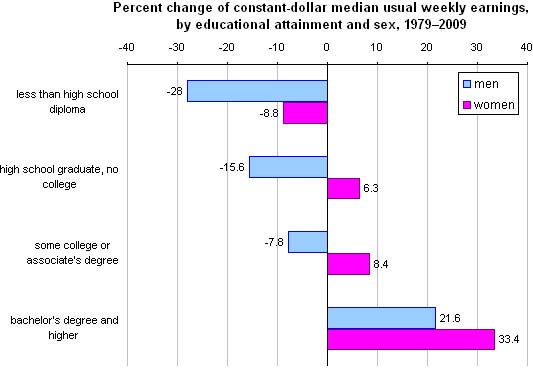
Earningsadjusted19792009

Catherine Rampell finds a chart:

As you can see, most men today earn less than equally educated men in 1979, with the exception of the most highly educated.  The opposite is true for women: Most women today earn more than their equally educated counterparts from 1979, with the exception of the least educated.

Joyner calls this chart evidence that earnings have plummeted over the last 30 years:

In 1979, most married women stayed at home with the kids or simply tended house; that almost immediately changed.   And, while being a high-school dropout wasn’t exactly a road to riches even then, there were still entry level jobs that would take you and allow you to work yourself up if you were good enough.

Derek Thompson adds:

The upshot is that even as the cost of college comes under scrutiny, the evidence continues to suggests that four expensive years is the price our generation has to pay if we expect to earn more than our parents.

Not From The Onion, Ctd

Max Fisher puts Iran's new hairstyle guidelines in perspective:

Demographically, Iran should be a democracy. It has high literacy and education rates, a large and vibrant middle class, independent labor and business communities, and a strong tradition of political organizing and involvement. The regime retains authoritarian rule in large part because it firmly controls so much of Iranians' public lives. The regime typically increases these controls in times of social unrest. The baseej, an informal citizen militia loosely tied to the state, can closely monitor their neighbors and brutally enforce state restrictions. Many Iranians become so consumed with navigating these complicated laws that public spaces become places of fear and self-censorship. Because phone taps are common and because your neighbor might be a baseej who closely monitors whoever enters your home, even private spaces are suffocated by state control. Regulating hair styles may not seem like it would be very effective, but this move is part of a sweeping, pervasive strategy to engineer individual freedom out of every imaginable aspect of public life.

How Dumb Is Mitt Romney? Ctd

Max Bergmann sees what Mitt is up to:

From a political perspective Romney is severely compromised with the Republican base for his past liberal positions on domestic and social policy issues (pro-choice, health care reform, etc). But one area where he is a blank slate is on foreign policy. And Romney has made a concerted effort to fully embrace the Heritage Foundation's national security positions.

Crowley agrees:

As a former business executive, Romney has shown little past interest in arms negotiations. But that's true of nearly all the most-often discussed 2012 Republican presidential possibles: Sarah Palin, Mitch Daniels, Mike Huckabee, Haley Barbour, John Thune and Tim Pawlenty. (To be fair, Palin does talk about national security; but no one would call her an expert.) Hence Romney's piece feels like an effort to play national security wonk and elevate himself above a field of domestically-oriented figures.

Americans Against Torture, Ctd

Bernstein notes how the debate has shifted:

By 2008, the only way to fully support George W. Bush was to oppose torture but to either ignore the vast evidence of what the United States had done, or to oppose torture but define it narrowly to exclude virtually everything that had every been considered to be torture.  And after the election, the emphasis shifted again, and while few have explicitly said that "torture" per se is good, the disclaimers are increasingly, as far as I can see, less and less prominent.  The old debate about whether the revelations were true, a very live debate through the middle of Bush's second term, is long gone, and explicit torture supporters (explicit in supporting everything but the actual word) dominate conservative discussion of the issue. 

Marcy Wheeler partially blames the press:

Is it possible…that by embracing the torture apologists’ relativism, newspapers encouraged individuals to think about torture as a political preference? This is all obviously speculation on my part. But it seems to me the most important question raised by this study on public opinion about torture is why under a then-popular nominally anti-torture president, torture became popular.

President Obama signaled as much by his actions, if not his words. By declining to initiate prosecution of indisputable war crimes, he tacitly endorsed them as not that serious, and continued America's withdrawal from the Geneva Conventions (it is a breach of the conventions not to prosecute clear instances of war crimes). And the hiring of torture supporters, like Marc Thiessen, at newspapers like the Washington Post, definitely entrenched the precedent.

The moral certainty of the Cheneyites, in other words, was compounded by the moral cowardice of the Obamaites and the Washington establishment. Yes, torture ended in 2009, and we should all be relieved by that. But that was at the cost of its long-term legitimization. It will return as soon as we get a Republican president. Can you imagine the extent and gravity of it under a future president Palin?
Those “Contentious Words” At The NYT, Ctd

From TNC's take on the NYT's cowardice:

Some years ago, I heard a linguist jokingly assert that the difference between languages and dialects, was that languages had armies. I am not convinced that this holds in every case. Nevertheless his point was that the labels we affix to things have a direct relationship to power. Throughout the 20th century, unpleasant regimes have made use of waterboarding. But they lacked the power of proximity, and thus could not cleanse their acts with the white words of "enhanced interrogation."

And few newspapers rushed to cleanse their record for them.

Wehner On Steele

Money quote:

One problem with political discourse in our age is that in the heat of debate, we too easily suspend a disinterested search for the truth and advance a more narrow, partisan aim. That leads to hypocrisy and double standards. Very few of us are completely free of such things. We view the world through a tinted lens. But we ought to at least aspire to intellectual integrity and uphold as models those who embody it.

Palin’s Chances, Ctd

A reader writes:

Her moves and the GOP's current condition suggest to me that what she's really running for is vice president again. I'm surprised that no one out there seems to be considering this possibility, since from what I can tell it's pretty much inevitable.

For both her and her competitors, it's the only way to square the circle. No one in the party can win without her support, but she lacks the credibility with the public to make it on her own. And if she loses on her own two feet, she's toast – not just in politics, but with her emerging media empire as well. But an alliance with either Romney or Gingrich would instantly make them a favorite, while perfectly setting herself up for a future presidency. If Barack Obama and Hillary Clinton can form a successful alliance, then Palin should have her pick of suitors.

Another writes:

The one question I haven't seen raised – and it could be because I haven't been looking particularly hard – is what will happen if she runs and loses the nomination. Since McCain brought her into our lives almost two years ago, it's become pretty apparent that she cares little about anyone but herself and is more than a little delusional. Why WOULDN'T she run as a 3rd party? Do we really believe she thinks (or will think after what is sure to be an ugly primary) that she owes the GOP establishment anything?

In my mind the Republicans will end up with one of three situations: 1) Sarah Palin as nominee, 2) Sarah Palin as VP to appease her, or 3) Sarah Palin as general election opponent. How can this be anything but an unmitigated disaster for them?