Ross On Afghanistan: Getting Warmer, Ctd

Doctrineman

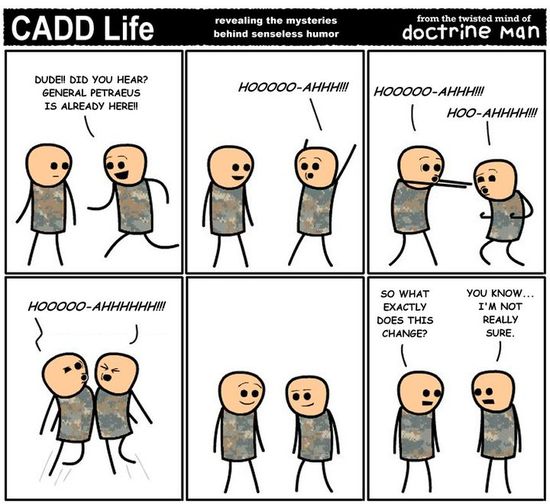
Douthat answers Millman's query:

The point of a counterinsurgency campaign… isn’t to crush the Taliban once and for all. It’s to create an environment in which they feel like they could be crushed, and to turn those security gains to political ends. Whereas so long as the Taliban’s leaders and fellow travelers are convinced that they’ve all but won the war, any “orderly entry” into government that they negotiate is likely to end in disaster — for our interests, and for Afghanistan.

(Cartoon via Joyner)

The View From Your Recession

A reader writes:

I am a small business owner in New York City. At the beginning of the recession, I had a handful of part-time employees who got paid cash under the table, as they freelanced or worked other jobs. My best employee lost his main gig and asked me for help. I cut the rest of the employees and put him on payroll. I allotted more work-hours than I really needed, but he was in a jam and I believed that I would see a return on the investment.

A year and a half later, the investment has not born as much fruit as I had hoped. There's simply not enough work to support the position. Meanwhile hungry, overqualified people drop me resumes and beg for part time work. Our financial picture is still perilous and I have simply come to the conclusion that I can (and that I must) get the same work product for less money from people who will be happy to do it. The employment pool is so good that I'm going to kill a real job – full time, on the books – for under-the-table work from someone who will likely be far overqualified for it.

So I agree with Hale Stewart that it's a win-win for employers. But I don't think it's very good for the country overall.

The Consequences Of Disengagement?

While urging "strategic patience" in the Middle East, Ryan Crocker writes that "disengagement from Pakistan and Afghanistan after the Soviet retreat in 1989 ultimately gave al-Qaeda the space to plan the 9/11 attacks." Greg Scoblete begs to differ:

Can Crocker, or anyone – offer a remotely plausible scenario which sees the U.S. "engaged" in Afghanistan in the 1980s that prevents the rise of al Qaeda internationally? Bin Laden wasn't even in Afghanistan until 1996. As we're learning now, the problem in Afghanistan isn't American engagement or lack thereof, it's Pakistan's regional interests. Maybe there was a magical formula available to the U.S. in the 1980s that changes Pakistan's interests in Afghanistan so that it didn't use the country as a dumping ground for the ISI's fundamentalists. But I doubt it.

Why Do Cops Care About Pot?

Marijuana

Because targeting marijuana gives police departments access to federal anti-drug money. Mike Meno sighs:

As we’ve stated many times before, marijuana eradication programs are not only horribly ineffective at reducing the supply of marijuana, but even worse, they force law enforcement to commit massive amounts of resources and manpower to marijuana offenses at the expense of much more serious crimes. That’s why it’s so insane for the federal government to encourage and reward this type of misallocation. As the Journal article points out, California police departments are expected to lose $100 million in state funding this year, presumably leading even more departments to take up the eradication cause.

The Daily Wrap

Today on the Dish, Andrew sided with Steele against Obama's war in Afghanistan and spotlighted the extremely small number of enemies there. The president was already beating Bush on the budget and his healthcare bill was growing in popularity. Cameron stood tall against torture and the mayor of London stood up for marriage equality. A gay man was slaughtered in Uganda.

In economic coverage, Hale Stewart showed how the recession has been good to business owners, Brad DeLong pushed for another stimulus, Adam Ozimek weighed the pros and cons, and Howard Gleckman took a turn at the question of unemployment benefits and laziness. Josh Green explained how pot propositions help Democrats on the ballot. Thiessen posed as a tea-partier, Larison voted nay on a Palin nomination, and NRO nominated her for RNC chair. Another big dose of Trig talk here.

Looking abroad, the American public continued to diverge with Israelis over the flotilla, Beinart went to bat for Karl Eikenberry and gave a pep talk to Obama on Israeli discontent, settlers tightened the screws on Bibi, Andrew highlighted how US taxpayers fund the settlements, and the IDF got down to Ke$ha.

In media coverage, new details emerged over Weigel-gate, Chris Beam profiled a humble David Brooks, Chait offered his take, Greenwald defended Nazi comparisons, Howard Kurtz outed personal emails again, and Prince proclaimed the end of the Internet. Readers wondered whether to pray for an atheist and sounded off on the evolutionary case against monogamy. Hilarious tech video here and a funny video on "faggots" here.  MHB here, VFYW here, and FOTD here.

— C.B.
Regrets And Happiness

Jennifer Senior's NyMag article has revived the never-ending debate about children and happiness. KJ Dell'Antonia, mother of four, adds her two cents:

Tom Gilovich, a psychologist at Cornell famous for a study showing that people regret things they haven't done more than things they have, asks "Should you value moment-to-moment happiness more than retrospective evaluations of your life?” He says he doesn't know the answer, but maybe the question is the answer. If you can keep a sense of the way you'll feel about the comically difficult moments as you go about the truly crazy days—the nights when multiple children are sick in their beds or the moment when you look over your Fourth of July and realize that one of your children has literally eaten nothing but candy from morning until night—then those times of epic lunacy hold the seeds of their own pleasure. If parenting is hard in part because we make it hard, then we can make it easier. We can let some things go, and we can look at other things differently, and we can hold on to one bittersweet thought: someday we'll look back on all of this and laugh.

Face Of The Day

102641223

Sri Lankan traditional dancers perform the 'thovil' or devil dance, which is performed to exorcise evil spirits, outside the UN office during a protest rally in Colombo on July 6, 2010. Protesters led by a Sri Lankan cabinet minister were speaking out against a UN panel set to probe allegations of war crimes. By Lakruwan Wanniarachchi/AFP/Getty Images.

The World In 2400

Ezra Klein searches for a weak spot in Manzi's latest argument against a carbon tax:

Even if Manzi is right that the costs [from global warming] are manageable into 2100 — a century, after all, is a long time for a human, but not for the atmosphere — what does that do to our descendants who have to deal with a scorching planet between 2100 and 2200? And then into 2300, and then 2400?

I think Manzi's answer is that technology will save us by then. And maybe he's right. But maybe he's not. And if he's not, then we've let the problem become unimaginably bad for our descendants. If you bet on technology and you're wrong, it's not like we've got another of these planets waiting in the back somewhere.