Time To Act

by Zoe Pollock

The tragic realities of prison rape continue, as evidenced by a new report. Lovisa Stannow and David Kaiser follow one man's story:

[C]onsider the case of Scott Howard. Scott was a gay, non-violent, first-time inmate in a Colorado prison when he was targeted by members of the “2-11 crew,” a white supremacist gang with over 1,000 members in prisons throughout the state. For two years he was forced into prostitution by the gang’s leaders, repeatedly raped and made to perform oral sex. Even after he told prison staff that he was being raped and needed protection from the gang, Scott was told that nothing could be done unless he named his abusers—even though they had threatened to kill him if he did. Because Scott is openly gay, some officials blamed him for the attacks, saying that as a homosexual he should expect to be targeted by one gang or another. And by his account, even those officers who were not hostile didn’t know how to respond to his reports, because appropriate procedures were not in place. They failed to take even the most basic measures to protect him.

Ultimately, despite his fear, Scott did identify some of the gang members who had raped him. Not only did the prison authorities again fail to respond, they later put Scott in a holding cell with one of his previous assailants on the day he was to be released from state custody. Again, he was beaten and forced to perform oral sex. Scott had a civil lawsuit settled in his favor recently, winning financial damages and seventeen policy changes that will now become mandatory in the Colorado prison system. Otherwise, however, nothing about his story is unusual.
The Big Picture

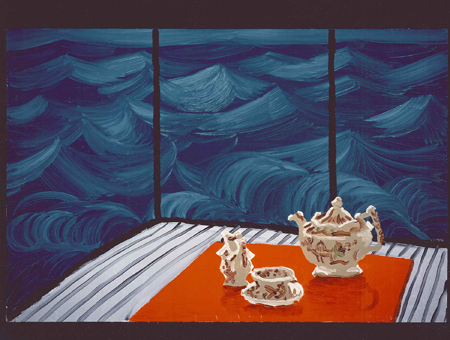
Teacups

by Zoe Pollock

at the height of the AIDS epidemic, as it happens, at a time when Hockney used to have a beach house overlooking the occasionally quite wild surf off Malibu Beach: a dainty porcelain tea set in the foreground against the backdrop of the roiling sea. Where, one is given to wonder, is the true drama?

“Wish The Rent Was Heaven Sent”

by Zoe Pollock

Regina Brett of the Cleveland Plain Dealer debates whether a house Langston Hughes lived in for two years in high school is worth saving:

It's tempting to turn the home of writers into museums to honor the writers, bring in tourists, and preserve the cultural legacy of a neighborhood. But she's visited 55 homes of famous writers in America and found that many of them suffer financially. To do well, they need to be in a good location and have a big operating budget. Last year, foreclosure hit the Edith Wharton House in Lenox, Mass., and the Mark Twain House in Hartford, Conn.

[Anne Trubek, an associate professor at Oberlin College] has a better proposal. Why not honor authors like Hughes by reading their work?

"What if we gave a free copy of his poetry to all kids?" she said.

Her young son was never assigned to read Hughes, so she made him. When she drove him by the house, he wasn't impressed.

"It's just a house," he told her.

While in the house, Hughes wrote the below words, which Brett offers as a fitting coda to a story where the words might matter more than the house:

I couldn't afford to eat in a restaurant, and the only thing I knew how to cook myself in the kitchen of the house where I roomed was rice, which I boiled to a paste. Rice and hot dogs, rice and hot dogs, every night for dinner. Then I read myself to sleep.

The Easy Narrative

by Zoe Pollock

Tom Bissell defends Virginia Quarterly Review editor Ted Genoways and expresses disappointment that a true tragedy, the suicide of managing editor Kevin Morrissey, has been turned into a trend story, which seems to be a popular thing to do these days:

I would like to believe that I know enough about human nature to be able to sense within someone to whom I am close a monstrousness capable of tormenting a colleague into the dark embrace of suicide. What I do sense in the VQR tragedy, unmistakably so, is a far more complicated story about people who grew to despise one another, worked terribly together and had access to too much money and not enough support systems, whether personal or official. But "workplace bullying," like the "ground zero mosque," is a narrative so easy and pleasing it practically fits you for your toga.

Book Biases

by Zoe Pollock

Chris Jackson, subbing in for TNC, has a nice post about our own unintentional literary biases, after he had to make a concerted effort to read more female fiction. As a fiction lover, I just recently vowed to bone up on my foreign policy non-fiction, thanks to some enthusiastic encouragement from my nerd boyfriend. Chris' point is well put and well-taken:

There are ways that our reading is shaped and limited by the biases of the dominant literary gatekeepers–maybe without realizing it, we've only read books by people of a certain race, or who write in a certain language, or who follow the conventions of a certain genre (including the unnamed genre of Anglo-American Serious Fiction). To some people this is the great opportunity in the coming bookquake, the chance to disintermediate some of those gatekeepers and their peculiar, ossified biases. But the real bias may be inside of us, as readers, and we might have to force ourselves out of them to take advantage of these new opportunities. How exciting is it to consider that there are worlds of literature out there that you may not have tapped into, undiscovered countries of books to explore that might yet tell you something new in a new way?

Atomized Individuals

by Zoe Pollock

Mark Lilla explores China's one-child policy and its psychological repercussions, through the story of a father distraught over his only son's breakup with a girl:

It worries him that the popular culture now promotes dating and youthful romantic love, something he feels Chinese young people aren’t psychologically prepared for, especially the breakups. The more he spoke, the more anguished he sounded about losing his son in other ways, too. Even as a youngster the boy would stay in his room glued to his computer avoiding human contact, rarely going out with his few friends. Other Chinese parents I spoke with said similar things about their children, complaining about their remoteness, their social isolation, and their obsession with technology. They seem an alien race of free-floating individuals.

For many Westerners, this is a familiar picture. We have not only accustomed ourselves to the atomizing forces of capitalism and modern culture, we idolize them. They only make us freer (we think), and anything that increases our freedom is good (we think), given that freedom is the highest good (our unquestioned questionable assumption). Q.E.D. But China isn’t there yet. People I spoke with my age or older still think in traditional ways about family and society, even as economic growth and the one-child policy promote individualism, selfishness, and narcissism. They are disturbed by the prospect of atomized individuals facing a powerful state and largely un-regulated market forces without mediating social institutions. Western nations have somewhat adapted to the cultural contradictions of capitalism because they are politically and socially democratic. China hasn’t, and isn’t.

Can Church Be Hip? Ctd

by Chris Bodenner

In contrast to this response, a reader writes:

As a longtime reader of this blog and a professional church musician, I must say that I have found the series, "Can the Church be Hip?" mildly irritating and was moved by the reader who wrote this:

Based on the material you've been showcasing, "Can church be hip?" is not the question you're actually exploring. Those songs may make reference to Christian concepts or images, but they are lyrics; they display an intimate, personal, unique and emotionally charged state of mind, and are clearly intended for performance or for private listening as recordings.  They are manifestly not appropriate for "church" in any sense that I as a lifelong churchgoer would recognize.  They are not songs for worship – communal in nature and addressed to God or expressing the community's universal understanding of God or the faith story.

Indeed, the music of the ancient traditions, when true to itself, is always of a cultic (in the anthropological sense) and communal nature. It is music that has been shaped in an organic fashion over thousands of years and is meant to be sung by a body of believers. It is not meant to be entertaining in a passive way like all of the music you have highlighted.

One of my teachers who was a respected liturgist, author, and college professor once quipped that "today's relevance (hipness) often ends up being tomorrow's embarrassment." His remedy for that was that the church's liturgy and its music should always be done the way one orders a drink – straight up!  Inevitably, such an approach will always command the respect of those who are listening for a deeper resonance which transcends the merely superficial. The music you have highlighted, while fun, will not survive in the church, nor is it meant to. Naturally none of this applies to the mega-fundamentalist churches. For them all of the music you have highlighted would work just fine in their worship, which is essentially consumer-driven entertainment.

By the way, I think Andrew may agree with me on this one. This paragraph, in which he describes his attraction to Catholicism, comes to mind:

Why would I want to forget all of that precious inheritance – the humility of Mary, the foolishness of Peter, the genius of Paul, the candor of Augustine, the genius of Francis, the glory of Chartres cathedral, the haunting music of Tallis, the art of Michelangelo, the ecstasies of Teresa, the rigor of Ignatius, the whole astonishing, ravishing panoply of ancient Christianity that suddenly arrived at my door, in a banal little town in an ordinary family in the grim nights of the 1970s in England?

Poem For Sunday

by Zoe Pollock

"August Walk" by Rosanna Warren:

The forest fungal, and a seethe of rain.
Indian pipes prod white, crooked fingers up through mulch,
boletus and inky caps glutton in the dank.
Lichen glues coral to moist granite.
We follow cleft hoofprints
of a bull moose, you striding ahead, I lagging;
you reading woods lore–ice-stripped bark, deer-nibble,
last winter's furry, matted fisher-cat spoor; I distracted,
musing. The soil springs at our tread, mossbanks
bristle with spores. Rainlight shivers down.
The felled giant sugar maple has broken out
in boles: baroque, all bulging eyes,
beaks, foreheads, claws, diseased
and dark as a mahogany Roman choir stall.
Off the moose path now, it's an old farm you seek:
rock piles from last century's sheepfolds;
inward-lapsing cellar hole;
a tumble where the chimney stood;
at the threshold, by the granite doorslab,
a cluster of weed-choked lilies sprouted from lilies
the farm wife planted before the Civil War.
The road is a soft cesarean scar in tufted grass.
Each rain-glossed leaf emits a stab of green.
Somewhere here survives the idea of home.

The poem was originally published in the Atlantic Monthly in 2002.