
A Conservatism That’s, Er, Relevant

Ross keeps plugging along:

…the obvious goal for conservative policymakers should be to come up with policy alternatives that enhance mobility and opportunity without requiring us to spend far, far more public dollars than we spend right now.

I think such policy alternatives exist. They include a tax reform that makes the tax code more pro-growth and more pro-family, an assault on corporate welfare and subsidies for the rich, a move to a more means-tested entitlement system, an immigration policy that tilts away from mass low-skilled migration and emphasizes recruitment instead, a continuation of the push for public-school deregulation that the Obama administration has embraced, and other more modest proposals.

Count me in. But who among today’s Republican leaders is even interested in this? Bashing Muslims and illegals is more their, er, cup of tea.

What Is This Vast “Defense” Structure For?

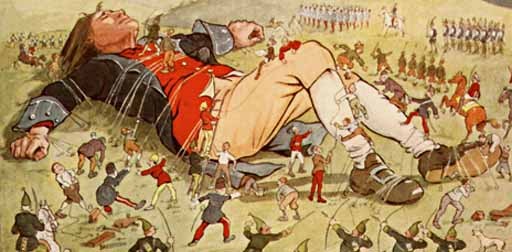
Gullivers-travels

This is a debate we have to have, not just because of the relative decline of America's economic power but because of its accelerating bankruptcy, and the desperate need to find budget savings if we are not going to get the massive Bush tax hike that's been pending since 2001. And yet questioning the value of being a global hegemon doesn't seem to enter into the mindset of those in the pundit-version of the military-industrial complex. Maybe they are too close to it to see the mounting contradictions. Or maybe these arguments are too telling to be countered, rather than just ignored. But the case for American retrenchment is both fiscal and prudential. Christopher Preble:

Some scholars, however, questioned the logic of hegemonic stability theory from the very beginning. A number continue to do so today. They advance arguments diametrically at odds with the primacist consensus. Trade routes need not be policed by a single dominant power; the international economy is complex and resilient. Supply disruptions are likely to be temporary, and the costs of mitigating their effects should be borne by those who stand to lose — or gain — the most. Islamic extremists are scary, but hardly comparable to the threat posed by a globe-straddling Soviet Union armed with thousands of nuclear weapons. It is frankly absurd that we spend more today to fight Osama bin Laden and his tiny band of murderous thugs than we spent to face down Joseph Stalin and Chairman Mao. Many factors have contributed to the dramatic decline in the number of wars between nation-states; it is unrealistic to expect that a new spasm of global conflict would erupt if the United States were to modestly refocus its efforts, draw down its military power, and call on other countries to play a larger role in their own defense, and in the security of their respective regions.

But while there are credible alternatives to the United States serving in its current dual role as world policeman / armed social worker, the foreign policy establishment in Washington has no interest in exploring them. The people here have grown accustomed to living at the center of the earth, and indeed, of the universe. The tangible benefits of all this military spending flow disproportionately to this tiny corner of the United States while the schlubs in fly-over country pick up the tab.

When Doctors Became Torturers

An important new study came out today. It's from the Journal of the American Medical Association about the deep and unethical involvement of CIA doctors and psychiatrists in pioneering torture techniques for the Bush-Cheney administration. Money quote:

The CIA Office of Medical Services

* purported to subject some techniques to "medical limitations," but those claimed limitations imposed no constraint on use of torture, e.g., allowing weight loss up to serious malnutrition, noise up to level of permanent hearing damage, exposure to cold water right up to development of hypothermia, shackling in upright sitting or horizontal position for 48 hours (and longer with medical monitoring);

* placed no medical limitations at all on the use of isolation, hooding, walling, cramped confinement or stress positions except in some cases avoidance of aggravation of pre-existing injury;

* ignored medical and other literature on effects of these forms of torture, and instead cited sources like NIH web site, wilderness manuals and WHO guidelines.

* recognized dangers of certain enhanced methods but nevertheless approved them, e.g., that waterboarding risks drowning, aspiration pneumonia, and laryngospasm; sleep deprivation can degrade cognitive performance, lead to visual disturbances and reduce immune competence acutely; prolonged standing can induce dependent edeme, increased risk for DVT, cellulitis.

These individuals need to be stripped of their medical licenses and prosecuted under the Geneva Conventions. Fat chance under Obama.

Christianism Watch

"And these programs that you mentioned — that Obama has going with Reid and Pelosi pushing them forward — are all entitlement programs built to make government our God. And that’s really what’s happening in this country is a violation of the First Commandment. We have become a country entrenched in idolatry, and that idolatry is the dependency upon our government. We’re supposed to depend upon God for our protection and our provision and for our daily bread, not for our government," – Sharron Angle, where the tea-party and the Chistianist right meet.

The Cordoba Mosque – And Conservatism

800px-2002-10-26_11-15_Andalusien,_Lissabon_182_Córdoba,_Mezquita

This is a defining moment – not just for America but for conservatism as a political philosophy. The campaign to prevent the construction of a Muslim interfaith center two blocks from Ground Zero strikes me as so dangerous in its assumptions, so pernicious in its bigotry, and so dangerous in the war on terror that it needs to be repudiated as swiftly and as powerfully as possible. It is as antithetical to the principles on which this country was founded as the importation of torture into the government of the U.S. Alan Jacobs:

It’s remarkable that people who invoke the Founders so regularly and in such tones of devotion could be utterly deaf to the Founders’ concern to ensure freedom for mistrusted minority religions. They might start by reading George Washington’s once-famous letter to the Newport synagogue, paying special attention to this sentence: “It is now no more that toleration is spoken of, as if it was by the indulgence of one class of people, that another enjoyed the exercise of their inherent national gifts.” In Washington’s understanding, it is misbegotten even to ask the question, “Should we tolerate this?” …

In its origins, with Burke, conservatism was supposed to be about taking the long view, having proper deference to the wisdom of our ancestors and taking proper care for the flourishing of our descendants. This is also what Chesterton meant when he said that tradition is “the democracy of the dead.” Burke thought this long view was most likely to be taken by the aristocracy, but in a society without an aristocracy there needs to be a body of intellectuals who take it as their special mission to meditate on the “first things”, one might say, that link us to those who went before us and those who will come after.

The approach Gingrich and Palin take to the proposed lower Manhattan mosque has nothing to do with conservatism in this sense. It is neither conservative, nor liberal, nor anything else worthy to be called “political thought.” It is an infantile grasping after a fleeting and elusive cultural dominance.

And that, one fears, is what conservatism has become in the new millennium: a paranoid, infantile grasping for cultural dominance – white, evangelical, rural – that is only one part of America, and not the whole, and a minuscule part of the wider world, not its defining hegemon.

A despairing Kevin Drum wonders why some conservatives behave this way. Will Wilkinson has an explanation:

[T]he conservative movement has become obsessed to the point of derangement with a right-wing version of identity politics that sees everything through the lens of the assumption that American identity is under seige. The modus operandi of the populist right is patriotic semiotics gone wild.

It is Reaganism revisited as farce. Conor:

Candidates like Newt Gingrich and Sarah Palin aren’t going to alienate the corporate interests that bankroll so many GOP campaigns, even if certain anti-corporate stances would be popular among Tea Partiers. In order to compensate, they’re going to earn their populist credentials by setting themselves up in opposition to an unpopular religious minority and railing against the mainstream media. Put another way, they’re going to garner the kind of support that won’t require them to actually act against entrenched interests should they be elected. Anyone on the right upset by “politics as usual” should wise up and understand that the candidate who most adeptly exploits culture war issues is going to continue doing so once elected. Can’t we find someone capable of directing ire at unsustainable entitlements instead of Muslim Americans?

Not yet, Conor, not yet.
Why Not?

Hitch writes about his cancer:

In one way, I suppose, I have been “in denial” for some time, knowingly burning the candle at both ends and finding that it often gives a lovely light. But for precisely that reason, I can’t see myself smiting my brow with shock or hear myself whining about how it’s all so unfair: I have been taunting the Reaper into taking a free scythe in my direction and have now succumbed to something so predictable and banal that it bores even me. Rage would be beside the point for the same reason. Instead, I am badly oppressed by a gnawing sense of waste. I had real plans for my next decade and felt I’d worked hard enough to earn it. Will I really not live to see my children married? To watch the World Trade Center rise again? To read—if not indeed write—the obituaries of elderly villains like Henry Kissinger and Joseph Ratzinger?

But I understand this sort of non-thinking for what it is: sentimentality and self-pity. Of course my book hit the best-seller list on the day that I received the grimmest of news bulletins, and for that matter the last flight I took as a healthy-feeling person (to a fine, big audience at the Chicago Book Fair) was the one that made me a million-miler on United Airlines, with a lifetime of free upgrades to look forward to. But irony is my business and I just can’t see any ironies here: would it be less poignant to get cancer on the day that my memoirs were remaindered as a box-office turkey, or that I was bounced from a coach-class flight and left on the tarmac? To the dumb question “Why me?” the cosmos barely bothers to return the reply: Why not?