Putting Sarah On The Couch

Arianna Huffington psychoanalyzes Palin:

It's not Palin's positions people respond to — it's her use of symbols. Mama grizzlies rearing up to protect their young? That's straight out of Jung's "collective unconscious" — the term Jung used to describe the part of the unconscious mind that, unlike the personal unconscious, is shared by all human beings, made up of archetypes, or, in Jung's words, "universal images that have existed since the remotest times." Unlike personal experiences, these archetypes are inherited, not acquired. They are "inborn forms… of perception and apprehension," the "deposits of the constantly repeated experiences of

humanity."

Allahpundit shrugs:

The point, as always, is to reassure fellow hyperpartisans that it’s not the opposition’s policies that voters find appealing but something (anything!) else … You’re going to see a lot of this if she’s the nominee, and it’ll all run along the same lines: Palin’s practicing some sort of witchcraft or hypnosis or unleashing America’s “id,” etc etc, all geared towards insisting that her appeal is, and can only be, operating on a sub-cerebral level. That’s the goal here — to suggest that, because no thinking person could vote for her, this is all playing out somehow in America’s subconscious. Credit to Arianna for framing it in terms of Jung, at least. Most of the lazier pieces you’ll see in this vein, and there’ll be many more, will stick with Freud.

What policies? The point here is that Palin's incoherent, whatever-sounds-good-right-now, whatever-hurts-Obama streams of consciousness have nothing to do with policy. They have to do with identity, with visceral issues of national meaning, and with the starbursts factor of a beauty queen as war-leader. Her appeal is sub-rational in a party that is irrational.
Bloomberg’s Finest Hour

Fallows' judgment:

Apart from the lofty sentiments, I love the plain "That's life" — part of the thick-skinned, no-nonsense realism that Americans like to think exemplifies our culture, but doesn't always. Nothing is more admirable about this country in the rest of the world's eyes than the big-shouldered unflappable confidence demonstrated in that speech. Nothing is more contemptible than the touchy, nervous, intolerant defensiveness we sometimes show. 

The GOP’s Fiscal Fraudulence

Clive Crook's succinct summary:

Paul Ryan is a good thing, and his Roadmap is very interesting. He is grappling with specific proposals, and his plan for long-term entitlement reform deserves a serious look. Note, though, that on plausible assumptions, it is not a deficit-reducing proposal: revenues would fall even more than spending.

More to the point, the party is not backing Ryan's proposals. If conservatives who say, "Don't raise taxes, cut spending," were willing to contemplate Ryan's approach to entitlement reform, well and good. Few are. The party as a whole is scared of it. Republicans in Congress understand how difficult it would be to get the country behind it. (If George Bush's plan for Social Security privatisation, timid by comparison, got shot down, what hope is there for Ryan's ideas?) Right now the party's position is to reject every meaningful spending cut and any and all tax increases. That is not fiscal responsibility. It is complete nonsense.

Quote For The Day

WTCEricThayer:Getty

“In the mid-1650s, the small Jewish community living in lower Manhattan petitioned Dutch governor Peter Stuyvesant for the right to build a synagogue, and they were turned down. In 1657, when Stuyvesant also prohibited Quakers from holding meetings, a group of non-Quakers in Queens signed the Flushing Remonstrance, a petition in defense of the right of Quakers and others to freely practice their religion. It was perhaps the first formal political petition for religious freedom in the American colonies, and the organizer was thrown in jail and then banished from New Amsterdam.

“In the 1700s, even as religious freedom took hold in America, Catholics in New York were effectively prohibited from practicing their religion, and priests could be arrested. Largely as a result, the first Catholic parish in New York City was not established until the 1780s, St. Peter's on Barclay Street, which still stands just one block north of the World Trade Center site, and one block south of the proposed mosque and community center….

Whatever you may think of the proposed mosque and community center, lost in the heat of the debate has been a basic question: Should government attempt to deny private citizens the right to build a house of worship on private property based on their particular religion? That may happen in other countries, but we should never allow it to happen here.

This nation was founded on the principle that the government must never choose between religions or favor one over another. The World Trade Center site will forever hold a special place in our city, in our hearts. But we would be untrue to the best part of ourselves and who we are as New Yorkers and Americans if we said no to a mosque in lower Manhattan.

Let us not forget that Muslims were among those murdered on 9/11, and that our Muslim neighbors grieved with us as New Yorkers and as Americans. We would betray our values and play into our enemies' hands if we were to treat Muslims differently than anyone else. In fact, to cave to popular sentiment would be to hand a victory to the terrorists, and we should not stand for that," – mayor Mike Bloomberg, fighting back against the disgraceful Republican efforts to exploit and foment restrictions on religious liberty.

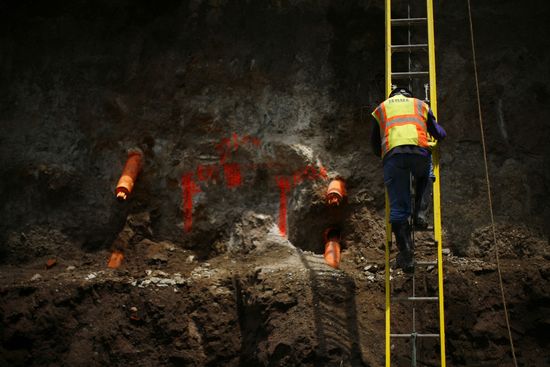
(Photo: A man climbs a ladder as workers continue construction on the World Trade Center site in July 15, 2010 New York City. Construction at the site is expected to be completed by 2013. By Eric Thayer/Getty Images.)

The Prop 8 Decision, Ctd

Bmaz at Emptywheel is expecting a win for the plaintiffs:

Walker is very detailed and very smart and crafty. He will lock in and protect his decision to every extent he can, and trust me Walker is very good at this. One of the best I have ever seen. Ted Olson, David Boies, Plaintiffs Perry et. al and fans of Constitutional equality everywhere could not ask for anything more.

We'll know this afternoon.

Climbing The Ladder

Dylan Matthews looks at American income mobility:

The U.S. does not come out the worst here; Italy and Great Britain have sharper class divisions than we do. But most other countries do substantially better. This includes not just Scandinavian social democracies like Denmark, Norway, and Finland (Sweden, curiously, does a bit worse) but Anglophone states such as Canada and Australia, with which the U.S. has much more in common.

The War Against Wikileaks

Scott Horton watches the government's maneuvering. He poses a question:

Few functions are so fundamental to a democracy as the decision about when and how to wage a war. That decision means an investment of treasure and blood that can affect the lives of hundreds of millions in America and elsewhere. In this process, fair presentation and discussion of the facts is essential to a correct result. If information can be routinely suppressed because it is embarrassing to political leaders or would undermine the arguments they make to the nation, then our democracy is faltering. In the wake of these disclosures, Americans should carefully judge the conduct of those who claim that suppressing the leaks is in the interests of national security. Are they upholding national security, or are they betraying American democracy?