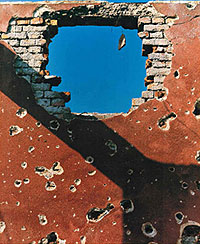
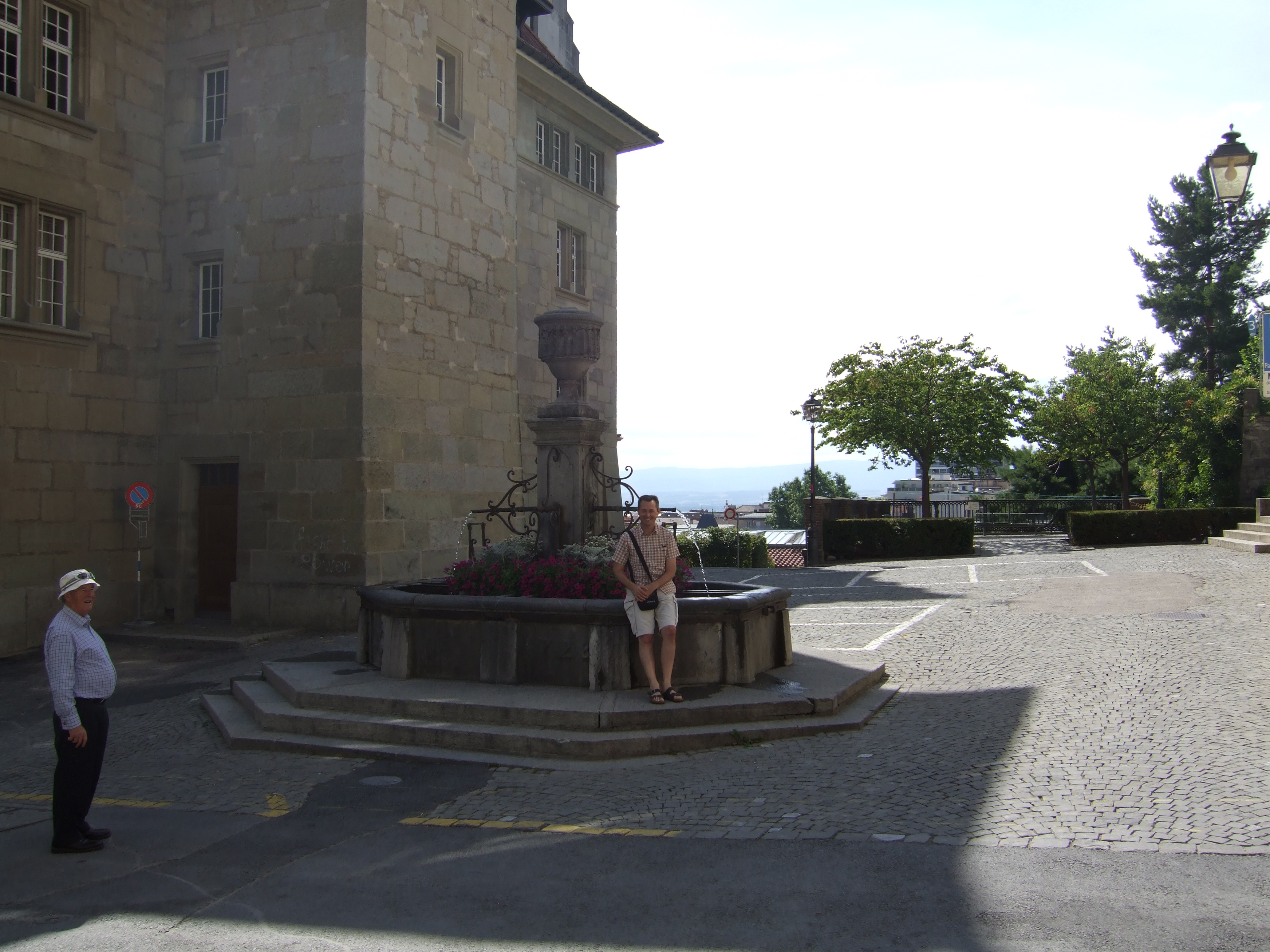
The wrong house; two orphans.
Month: August 2010
Drones Over Iceland? Ctd
Michael Scherer takes the time to rebut Thiessen:
To be clear, Assange's crime, according to Thiessen, is intentionally receiving and republishing classified information, something that is done with some regularity in the United States by respectable and responsible reporters working for top flight news organizations. To adopt Thiessen's view, one would effectively have to reject the Supreme Court's opinion in New York Times Co. v. United States, the so-called Pentagon Papers case from 1971.
Quote For The Day III
"Now, look. I am not exactly an apologist for J Street. But put the merits of J Street aside. Rubin's charge is that the group is a front for "pro-Muslims." Why? Because it favors religious freedom for American Muslims. Rubin does not charge the group with advancing some objectionable principle — Jihad, America-hatred, or whatnot. She accuses J Street of favoring an objectionable group, Muslims. In her mind, you are either for us or you are for them. The notion that certain principles — say, religious freedom — might be good for both us and for them is beyond the scope of her consideration. Indeed, the notion that Americans of all backgrounds deserve equal consideration is utterly foreign to her. In this sense, the current Commentary writers are fitting heirs to the legacy of Podhoretz's descent," – Jon Chait.
It has always seemed to me that this war against al Qaeda is a war for religious freedom, and ultimately for the separation of church and state. It is al Qaeda's psychotic conflation of politics and religion that we fight, not their religion itself. But these are very abstract things for anyone to fight for, to identify with emotionally and viscerally. And so, even when we start with good intentions and clear minds – we are fighting not Islam but Islamism, not religion but theocracy – we can soon simply drift and degenerate into more primitive associations.
What we've been watching from Palin to Gingrich is an exploitation of this human degeneracy, or in the ADL's case, sheer liberal cowardice in the face of tribalism. Even now, Gingrich and Palin fail to understand that rhetorical polarization may be good politics but it is terrible statesmanship in a war of ideas as well as physical combat. It's a long war that will only be won in the minds of most Muslims, which is why how we act remains of importance. Yes, the human psyche will make easy and common and hard-to-resist associations between a religion and an act of war by the most deranged and nihilist members of that religion.
But resisting it is what makes us decent. And to be, at a minimum, decent is, to my mind, the core aspiration of Anglo-American political morality.
Banning The Burqa Is Wrong. But We Must Do It.
In a piece reported from Turkey, Claire Berlinski changes her mind about a prohibition against a type of Islamic dress, arguing that to ban the burqa "is an offense to liberty; not to do so is a greater one." I disagree; but I have to say her piece is one of those rare moments when you see both sides in extreme clarity.
Manzi vs Kleiman
Jim ably dispatches some salient challenges. But there is a concept in this crucial conservative distinction between theoretical and practical wisdom that has been missing so far: individual judgment. A social change can never be proven in advance to be the right answer to a pressing problem. We can try to understand previous examples; we can examine large randomized trials; but in the end, we have to make a judgment about the timeliness and effectiveness of certain changes. It is the ability to sense when such a moment is ripe that we used to call statesmanship. It is that quality that no wonkery can ever replace.
It is why we elect people and not algorithms.
The 20th Billion Tweet
The Guardian documents it:
Batty writes that it took Twitter four years to see its first 10 billion Tweets but just the past five months to see the next 10 billion.
Read Write Web is a little underwhelmed:
It would be nice to know what percentage of those Tweets were sent by humans, and what percentage by robots, RSS feeds, Tweeting houseplants in need of watering and marketing sleazebags who re-Tweet reputable blogs’ feeds automatically to give credence and cover to their occasionally original in-stream advertisements.
The tweet itself was a little incomprehensible, if not eerily instructive of the entire medium:
“So that means the barrage might come back later all at once.”
Words for the ages.
The View From Your Window Contest: Winner #9
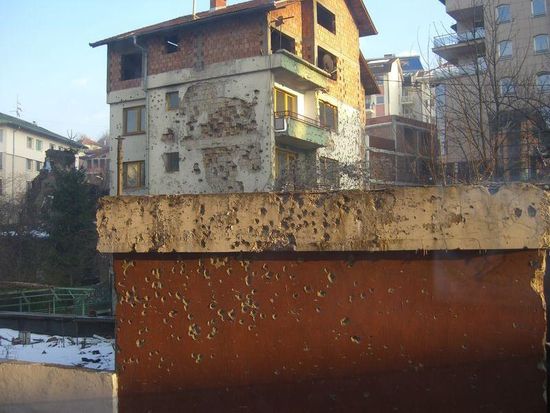
This week’s contest was quite a bit easier than last week’s. A reader writes:
OK, this is now getting fun. I see snow on the ground, so it has to be somewhere cold enough in July to hold that kind of precipitation. I don’t believe there is much snow in anything habitable or urban right now in Europe, which would be my first guess given the architecture (new and old) and bullet-spangled buildings. So I want to shift to the southern hemisphere as I do not believe this is anything Himalayan or former-Soviet. There is only one country I can think of with similar architecture, flora, and weather and that is South Africa. I’ll go with Cape Town.
The snow is a red herring; the photo was taken in the winter (though emailed to us in July). Another writes:
The snow on the ground eliminates a lot of possible locations (it ain’t Africa, Iraq, Lebanon, the West Bank, etc.), and the location is hilly as well. I have to think it’s in the former Yugoslavia, and I’m going to go with Pristina, Kosovo.
Another:
Grozny, Chechnya? Looks like heavy gunfire pretty recently with time to rebuild. Snow on ground shifts time of year from present, but that’s my guess.
Another:
This was difficult (as usual), but I’ll put my money on Tskhinvali
in South Ossetia. My initial guesses (based on the bullet-ridden wall) were Kosovo, Chechnya or South Ossetia. The buildings suggest Eastern European/Caucuses-region architecture. There are a few modern apartment complexes in view, so I discounted the possibility that it would be Chechnya (which was heavily damaged and impoverished after the conflict). The fact the main building still remains damaged suggests that any conflict was recent (so discounting Kosovo). The only town in South Ossetia that could be as built-up as this picture suggests is Tskhinvali.
Another:
Tskhinvali? Obvious bullet holes first made me think of Africa, then I saw the snow. The buildings seemed to represent Georgia better than the Balkan damage of the last decade.
P.S. I’m not just participating for a copy of the book; I teach 7th grade Social Studies and have offered a reward if any of my former students wins the contest before I do. So my reputation amongst “my minions” is at stake.
Another:
I was going to guess the Republic of Georgia, but something made me change my mind. I’m going to move a little westward and guess Turkey. The picture brought to mind the novel “Snow” by Orhan Pamuk, so I’ll go ahead and guess the city that the novel takes place in: Kars, Turkey. Can’t wait to find out I wasn’t even on the right continent.
Not the right continent. Another:
This is a depressingly common sight in Croatia and Bosnia fifteen years after the last shots were fired, too common for me to make anything more than a wild guess of which town or city this house stands in. Unfinished three- or four-story houses are another all-too-common sight in this land of big dreams and poor planning. My guess is Karlovac, Croatia.
Another:
Tropoje, Albania? Clearly European architecture. Impacts indicate ordinance less than .50 cal. The size and disposition of the houses indicates a city less destroyed than one would expect in Chechnya, and greater in population than what one finds in South Ossetia. I don’t think the caliber weapons and the type of engagement indicated thereby fit with either of those either. Tropoje is a guess based on the assumption of a conflict related to Kosovo.
Another:
My best guess is somewhere in Bosnia & Herzegovina. Sarajevo fits the bill, but that is too obvious. You like your views a little wonky. Tuzla was a major flash-point in the ethnic wars of the former Yugoslavia and very close to Serbia, making it my best guess.
Another:
Srebrenica immediately came to mind when I saw the photograph, so this a gut-feeling guess.
Another:
Because everyone and their mother is going to guess Sarajevo, I’m going with Germany, East Berlin.
Everyone and their mother were correct. The following is the most impressive entry we received (and since the reader also correctly guessed Lausanne last week, he doubly deserves this week’s prize of a Blurb window book):
Oof, this is much harder to pin to down than last week. OK, start with clues:
Bullet holes = former war zone, recent enough to have not been fully repaired
New buildings in mid- and background = war over sufficiently long enough for some rebuilding
Snow on ground and pitched roofs = somewhere it snows/rains regularly
Architecture = EuropeSo we’re clearly in the Balkans, and either in Kosovo or Bosnia – Dubrovnik and Osijek (the
main Croatian towns that might still have war damage) would not, I’m guessing, have this kind of dense modernist residential area. A Google search for “bullet holes Sarajevo” returns this photo of a mortar-damaged wall, taken in 1997 by Masaki Hirano, that has the same colour paint as the wall in the contest photo. Photos of Pristina suggest different architecture (also, the fighting in Kosovo lasted for a much shorter time, making it, I guess, less likely that there would be extensive damage to non-strategic residential areas – no siege, so no entrenched front lines). Then, with a little more digging, I found this photo – of the same building, taken from a different angle. Unfortunately, the blog post isn’t entirely clear where it’s of – could be Sarajevo or Mostar – but based on the Hirano picture, I’m going to go with Sarajevo, Bosnia as this week’s answer.
Unfortunately, having never been there, I don’t know the city well enough to figure out the exact location on Google maps. I also have never asked anyone to marry me there, nor do I have time to get there and back for a photo before Tuesday. However, if it swings the prize my way, I can link the city to Kevin Bacon in three moves:
1) The 2007 film, The Hunting Party, directed by Richard Shephard, starred Richard Gere as Simon Hunt, a TV journalist who goes into a downward spiral reporting on the Bosnian war
2) In 1990, Richard Gere starred in Pretty Woman alongside Julia Roberts
3) Julia Roberts appeared alongside Kevin Bacon in the film Flatliners, also released in 1990.Gotta be worth a try, right?
Well worth one. Some honorable mentions:
Sarajevo? This is the best I’ve felt so far regarding the contest, but there is no way I can compete with folks who actually travel to or google map the exact location to the actual coordinates. Gosh, you would think Dish readers could find Bin Laden if you made it into a contest!
Another:
This is clearly from one of the war-torn countries of the Balkans. I was in Bosnia last summer, and this photograph definitely remind me of Sarajevo, where the “Sarajevo roses” – holes in the sidewalk from mortar shells that have been filled in with red paint – are next to gleaming new buildings, which in turn are side-by-side with buildings covered with bullet holes, even to this day, 15 years after the war ended.
Another:
The bullet holes in the concrete wall make me think of this video of Russian dissident, writer and crackpot Eduard Limonov hanging with accused war criminal Radovan Karadzic and firing rounds from a sniper rifle into Sarajevo. So that’s my guess.
From the YouTube caption:
Episode from “Serbian Epic”, by Pawel Pawlikowski and Lazar Stojanovi?, 1992. Evidence exhibit at the Hague International War Crimes Tribunal, ICTY
The Power To Form A Family
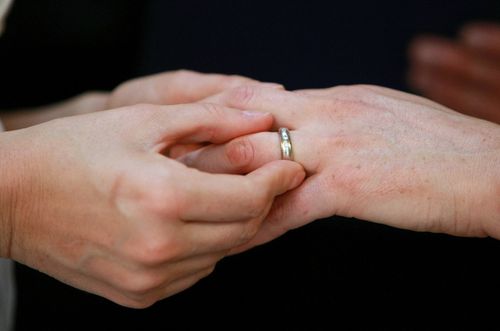
TNC compares bans on interracial marriage to prohibitions against same-sex marriage:
Banning interracial marriage meant that most black people could not marry outside of their race. This was morally indefensible, but very different than a total exclusion of gays from the institution of marriage. Throughout much of America, gays are effectively banned from marrying, not simply certain types of people, but any another compatible partner period. …
A more compelling analogy would be a law barring blacks, not from marrying other whites, but effectively from marrying anyone at all. In fact we have just such an analogy. In the antebellum South, the marriages of the vast majority of African-Americans, much like gays today, held no legal standing. Slavery is obviously, itself, a problem–but abolitionists often, and accurately, noted that among its most heinous features was its utter disrespect for the families of the enslaved. Likewise, systemic homophobia is, itself, a problem–but among its most heinous features is its utter disrespect for the families formed by gays and lesbians. Of course African-Americans, gay and straight, in 1810 lacked many other rights that gays, of all colors, today enjoy. Thus, to state the obvious, being born gay is not the same as being born a slave. But the fact is that in 1810, the vast majority of African-Americans–much like the vast majority of gays in 2010–lacked the ability to legally marry.
(Image by Justin Sullivan/Getty)
Quote For The Day II
"I think you're on to why the 'Tea Party' was created, i.e. to give conservatives a way to rally with the Republican brand name in ruins, nothing more. They're the Altria of politics," – A commenter at TPM.
The Republican Who Gives Me Hope
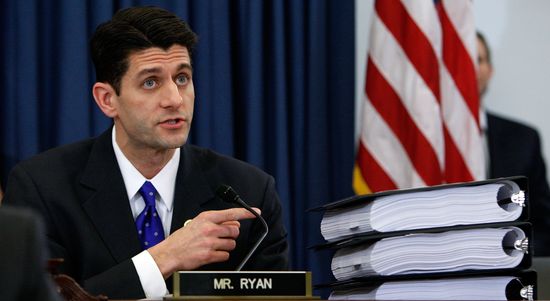
Because, regardless of whether you agree or disagree, he's being intellectually honest about the debt and entitlements, even if he is far too utopian in seeing a viable political majority for his vision. And because he seems unafraid to put real, adult fiscal conservatism to the people:
Ryan said he does not think that voters would punish the GOP for shunning attack politics and for speaking plainly about the country's problems. He notes his own political success: He won reelection in 2008 with 62 percent of the vote despite coming from a district and a state that voted for Obama.
"It's really important, I think, not to run campaigns on some vague platitudes and rip down the other party, to hopefully win an election by default," he said. "You have to win an election by acclamation, by aspiration, by telling people who you are and what you are going to do, and then go do it once you get there."
If the GOP wins the House, as I assume they will, Ryan really will become a critical figure, it seems to me. He'll be the Chairman of the Budget Committee – and one of six members of the president's Debt Commission. If he can resist the enormous partisan pressure against bipartisan compromise and intellectual honesty, he will be the unlikely hinge in one of the most critical moments in American economic and fiscal history.
Can Ryan keep his nerve?
And does Obama have the integrity to force the Democrats to get real on Medicare as well?
And can they form an alliance against the reactionary wings in both parties?
(Photo: Alex Wong/Getty.)
 The Dish