Lies To Cover Up The Truth

by Zoe Pollock

Andrew O'Hehir reviews "A Film Unfinished," a documentary on the partially staged Nazi propaganda film shot in the Warsaw Ghetto in 1942:

You might view "A Film Unfinished" as an exploration of the film-theory idea that movies always embody lies and the truth at the same time. The fact that Nazis compelled well-dressed Jews to walk past dead bodies, over and over again, or forced groups of men and women to strip naked and plunge into the mikvah, or ritual bath, in front of the cameramen exposes the regime's cruelty and cynicism.

But those dead people were really dead, and the anguish and humiliation we see on the face of one of those naked women in the bath speak loudly and clearly and directly to the heart, across all that time and history and death. It's a truism to say that history always teaches us about the present, but the lessons of "A Film Unfinished" may be useful the next time you hear someone ranting about the "ground zero mosque." "Das Ghetto" sat on the shelf because its lies were insufficient to cover up its truth, and because even the most evil works of propaganda always reveal more about its creators than they want you to see.

My former coworkers, the team behind The PBS NewsHour's Art Beat, spoke to the filmmaker here.

“Straight Man’s Burden”

by Zoe Pollock

Jeff Sharlet reports from the front lines of Uganda's political anti-gay persecutions. Sharlet interviews the people behind Uganda's Fellowship movement and its roots in and ties to the American evangelical movement, the Family. It's behind the pay wall but it's pretty scary stuff:

Every year, right before Uganda's Independence Day, the government holds a National Prayer Breakfast modelled on the Family's event in Washington. Americans, among them Republican Senator Jim Inhofe of Oklahama, former attorney general John Ashcroft – both longtime Family men and outspoken antigay activists – and Pastor Rick Warren, are a frequent attraction at the Ugandan Fellowship's weekly meetings. "He said homosexuality is a sin and that we should fight it," Bahati recalled of Warren's visits.

Inhofe and Warren, like most American fundamentalists, came out in muted opposition to Uganda's gay death penalty, but they didn't dispute the motive behind it: the eradication of homosexuality. The may disagree on the means, favoring a "cure" rather than killing, but not the ends.

Missal Fire

by Zoe Pollock

Get Religion dissects the AP's coverage of the revised Roman Missal, the Catholic prayer book that will feature some new English translations by noting that:

Arguments about sex will stir things up, but if you really want to touch people at the local level all you really need to do is change their prayer books and hymnals.

Life Of Leisure

by Zoe Pollock

Alex Jung interviews Thomas Geoghegan, a labor lawyer in Chicago and author of "Were You Born on the Wrong Continent?: How the European Model Can Help You Get a Life." He makes a pretty convincing case for moving to Germany:

Why do we work so much in the first place?

There aren’t any historical or cultural reasons for it. Americans had more leisure time than Europeans back in the 1960s. I would say if you did a survey of most people who are in their late 50s or 60s, they will tell you that they take fewer vacations than their parents did. Now why did that change? It wasn’t because of the Pilgrims. People work hard in America, but there was a period where leisure time was increasing. I quoted Linda Bell and Richard Freeman in an article they wrote about what happened during the ‘90s. There was nobody to stop you from working longer. There was no government check, there was no union check as there is on excessive work as there is in Germany or elsewhere in Europe. These institutional checks are gone. So people feel like lab rats: "If I work an extra 10 minutes over the person in the cubicle next to me, then I’m less likely to get laid off." It’s a very rational response…

Nostalgic For A Time That Never Was

 
Future2

by Patrick Appel

Deep Glamour interviews Matt Novak, the proprietor of  Paleofuture. Novak:

Nostalgia as a symptom of fear is far too broad of an idea, and frankly I regret saying it so matter of factly. There is an important distinction I feel that we should make between personal nostalgia and societal nostalgia. Personal nostalgia is that smell of your first teddy bear or the feeling of your first kiss. Personal nostalgia is a wonderful part of the human experience. But I feel that personal nostalgia is anecdotal and thus dangerous when used as ammunition to describe this desire to return to a "better time." I find that more often than not, the time and place that society is nostalgic for never existed. Romanticizing the past, while perfectly fine when applied individually, can stifle progress.

Image from NASA Ames Research Center.

Memory Wall

by Zoe Pollock

Last weekend I finished Anthony Doerr's recent collection of stories, "Memory Wall." It's a breathtaking book, not only for the range of stories it tells and the near-perfect writing, but for its ability to capture memories and how we spend our entire adult lives reliving them. In one of my favorite passages, near the end of "Afterworld," the grandson of the protagonist takes his newly adopted Chinese sisters to play in the snow for the first time:

Every hour, Robert thinks, all over the globe, an infinite number of memories disappear, whole glowing atlases dragged into graves. But during that same hour children are moving about, surveying territory that seems to them entirely new. They push back the darkness; they scatter memories behind them like bread crumbs. The world is remade.

In the five days Robert will be home his sisters will learn to say "rocks," "heavy," and "snowman." They'll learn the different smells of snow and the slick feel of a plastic sled as their brother drags them down the driveway.

We return to the places we're from; we trample faded corners and pencil in new lines. "You've grown up so fast," Robert's mother tells him at breakfast, at dinner. "Look at you." But she's wrong, thinks Robert. You bury your childhood here and there. It waits for you, all your life, to come and dig it back up.

Attending To Him

by Zoe Pollock

A South African pastor has drawn criticism for preaching AIDS awareness, getting tested in front of his congregation (along with 100 others from his township) and delivering a sermon "Jesus was HIV-positive." In an interview the pastor stands by his sermon:

In many parts of the Bible, God put himself in the position of the destitute, the sick, the marginalised. When we attend to those who are sick, we are attending to him. When we ignore people who are sick, we are ignoring him.

Rationality And Well-Being

by Zoe Pollock

The eternal fight over religion and rhetoric was reignited this week, fueled by the basic question: should atheists should be nicer? Quinn O'Neill at 3QD voted for moderation:

Let’s assume that the value of reason ultimately lies in its ability to improve well-being.  Reason and empiricism have brought us great scientific discoveries, lifesaving medicines, and technologies that make our lives longer and healthier.  It’s undeniable that rationality can improve well-being.

It might seem, given these benefits, that improving rationality would improve well-being.  But irrationality has its perks.  Delusions can provide comfort.  They can give us confidence, hope, or a sense of purpose.  Superstitions can improve athletic performance, and psychics and astrologers can help people deal with the discomfort of not knowing what the future holds.  The most rational objective, then, is not necessarily to have everyone be completely rational but rational to the extent that optimizes well-being.  

Phil Plait's lecture, "Don't Be A Dick" which Quinn references, is now online, wherein he writes he wasn't specifically reprimanding people like Richard Dawkins or PZ Myers:

It was aimed at everyone, everywhere, and also inward toward myself. I cannot accuse others of that which I have not at the very least searched for in myself. And I have indeed found it in myself, which was the final factor in my making the speech in the first place.

PZ Myers rebutted using his own heart trouble this week as an allegory about the importance of skepticism:

Denial is so tempting: the appeal of choosing ignorance to avoid hard consequences was something I felt strongly — it would have been so nice to go home and pretend there were no problems, and I probably would have been just fine, on the surface. But the heart disease would have continued to progress, and a problem deferred would have become a problem amplified.

That is the virtue of dickishness. It provides the social and psychological penalties that counter the draw of complacency. It's so easy to go with the flow, to pretend that a thousand issues, whether it's homeopathy or religion or transcendental meditation or an absence of critical thinking or a lack of concern about our health, are OK because they make people happy, and it's even easier to demonize the cranky Cassandras and make them the problem, because they make people uncomfortable.

But if bad ideas don't have immediate consequences to the placid mob, and if everyone is being Mr and Mrs Nice Folk and reassuring everyone that they're still good people no matter what foolishness they might believe in, where is the motivation to change? A skeptic who thinks their mission is to provide only positive messages and lead everyone along with affirmations and friendliness is going to be an ineffective skeptic.

Everything Is Illuminated

Untitled-ultraviolet-7

by Zoe Pollock

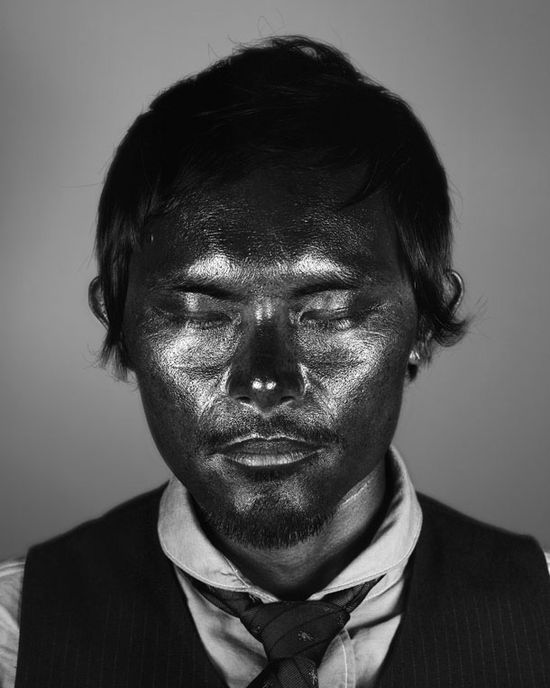
New York based Photographer Cara Phillips describes her latest project, Ultraviolet Beauties:

Many medi-spas and dermatologists take reflective ultraviolet photographs to show patients their ‘future’ skin. Even though there is no guarantee that this unseen damage will ever appear, beauty professionals and doctors still use these images to sell treatments to their clients and patients… The idea was to offer pedestrians a chance to see their possible future and reconsider the fear of flaws.