ScienceBlogs Goes To War

In Sunday's NYT Magazine Virginia Heffernan dinged the twenty-odd science bloggers to leave ScienceBlogs over the drama now called PepsiGate. Money quote:

Clearly I’ve been out of some loop for too long, but does everyone take for granted now that science sites are where graduate students, researchers, doctors and the “skeptical community” go not to interpret data or review experiments but to chip off one-liners, promote their books and jeer at smokers, fat people and churchgoers? And can anyone who still enjoys this class-inflected bloodsport tell me why it has to happen under the banner of science?

David Dobbs of Neuron Culture counters:

I hope readers understand that just because the science blogosphere is uneven and chaotic and cacophonous, it does not mean that it lacks high-quality material. The MSM is also uneven and cacophonous, but the best of it is good indeed.

Heffernan answers Dobbs in the comments. Apparently she isn't a big fan of blogging in general:

With notable exceptions, blogging, as a form, seems to me to have calcified. Many bloggers who started strong 3-5 years ago have gotten stuck in grudge matches. This is even more evident on political blogs than on science blogs. In fact, after being surprised to find the same cycles of invective on ScienceBlogs that appear on political blogs (where they’re well documented), I started to think the problem might be with the form itself. Like many literary and art forms before it (New Yorker poetry, jazz, manifestos) blogs may have had a heyday – when huge numbers of people were inspired to make original contributions – before, seemingly all at once, the moment is gone. Some people keep doing it, and doing it well, but the wave of innovation passes, and the form itself needs new life. (Twitter? Tumblr?)
Living Wills And Living Deaths, Ctd

A reader writes:

I sent you the email regarding my 88 year old father-in-law. Here is some additional information.  When my wife made the decision to let him go, the physician from his medical group that was stationed at the hospital told my wife that the process was that they would move him to a private room, leave in the breathing machine but removing the feeding tube and let him starve to death.  She said that process could take up to two weeks.  That would have been a terrible burden for my wife and 90 year old mother-in-law, who suffers from dementia.  My wife insisted that the medical group assign a new physician (for this and other reasons), which they did.
 
By the way, we got the bill a month later.  For a 14 day stay, it came to $516,779.34.

Another reader:

Catholic teaching about end-of-life issues is often misunderstood.  From the catechism:

2278 Discontinuing medical procedures that are burdensome, dangerous, extraordinary, or disproportionate to the expected outcome can be legitimate; it is the refusal of "over-zealous" treatment. Here one does not will to cause death; one's inability to impede it is merely accepted. The decisions should be made by the patient if he is competent and able or, if not, by those legally entitled to act for the patient, whose reasonable will and legitimate interests must always be respected.

2279 Even if death is thought imminent, the ordinary care owed to a sick person cannot be legitimately interrupted. The use of painkillers to alleviate the sufferings of the dying, even at the risk of shortening their days, can be morally in conformity with human dignity if death is not willed as either an end or a means, but only foreseen and tolerated as inevitable Palliative care is a special form of disinterested charity. As such it should be encouraged.

If the Englaro case involved death by starvation ("withdrawing essential nutrients"), other considerations come into play. Starving a person does not exactly result in death with dignity. The alternative is active euthanasia, which is abhorrent to me (and the Church).  It's a no win situation. Some situations just don't have an easy or agreeable solution.

The Bummer Summer

Says it all, really:

Gpe2ey9mxeyst7u4tcutpa

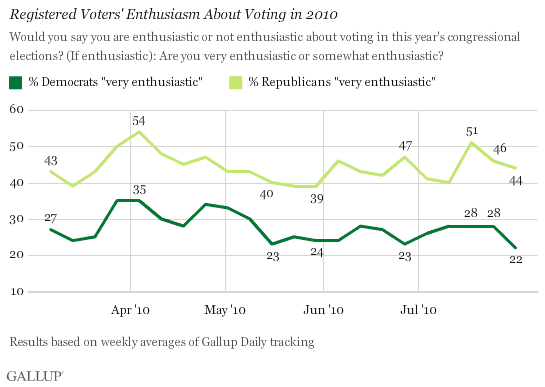
Barring some August surprise, this is largely set till September. Here's what I think has not been factored in: the president has barely begun to make his case for his first year and a half. The case is much stronger on fundamentals, in my view, than is now believed. I don't doubt that the GOP will do well this fall. What i do doubt is that it's based on anything more than protest in an amnesiac era of no good choices, and almost no margin for error either.

Drones Over Iceland? Ctd

He is quite literally arguing that the power of the US government to prohibit the disclosure of information that it – and it alone – designates as sensitive is strongest when the person making the disclosure is neither an American citizen nor a resident of the US.  Think about that for a moment.  Then think about the cognitive dissonance involved in Thiessen simultaneously decrying the injustice of and impropriety of other countries’ attempts to pass “laws of universal jurisdiction.”

The Gangs Of Iraq

Joel Wing studies them:

Organized crime has seen a steady expansion in Iraq since the 1970s. At first, gangs were organized by the Baath Party to steal from the government. Then Saddam came to depend upon them to break the U.N. sanctions. The U.S. invasion increased the opportunities and incentives to partake in crime, and those have hardly changed up to the present time. The Iraqi government still does not consider this a major issue, and many officials are corrupted themselves either being directly involved in crimes or getting payoffs to look the other way. There’s no other way that such large-scale criminal activity could continue without it. Until the economy improves, the government gains more strength, and there’s a real concerted effort to fight corruption gangs and crime will continue to flourish in Iraq.

Big Brother On The Web

Julian Sanchez expounds on the digital power grab: 

The Obama administration and the FBI's demand that Congress approve a huge expansion of their authority to obtain the sensitive Internet records of American citizens without a judge's approval is a brazen attack on civil liberties. … We increasingly live online. We flirt, shop, read, speak out, and organize in a virtual space where nearly every action leaves a digital trace — and where those breadcrumb bits often track us through the physical world as well. If the Obama administration gets its way, an agency that has already proved itself utterly unable to respect the limits of its authority will have discretion to map our digital lives in potentially astonishing detail, with no judge looking over their shoulders. That the administration and the FBI would seek such power under the guise of a “technical clarification” is proof enough that they cannot be trusted with it.

(Hat tip: E.D. Kain)