Face Of The Day

  IsraelUrielSinaiGettyImagess

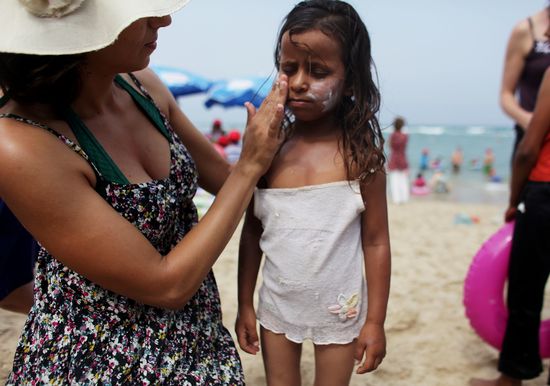
An Israeli woman rubs sunscreen on a Palestinian girl from the West Bank village of Jahalin as they spend the day at the beach on August 2, 2010 in Bat Yam, Israel. A group of Israeli women organize a weekly visit for Palestinian children from all over the West Bank to the the Israeli seaside, for most of the children this is the first time they get to the beach. By Uriel Sinai/Getty Images.

The Myth Of True Social Knowledge

City Journal has an excerpt from Manzi's forthcoming book. He focuses on the limits of social science:

At the moment, it is certain that we do not have anything remotely approaching a scientific understanding of human society. And the methods of experimental social science are not close to providing one within the foreseeable future. Science may someday allow us to predict human behavior comprehensively and reliably. Until then, we need to keep stumbling forward with trial-and-error learning as best we can.

Abortion And Slavery, Ctd

Ta-Nehisi and Megan tackled this topic a while back. Here's TNC:

Slave-masters often allowed–indeed encouraged–slaves to engage in acts common among people. Slaves married. Slaves were baptized. Slaves were converted to attend Christianity–and even attended white churches, at times. Slaves and masters exchanged gifts on Christmas. Slaves were allowed to hire themselves out and buy their own freedom. Slaves were manumitted by masters. The point is that what you see in all of that is something more complicated than "Are Africans people?" The better question seems to be "Are black people equal to whites?"

But more than that, core reason an abortion/slavery comparison falls down lay in the actions of the enslaved, versus the inability of action amongst embryos.

Abortion is a debate between two groups over the ultimate fate of embryos.  The Anti-Slavery fight was a violent struggle between two groups over the fate of the enslaved, but with the enslaved as indispensable actors. Unlike embryos, black people were very capable of expressing their thoughts about their own personhood, and never held it in much doubt. Whereas the fight against abortion begins with pro-lifers asserting the rights of embryos, the fight against slavery doesn't begin with the abolitionists, but with the Africans themselves who resisted.

The Chinese Century

It's their turn, after all. And they've been around a great deal longer than the US. Frum on the historical context:

European history extends a long way back: Cro-Magnons were painting caves 25,000 years ago, Celts were making good-looking swords and pots a thousand years before Christ, and the Parthenon is near as old as Confucius.

But here’s the difference between Europe and China, and it takes considerable adjustment to absorb all the implications of this difference.

The_Reception The history of Europe is driven by sharp discontinuities of period and self-conscious distinctions between peoples … But with China, there really is no choice: You have to study the whole damn thing to understand any of it.

That is not to say that “China” is an unchanging unity. It’s startling to think that through most of the period covered by this volume, tea was regarded as a medicine, rice as an unusual addition to the diet. Over the centuries, the Chinese would worship different gods in different ways. Buddhism would come and then (largely) go. Spoken languages would arise and vanish, the written characters would change their shapes and meaning. Nor was this change always gradual. Chinese history would be punctuated with catastrophes as terrible as the fall of Rome and the Black Plague: millions of people could die in the tumult that accompanied the end of a dynasty.

And yet notwithstanding all that: a literate Chinese of the year, say 1850 lived in a mental universe much more similar to that of a Chinese of 2000 years before than did a literate Englishman of the year 1850 a literate Englishman of the year 1750.

There's much more here. (Details for illustration here.)

Time’s Cover, Ctd

A reader writes:

That photograph is open to a multitude of interpretations. Time clearly has set this up as: "Look what will happen if we leave."  But I look at that picture and think to myself, "What can we possibly hope to accomplish there?"

This girl's face isn't a warning about the consequences of withdrawal. It's a tragic reminder of the futility of the United States' efforts in Afghanistan. After all, this girl was not maimed before the American occupation. She was assaulted during the occupation, when NATO forces were spread out all over the country fighting pockets of Taliban and al Qaeda dead-enders.

This photograph just reminds me that we can put any number of troops on the ground and we still won't be able to change a thing about the culture of Afghanistan. It's a stark, tribal, medieval place in a lot of ways. We need to have a little bit of humility and realize that the world is a big, complicated place and we can't afford to spend billions of dollars and thousands of lives trying to impose our cultural values and our version of civil society on people who have no history of accepting such an imposition nor any interest of doing so.

Another writes:

The largely South Asian practice of maiming, mutilating and murdering women for not living up to a horribly inhuman and archaic standard of female behaviour is appalling. Not enough can be written against it, not enough scorn can be expressed. However, in light of what has been happening in countries such as Germany and Canada over the past decade, how can anyone argue that American and NATO troops will be able to stop this awful practice?

In Germany alone, at least 55 women were murdered in honour killings between 1996 and 2005, with several more since. In Canada, 12 women have been killed since 2002. In two of the safest countries for women around the world, with police forces, support centres and general societal disgust, we have been unable to stop this practice. It feels awful to say this, but keeping western troops in Afghanistan will have little impact on this. Let's try to find a solution to this in our own back yards, before thinking we can do it elsewhere.

Another:

Do you not find it peculiar that many of the very same people who insist that the U.S. should spend billions of dollars and sacrifice hundreds of lives each year to ensure that Afghan women (and the Afghan people in general) can enjoy a better life are the same people who want to spend millions, if not hundreds of millions of dollars to prevent Mexican immigrants from crossing our border in search of work so that they can live a better life?

Why is the sacrifice of American lives and billions of dollars a burden worth shouldering in the case of Afghanistan, whereas a few tens of millions of dollars in social services is an unbearable burden in the case of immigrants who have come to perform productive work and who contribute billions of dollars to the U.S. economy and tax base?

I've seen arguments both ways that seek to show that illegal immigrants are a net asset or a net burden to the treasury. But whatever the truth may be, no one can seriously argue that illegal immigrants are are anywhere near as burdensome to our nation and our treasury as the Afghan war is. Where's the consistency?

Another:

You say, "We were not responsible for these evils when they were perpetrated for years before 9/11."

Remember the high level of support the US offered to the Taliban and its predecessors when they were fighting the Soviet Union. I think a very good case could be made that the women of Afghanistan were better off under Soviet rule than they had been before, or will be again for a long time. To the extent that the US supported the anti-Soviet forces in Afghanistan, the US is responsible for the deteriorating situation faced by Afghan women. I still think the US should leave, but let's at least be honest about it. Nobody is fighting this war for the women, or ever has.
The Tel Aviv Beach Bubble

Dan Drezner is in Israel:

[Israelis] think containment can work in Gaza, and that engagement can work in the West Bank.  The wishful thinking that regime change will solve Israel's problem runs strong and deep within Israeli security circles (coincidentally, this is the only issue on which Israelis sound more optimistic than their America counterparts).  Mostly, however, Israeli officials are concerned that the attractiveness of the status quo will lull the population into inaction.  At a time when Israel could exploit its temporary advantages into the best deal possible, there isn't a lot of forward progress on any of Israel's security issues.  And normal Israeli citizens just want to go to the beach …

Drezner explains this apathy in a later post:

The problem with Tel Aviv is that it's sucking up all of the young,

secular Israelis from across the country.

As well it should – it offers good jobs and an easygoing lifestyle, like the Bay Area in the U.S. 

This migration within Israel creates a number of long-term policy headaches.  First, residents of Tel Aviv simply don't care that much about making peace with the Palestinian Authority, Syria, or the rest of the Arab world.  Tel Aviv is almost exclusively Jewish, it's too far south for Hezbollah to hit and too far north for Hamas to hit.  You can live in Tel Aviv and not think about long-term security concerns – which is exactly what most Israelis do.  This is the majority of the population, and they're politically apathetic.