Effortless Fashion

Not so fast:

If one word could be removed from fashion writing, I’d pick the following: “effortless.” It never, ever, ever, ever accurately describes the look in question.

How is a shot of someone who clearly takes care of herself hair- and body-wise and took particular care to dress nicely that day evidence of a lack of effort? It’s nearly impossible to come up with a styling result that couldn’t be labeled “effortless,” so meaningless is this adjective in the fashion context. I’ve contemplated images of “effortless” and tried to figure out what was being referred to about a given shot. Some “effortless” looks include slightly mussed-up hair, but even that isn’t necessary. Never does “effortless” manifest itself as an outfit that’s the obvious result of whatever was lying on the end of the couch.

The implication with “effortless” is that some women are simply born in Chanel suits and with perfect hair. These are the women whose perfection, we’re meant to believe, is on the one hand unattainable in that it’s innate, but on the other slightly attainable, if we’d only spend the money aka make the effort.

Effortless or not? You be the judge.

How Much Do Parents Matter?

Provoked by research on the importance of good kindergarten teachers, Greg Mankiw asks about the role of parents. The author of the kindergarten paper replies:

The best evidence I've seen on the long term impacts of parents is this quasi-experimental paper by Bruce Sacerdote published in the QJE. It shows that parental characteristics explain about three times more of the variation in adult outcomes than [kindergarten] classes, consistent with your intuition.

Leonhardt also answers:

As more and more education data is collected and more research is done — both of which are happening, fortunately — we may discover the impact of a good teacher is not as large as some economists now believe. Instead, we may realize that teachers matter, perhaps greatly, but that some of the gains we’re now attributing to them should in fact be attributed to other forces.

As it is, Raj Chetty, one of the economists who did the kindergarten study, notes that the effect that teachers have on their students may be significant, but it’s also small relative to all of the other forces affecting earnings. “A better class leads to higher average earnings, but there’s lots of variation around the mean,” he e-mailed me. “A lot of other things matter.”

Living Wills And Living Deaths, Ctd

A reader writes:

Two months ago, my 88-year-old father-in-law passed away after lung cancer surgery at a Catholic hospital.  The surgery was successful, but after two days his lungs filled with fluid, which caused his heart to stop due to lack of oxygen.  By the time he was breathing and his heart beating again, his brain lacked oxygen for several minutes.  An EEG showed some brain activity but he was effectively in a coma.

My wife had power of attorney and after 10 days of no change decided to remove the breathing machine.  He would not want to live this way and his health care directive stated that.  They removed the breathing machine, put him on a morphine drip and also injected a large dose of morphine at decreasing intervals.  When the breathing machine was removed, his breath rate went from 15 breaths per minute, to 10, then 5, then 3 at each morphine injection until he finally stopped breathing.  The whole process took 7 hours. 

To me, the actions this Catholic hospital took showed true mercy, and put humanity above doctrine.

Another writes:

If you are not already aware of it, you might look into the case of Eluana Englaro, a young Italian woman who found herself the focus of a sort of mirrored version of the Terri Schiavo affair here in Italy not that long ago.

Ms. Englaro had been in a vegetative state for 17 years after a car accident. Whereas the parents wanted to remove the artificial measures that were keeping her that way, entities within the Italian government (heavily influenced by the Vatican) argued that she must be kept "alive" via such measures indefinitely. As did the Bush administration, Mr. Berlusconi scrambled to gain ad personam legislation allowing him to directly intervene, despite the final court's ruling in the parents' favor (too late, however, to influence the outcome).

After many, many years of appeals, the father ultimately prevailed and was granted the 'privilege' of allowing his brain-dead daughter her final release. The news of Ms. Englaro’s death came as the Upper House of parliament began debating emergency legislation rushed out by the centre-right Government of Berlusconi. It would have ordered medical staff to restore all nutrients.

The Italian "caso Welby" is also worth reviewing: a man with ALS who just had had enough, and begged for years to be released from his pointless suffering. The notion of a "living will" is rather new in Italy, and the discussion of it has circulated around these two cases in particular.

Of course, we need to be on guard about euthanasia. But allowing people to die in peace with dignity seems to me one of the core challenges in this technocratic age. And I find it bizarre that contemporary Christians, so unlike their forefathers, seem intent on fetishizing physical life rather than anticipating the glories of what comes after death.

Quote For The Day II

Tcome

"Why don't you think of [Christ] as the coming one, who has been at hand since eternity, the future one, the final fruit of a tree, with us as its leaves? What is keeping you from hurling his birth into evolving times and from living your life as though it were one painful beautiful day in the history of a great pregnancy? Don't you see that everything that happens becomes a beginning again and again? Could it not be his beginning, since a beginning in itself is always so beautiful? If, however, he is the most perfect one, would not what is less than perfect have to precede him, so that he can choose himself from great abundance? Would not he have to be the last one, in order to envelop everything within himself? And what sense would our existence make, if the one we longed for had already had his existence in the past?

By extracting the most possible sweetness out of everything, just as the bees gather honey, we thus build him. With any insignificant thing, even with the smallest thing–if only it is done out of love–we begin, with work, with a time of rest following, with keeping silent or with a small lonely joy, with everything that we do alone, without participants or supporters, we begin him: the one whom we shall not experience in this lifetime, even as our ancestors could not experience us. Yet they who belong to the distant past are in us, serving as impetus, as a burden to our fate, as blood that can be heard rushing, as a gesture rising out of the depths of time," – Rainer Maria Rilke.

Another Conservatism

David Cameron writes an op-ed addressing the gay community. Imagine a Republican leader doing that. Better still, imagine him or her writing this:

I know there is one other subject that the gay community is particularly interested in: marriage. As someone who believes in commitment, in marriage and in civil partnerships, my view is that if religious organisations want to have civil partnerships registered at their places of worship that should be able to happen. Last week the Equalities Minister held listening events with faith groups and representatives of the gay community, as we consider what the next steps are for civil partnerships and how we enable religious organisations to register same-sex relationships on their premises if they wish to do so. I think this is an important step forward and we will help to make it happen. But making this country a more equal, open place isn't just a job for government alone. The truth is we will never really tackle homophobia in schools, the workplace or in sport just by passing laws. We need a culture change as well. 

There's no single lever we can pull or even collection of measures that we can take to make that happen. The wall of prejudice is also chipped away by high-profile role models, by public celebrations, by a positive approach to diversity. That's why I am proud that there are now more openly gay MPs in the Conservative Party than any other party. It's why I wish the upcoming Pride events – today in Leeds, all week in Brighton and on Saturday in Liverpool – every success. And it's why I congratulate everyone on this list for doing their bit to inspire and change attitudes. This is a country where people can be proud of who they are – and quite right too.

Abortion And Slavery, Ctd

A reader writes:

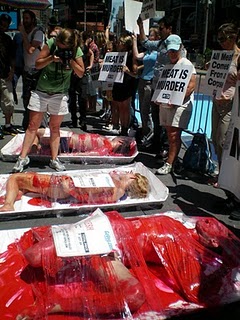
Kain makes the mistake of thinking that any moral belief deeply held, no matter how extreme, PetaNYCmeat1 can't be criticized for being too extreme. It's a moral belief, after all!

But imagine a militant animal rights activist who claimed, "The meat industry is indisputably the worst Holocaust in history." If we buy into Kain's argument, there's nothing ridiculous here. If you believe in your heart of hearts that an animal is a sentient being worthy of equal moral weight to a human being, and yet the law of the land dictates that said being is not in possession of even the most basic right – the right to life – then really how different is the meat industry from the Holocaust?

The only difference that I can see is that it's those damn hippies who would make one argument, while respectable and upstanding members of the community would make the other.

The photo is from a PETA "die-in".  Another writes:

Two can play that game: If you believe in your heart of hearts that a woman is nevertheless a person – a live, autonomous human being – and yet the law of the land dictates that said live, autonomous being is not in possession of even the most basic right – the right to control what happens to her body – then how different is this from slavery? It's all about control; does the government get to decide what I do with my body, or do I?

Another:

In the US, murder of a slave was still murder. They had a right to life. The enforcement may have been lax (or nonexistent), but it was illegal. So I say the Malkin award stands. Abortion = Slavery is a ridiculous analogy. Abortion foes have legitimate morals to raise, why raise specious ones?

The ADL And Sensitivity

Always a one-way street:

When it comes to the Simon Wiesenthal Center's building the Museum of Tolerance on the oldest and largest Muslim cemetery in Jerusalem, the ADL has no problem backing the legal rights of the Wiesenthal Center and turning a deaf ear to the sensitivities of the Palestinian Muslims.

Beinart unloads on another double-standard:

When Arizona passes a law that encourages police to harass Latinos, the ADL expresses outrage. But when Israel builds 170 kilometers of roads in the West Bank for the convenience of Jewish settlers, from which Palestinians are wholly or partially banned, the ADL takes out advertisements declaring, “The Problem Isn’t Settlements.”

Obama’s Foreign Policy: 0 – 4 So Far

Steven Walt writes that Obama is likely to be zero for four on big foreign policy goals going into 2012, Iraq, Iran, Afghanistan and Israel:

Obama didn't get us into Iraq, and he's doing the right thing to get us out more-or-less on the schedule that the Bush adminstration negotiated back in 2008. But it's now clear that the much-vaunted "surge" was a strategic failure, and Iraq could easily spin back out of control once U.S. forces are gone. Even in the best case, Iraq can only be judged a defeat for the United States: we will have spent trillions of dollars and lost thousands of lives in order to bring to power an unstable government that is sympathetic to Iran and unlikely to be particularly friendly to the United States. Americans don't like losing, however, and Obama is going to get blamed for this outcome even though it was entirely his predecessor's fault…

Obama's fundamental error was to run try to run a very conventional foreign policy — one that turned out to be not very different from the second Bush term — in a situation that called for far more creative thinking and a willingness to try new approaches and stick with them even if it alienated some domestic constituencies.

I think it's far too early to judge. If you view Iraq and Afghanistan as FUBAR, then finding some face-saver to get out of both places will be some achievement. Iran's isolation is as about as acute as at any time in recent history. On Israel, Obama was simply crushed by the pro-Israel lobby, and is now reduced to acting as Netanyahu's puppet. Marc Lynch differs on Iraq:

Obama is on track to deliver on his campaign promise to withdraw from Iraq — something which voters might begin to notice next month when they discover that he has also met his promise to get down to 50,000 troops.  He's already almost there, without anyone really paying attention, and he has admirably resisted all pressure and temptation to relax the timeline in the face of the political paralysis of Iraq's political class.  What's more, Iraqi security forces and state institutions have proven quite robust during the extended political crisis, and the general security trends are not nearly as dire as the headlines would suggest.   Iraq should be a major positive for 2012 if Obama makes the case, as I'm sure he will:  he kept his promise on his signature policy initiative and it has worked out pretty well.  

And the GOP alternative is…. staying longer?  I don't see that as a political winner.