Let us count the ways we wince.
Month: August 2010
Seducing Your Way To A Very Clean Bathroom
Or something like that:
Stockman’s Diagnosis: Still True
It's the kind of op-ed that has one sitting up straight with the sting of fresh memory. Back in the 1980s, I was a Thatcherite. I believed in low taxes but I also believed in – you know – balanced budgets as a core principle of, you remember, conservatism. It was odd coming to America to be told that here, for the first time in human history, you could cut taxes and raise revenue at the same time! It was triply odd, coming from green eye-shade Thatcher-land, to hear that "deficits don't matter." In his first term, of course, even Reagan felt it necessary to adjust from this madness – a madness that, far from "starving the beast", simply made Americans believe that the beast never needed full funding. The first Bush, to his enormous credit, did the responsible thing – but was destroyed by his party for violating the no new taxes pledge. From that moment on, it became not policy but doctrine for the GOP. And the results of further tax cuts and further spending increases, mitigated by divided government in the 1990s, but unleashed in full force under Bush-Cheney, is what we face today:
By fiscal year 2009, the tax-cutters had reduced federal revenues to 15 percent of gross domestic product, lower than they had been since the 1940s. Then, after rarely vetoing a budget bill and engaging in two unfinanced foreign military adventures, George W. Bush surrendered on domestic spending cuts, too — signing into law $420 billion in non-defense appropriations, a 65 percent gain from the $260 billion he had inherited eight years earlier.
No intellectually honest person can hold Barack Obama responsible for this long term sabotage of America's fiscal health. The spending he has authorized has to be seen in the context of the massive financial crisis that nearly caused the second Great Depression and may well still cause a lost generation of output and jobs and productive lives.
But the central point Stockman makes is that all of this was not conservatism as it should be, but the degenerate mockery of conservatism that has come to dominate the GOP: a blend of fiscal abandon, politicized religion, lawless foreign policy and utter electoral cynicism. Until this is confronted, owned and refudiated, we may have a Republican future ahead, but not a conservative one.
The Neocons And The Cordoba Mosque
Abe Foxman is not alone in his conflation of Islamist terror and peaceful American Islam. The New York Sun, in an editorial that sounds as if it was written by Palin-admirer Seth Lipsky backs the anti-Muslim campaign:
We mentioned to him that we’d been impressed with the way Sarah Palin articulated her early opposition to the project.
“She’s got seichel,” we remarked to Mr. Foxman. It was a reference to the Yiddish word that has no single-word English translation but means a combination of intelligence, wisdom, and common sense. Mrs. Palin’s short messages on Twitter were crafted as a call not on the government to prohibit the project but on the moderate Muslims themselves to — in her now classic formulation — “refudiate” the plan. Her call was for forbearance out of understanding of the special nature of the Ground Zero site in the city’s and the nation’s memory.
Lipsky supports Greater Israel and found Sarah Palin's support for more intensified Israel Jewish colonization of the West Bank "wonderful":
In the two generations in which I’ve been covering the Middle East debate, it was one of the few times a public figure gave in response to a question about the settlements an answer that I would call ideal. It seemed to me courageous, in that Palin was going against not only the administration but many in her own party and the gods of political correctness. There was no shilly-shallying about the Oslo process and the Quartet and the United Nations. Palin didn’t seem particularly worried one way or another about how she might be perceived. She is just on Israel’s side.
And for an American politician, that is all that really matters, isn't it?
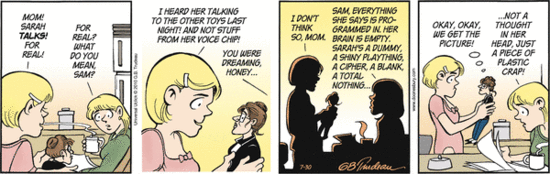
“A Total Nothing”
Your Kenny Powers Fix
Until the next season of Eastbound and Down (NSFW).
Unready For Government

The American Spectator hosts a symposium on whether the right has learned its lesson from the Bush years. Mercifully, a few see that it hasn't. James Antle III:
Is the Republican party ready to regain power? Probably not — we have seen that how Republicans behave in the minority, especially under a Democratic president, is no predictor of how they will act in the majority. As steadfast as they have been against President Obama, relatively few Republicans who voted for the TARP bailout, the Medicare prescription drug benefit, or our exercise in Mesopotamian nation-building have repented.
Antle still prefers them to Democrats, though. Phil Klein:
During their time in the wilderness, Republicans have not convincingly demonstrated that they are serious about getting the federal budget under control. Sure, Republicans talk a big game about President Obama's expansion of government and the record deficits being accrued under his watch. But this is mostly political theater. The focus is typically either on opposing spending in vague terms or highlighting earmarks that, while certainly wasteful, do not compose a significant portion of the budget. The only way to get serious about spending is to confront the looming entitlement crisis, which represents $108 trillion in long-term debt, putting our nation on track for a Greek-style financial meltdown. Yet Republicans, despite portraying themselves as champions of limited government, have not demonstrated any more willingness to confront this problem than Democrats. And let us not forget that when Republicans were last in the majority, they used their power to ram through what was at the time the largest expansion of entitlements since the Great Society in the form of the Medicare prescription drug plan…
Entitlement spending will burden future generations with more debt, crushing tax rates, a stagnant economy, and runaway inflation.
The GOP has made the war on America's youth a bipartisan affair. The party is not ready to retake the majority.
(Photo: Ishara S. Kodikara/AFP/Getty.)
9.1 Billion Mouths To Feed
Nature details the agricultural challenges ahead. On the latest crisis:
The world currently has more than enough food, but some 1 billion people still go hungry because they cannot afford to pay for it. The 2008 food crisis, which pushed around 100 million people into hunger, was not so much a result of a food shortage as of a market volatility — with causes going far beyond supply and demand — that sent prices through the roof and sparked riots in several countries. Economics can hit food supply in other ways. The countries in the Organisation for Economic Co-operation and Development pay subsidies to their farmers that total some US$1 billion a day. This makes it very difficult for farmers in developing nations to gain a foothold in world markets.
Antoine Dodson: Instant Global Star
From local news (worth watching first) to autotune in a matter of hours:
Now, he's doing media interviews.
Stopping Blood Diamonds Won’t Fix Congo, Ctd
Texas In Africa gets into the history of the region:
The perception that anyone who speaks Kinyarwanda is not a legitimate Congolese citizen – and therefore not entitled to own land in the region – is widespread and hugely problematic. The 2006 constitution guarantees citizenship rights to ethnic groups that were in the country at the time of independence, which includes most Rwandaphones in the Kivus, but the constitution doesn't list the groups by name, which leaves them vulnerable.
It's critical to understand this context when thinking about the region, because these issues – not minerals – motivate much of the current fighting.
 The Dish