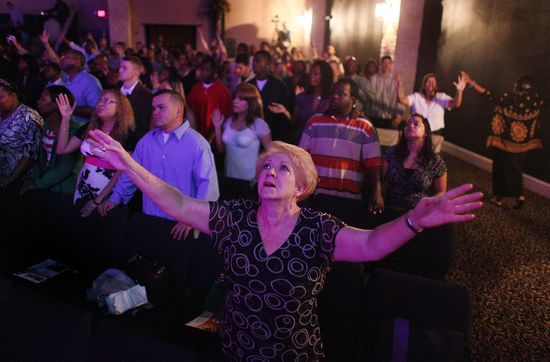
When The Economy Falters, The Pews Fill

CHURCHJoeRaedle:Getty

Lisa Miller notes that church attendance goes up during recessions and down during good times. She speaks with economist Daniel Hungerman, who keeps a graph comparing GDP and church attendance above his desk:

Hungerman’s best guess explanation for the wide spaces and tight spots in his graph has nothing to do with God and self-interest (“if I pray in church, I will get a job”) but with something grander: a sense of global interconnectedness. “Maybe when the economy turns sour, no matter how much money you make, you get nervous and decide to go to church and talk with your buddies and get a sense of what’s going on in your community. Or maybe people’s desire for spiritual guidance is influenced by their perception of how the world’s doing outside of themselves. Church attendance may not reflect our own circumstances but our own idea of how the world is doing beyond us.” In other words, Hungerman’s picture may illustrate our concern for our neighbors: down in good times and up in bad.

Avent's reasoning is more mundane:

Church is free entertainment—music, socialising, a bit of story telling, and a meal in the bargain if you're lucky (or Baptist). When mom and dad are both working, a night at the movies might seem grand. When dad loses his job, church may be the most affordable way to get out of the house.

(Photo: Joe Raedle/Getty.)

Living Wills And Living Deaths

Susan Jacoby has an elderly mother who wishes that "no extraordinary medical measures — including artificial feeding — be used to prolong her life if there is no hope of recovery." Jacoby imagines her mother in a Catholic hospital:

The bishops’ most recent health-care directives, issued near the end of 2009, make it clear that they consider it the duty of Catholic health-care providers to impose artificial nutrition and hydration on patients in persistent vegetative states. My brother and I would, of course, take immediate steps to have our mother removed from a setting where her wishes would be ignored. But what if she had no living children or, like some two-thirds of Americans, had procrastinated about putting her instructions in writing?

A commenter at Secular Right responds:

What the bishops say and what is done in practice are two different things. I’m a physician employed by a large Catholic hospital group (incidentally, in ten years never once has anyone inquired about my religious views, or lack thereof). We follow the same rules/guidelines as other hospitals in these situations. If someone has a living will/valid healthcare power of attorney, we will follow their directions/guidance completely (which is both legally and ethically required).

Obviously we don’t perform abortions and we don’t prescribe birth control pills (though they can be used for other accepted medical reasons, such as hormonal therapy for ovarian cysts). Otherwise, there is absolutely no difference between us and other secular facilities (except that, given our mission, we provide a lot more uncompensated care)