Can Church Be Hip? Ctd

by Chris Bodenner

A reader writes:

Black Sabbath, “After Forever”

No, really.

You will need the lyrics in text form (this is Ozzy, after all):

Have you ever thought about your soul – can it be saved?
Or perhaps you think that when you're dead you just stay in your grave
Is God just a thought within your head or is he a part of you?
Is Christ just a name that you read in a book when you were in school?

When you think about death do you lose your breath or do you keep your cool?
Would you like to see the Pope on the end of a rope – do you think he's a fool?
Well I have seen the truth, yes I've seen the light and I've changed my ways
And I'll be prepared when you're lonely and scared at the end of our days

Could it be you're afraid of what your friends might say
If they knew you believe in God above?
They should realize before they criticize
that God is the only way to love

Is your mind so small that you have to fall
In with the pack wherever they run
Will you still sneer when death is near
And say they may as well worship the sun?

I think it was true it was people like you that crucified Christ
I think it is sad the opinion you had was the only one voiced
Will you be so sure when your day is near, say you don't believe?
You had the chance but you turned it down, now you can't retrieve

Perhaps you'll think before you say that God is dead and gone
Open your eyes, just realize that he's the one
The only one who can save you now from all this sin and hate
Or will you still jeer at all you hear? Yes! I think it's too late.

From the Wikipedia page, "Christianity in mainstream metal":

During times when accused for supposed devil worhipping, Black Sabbath wanted to distance themselves from the subject, and wrote the song ”After Forever” (from Master of Reality, 1971), which talks about life after death from Christian point of view. Taking it a step further, Ozzy Osbourne, heavy metal singer and ex-Black Sabbath member, shows God in a positive light through his lyrics (despite his controversial past and his false reputation as a Satanist), and on a radio interview in 1983 stated that he was a member of the Anglican Church of England. Ozzy's former guitarist, Zakk Wylde, however, has identified himself as an Irish Catholic.
Let Them Swim in Deep Water

by Conor Friedersdorf

Over at Democracy in America, another liberal speaks up for part of the liberty agenda:

My colleague noted the other day the discussion Matthew Yglesias has been having with his readers over whether liberals and libertarians can agree on some regulations they both hate. So, here's a regulation I hate: you're not allowed to swim across the lake anymore in Massachusetts state parks. You have to stay inside the dinky little waist-deep swimming areas, with their bobbing lines of white buoys. There you are, under a deep blue New England summer sky, the lake laid out like a mirror in front of you and the rocks on the far shore gleaming under a bristling comb of red pine; you plunge in, strike out across the water, and tweet! A parks official blows his whistle and shouts after you. "Sir! Sir! Get back inside the swimming area!" What is this, summer camp? Henry David Thoreau never had to put up with this. It offends the dignity of man and nature. You want to shout, with Andy Samberg: "I'm an adult!"

Indeed. I feel the same way about Orange County's recent prohibition against climbing on the rocks at the beach.

“I’m Sorry” Ctd

by Chris Bodenner

A reader writes:

I'm a little put off by the oddly petty criticism of a Christian who is at least taking one step towards a rational point of view. My only question to those who make issue of t-shirts being sold, or some vague sense of hubris coming from Marin, is this: would you prefer him to shut up? Would you prefer to be left with Pat Robertson? Positive steps are positive steps.

No one is suggesting that by supporting Marin's gesture of apology, you therefore support everything else he does. There seems to be a great deal of forest-tree confusion going on here. Lastly it should be remembered that Marin is not the sole person in his organization. It is allegedly filled with numerous Christians who are willing and eager to apologize to the LGBT community about the wrongs committed by their church. Being an atheist and having no sway within the church, I can only say I'm thrilled that such a gesture is dared to be made at all.

Another writes:

I wanted to weigh in on your post on Andrew Marin, since I had the chance to meet him in person on a couple occasions. Savage's piece on him is rather cynical, but it seems very far removed from the person I met and read. I met Marin while he was teaching a class during Sunday school at Uptown Baptist Church in Chicago. For someone that is supposedly profiting selfishly on the GLBT community, it seems strange that he would spend hours of his time for several weeks teaching in a moderately sized church for free, never once mentioning anything for sale. The class dealt with material similar to his book that came out a year or two later, Love is an Orientation, which discussed the controversial Bible verses regarding homosexuality attempting to unearth principles beyond deciding "right or wrong", but mostly how to reach out to GLBT loved ones without condemnation. I can say that he definitely challenged the evangelical crowd there to change a lot of assumptions and I believe accomplished quite a bit.

During that time he was also quite candid about the Foundation, how blessed he felt to receive the grants and donations that made it possible, and that it existed because of the research angle. Again, since he was able to do what he's doing by doing research into the religious lives of those in the GLBT community, I really struggle to see the egotism in the name rather than a neutral starting point.

I'll admit that I like his message, so I may be biased. But Savage's main point is that he claimed Marin called homosexuality a sin (by anecdote, I might add) and he doubts he has changed. The basis of Marin's message, however, is that there are better conversations than whether it is sin, and he accepts the spiritual validity of those who say it is not. He clearly gets burned by both sides by refusing to say one way or another. Both sides will accuse him of being a sheep in wolves' clothing. While there seems to be plenty of careers in choosing either polemical side, he's taking a third, much more difficult way. For every person saying that he's not liberal enough, there are Christians out there claiming that he's not a real Christian. So whether one believes him or not, I think that deserves at least a nod of respect.

P.S. These "Can Church be Hip?" conversations have been like taking a tour through my iTunes collection.

The Annals Of Long-Form Journalism, Ctd

by Chris Bodenner

Josh Green gives props to Conor:

I first became acquainted with this effort when he posted his "Best Pieces of 2009" at the sadly departed True/Slant. But I'm glad he's kept it up on an a la carte basis over at the Daily Dish, where he's flagged a number of great pieces, including this one and this one. Google reveals that he also did a "best" list for 2008, which you can find here, and to which I will be devoting a good part of my weekend.

My two cents: Kurt Eichenwald's piece on webcam predators and Daniel Coyle's profile of an ultra-endurance athlete.  (And find Josh's own long-form collection from The Atlantic here.)

After The Bubble

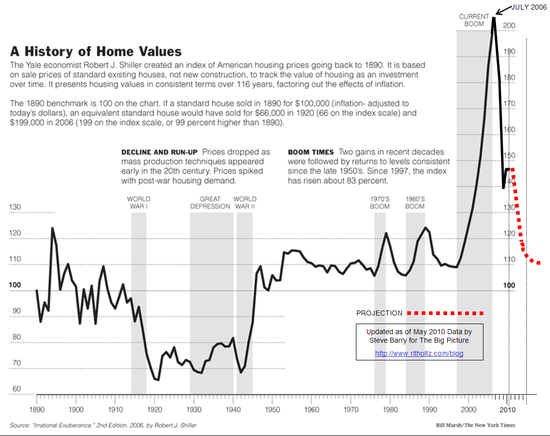
Home Price Index
by Patrick Appel

Wilkinson points his finger:

If you ask me, the ultimate culprit in the financial crisis was the American cult of homeownership. There are many ways to help poorer Americans accumulate wealth, such as channeling payroll taxes into personal retirement accounts. But we don't do that. Instead, because we consider it a humiliating indignity not to have a room or ten of our own, we subsidise home-buying six ways to Sunday and tell banks they won't have to suffer the downside of loans offered to bad credit risks. I think it's safe to say that this hasn't turned out to be the best scheme for helping poorer Americans into the ownership class.

Chart via Daniel Indiviglio:

This is a pretty fascinating picture. First, it shows just how incredibly absurd the housing boom was. Beginning in the 1940s, inflation-adjusted homes prices have settled around the 110 value according to the Case-Shiller index. Yet, the index value exceeded 200 in 2006. Prices began a descent when housing collapsed, but as of May the index remained well above the natural value of 110.

Eyeing the chart, the value looks to have hit around 147 in May. For it to drop back down to 110, home prices would have to decline another 25%. That's still a pretty long way to fall.

Campaign Ad Of The Day

Reid goes negative:

Sargent analyzes:

What's interesting is that even though Angle did say all these things, and even though Reid has widely disseminated her comments throughout the state, the race is still very close. It's a measure of how stiff a headwind Reid faces.

Meanwhile, Ed Kilgore looks at Joe Miller's platform:

I'd say the abolition of Medicaid and the total privatization of Medicare and Social Security qualify as positions that remain controversial in much of the GOP, though a lot less than was the case quite recently, when George W. Bush's SocSec partial privatization proposal sent Republicans running for the hills.

At what point, though, do such positions stop be treated as outliers? When five Republican Senators espouse them? Ten? Twenty?

Jest vs Joyce

by Conor Friedersdorf

Alan Jacobs compares Infinite Jest to Ulysses, and writes that "I am coming more and more to suspect that Infinite Jest would be a great book at half its current length." I agree with that judgment, though I very much enjoyed Infinite Jest.

I also enjoyed A Portrait of the Artist as a Young Man, but Ulysses is the single novel that I've started and been unable to finish. Even as I came across delightful turns of phrase, I hated the it, despite usually loving long, ambitious, unorthodox novels from Don Quixote on down. Given the opportunity to study it under Professor Jacobs, I'd give it another try.

Libertarian Utopia Meets Reality

by Patrick Appel

Timothy B Lee tackles seasteading, "a program for political reform based on a proliferation of self-governing ocean colonies":

If all you care about is avoiding the long arm of the law, that’s actually pretty easy to do. Buy a cabin in the woods in Wyoming and the government will pretty much leave you alone. Pick a job that allows you to deal in cash and you can probably get away without filing a tax return. In reality, hardly anyone does this. To the contrary, people have been leaving rural areas for high-tax, high-regulation cities for decades.

Almost no one’s goal in life is to maximize their liberty in this abstract sense. Rather, liberty is valuable because it enables us to achieve other goals, like raising a family, having a successful career, making friends, and so forth. To achieve those kinds of goals, you pretty much have to live near other people, conform to social norms, and make long-term investments. And people who live close together for long periods of time need a system of mechanisms for resolving disputes, which is to say they need a government.

Housing Tanks, Ctd

by Patrick Appel

Jonah Lehrer thinks our collective cognitive bias is part of the problem:

Between 1989 and 1992, Boston condo prices fell by nearly 40 percent. This meant that, for the vast majority of condo owners, they could only sell their home at a steep loss.

Classical economics assumes that people will adjust to the new reality. They’ll realize that the market has changed, and that they made a costly mistake. But that’s not what happened. In their paper, “Loss Aversion and Seller Behavior: Evidence From the Housing Market,” Mayer and Genesove found that, for essentially identical condos, people who had bought at the peak of the market (between 1989-1992) listed their properties for nearly 35 percent more than those who had bought after the collapse. Why? Because they couldn’t bear to take a loss.

The end result, of course, is that these overpriced properties just sat there, piling up like unwanted inventory. According to the economists, less than 25 percent of the properties bought during the condo bubble sold in less than 180 days.

I’d argue that the same thing is happening right now, except on a nationwide scale.

Christianist Watch

by Chris Bodenner

"We have two competing world views here and there is no way that we can reach across the aisle — one is going to have to win. We are either going to go down the socialist road and become like western Europe and create, I guess really a godless society, an atheist society. Or we're going to continue down the other pathway where we believe in freedom of speech, individual liberties and that we remain a Christian nation. So we're going to have to win that battle, we're going to have to solve that argument before we can once again reach across and work together on things," – Congressman John Fleming (R-LA).