The Daily Wrap

Today on the Dish, Muslims prayed at Ground Zero, while detractors angrily protested a non-Muslim man. Stephen Prothero put Mormons on the spot; Kinsley kept at Krauthammer; Eli Lake and Adam Sewer squared off for a Blogging Heads round; and moderate Muslims do (obviously) exist. We opened the thread on America and its ruling elites and asked the Tea Party what changes they might propose.

Sharron Angle campaigned against jersey colors, Hasselbeck supported gay marriage, and John Hawkins wanted to make the Republican party actually inclusive. We parsed Obama's faulty logic on gay marriage and examined whether Ron Paul really mattered. Conor riffed on liberty vs tyranny; Reihan took the rightier road to keeping the rich here in the U.S; and we dropped in on high school and college dropout factories.

Goldblog and Lynch expounded on Israel; Mongolia begged us to visit, and a surge in porn markets could be good for Iraq. Damaged irrigation systems could lead to food shortages in Pakistan, and combat operations never end when governments say they do.

TNC went night walking; bloggers got taxed in Philadelphia, and others got paid by the GOP. Our choices for beverages were limited, but we learned we're not that good at choice blindness anyways. The dog pile on Cesar Millan continued; hipster Christian rock bands have to pass the sniff test; and we all paid the fear tax.

Question of the week here, VFYW here, MHB here, FOTD here, and awkward family pet portraits here.

— Z.P.

Night Walking

Night

by Patrick Appel

TNC is still out in the woods doing his best Thoreau impression:

I took my first night-walk last week–no flashlight and no company. I would not exaggerate my courage. The moon was a fertility god, stout against the black blanket of sky. In many places I could not so much see the road, as an almost shadow of the road–a strip more blueish than black. But when I looked up, I could see the tops of trees swaying in the night-wind, marking the borders. And so I walked most strange–learning the earth, by sighting the sky.

The Value Of Truth, Ctd

by Zoe Pollock

I was very impressed with but not surprised by the wealth of knowledge and opinion expressed in response to this subject. To clarify, perhaps unnecessarily, I meant no disrespect to Hitchens, someone who is greatly admired by the Dish and whom I personally enjoy and respect very much. It was my first lesson in the passions and precisions of Dish readers and I look forward to more. Here is a sampling of some of those responses:

Once we accept things which aren't true in order to ease the pain of existence, we open the door to accepting other ideas that aren't true simply because they are convenient to our immediate psychological well-being.  This often leads to bad consequences, such as when slave-traders justified their exploitation of labor with the comfortable lie that stealing people away from their homes in order to face torture and servitude worked to save souls.  Today we see similar self-serving lies in the base subjugation of women by the Taliban, and in the "Christian" labels that are applied by the right to bad treatment of the poor. The erosion of rationality caused by convenient lies of faith has led to the battling irrational ideas that underlie many of our most problematic contemporary conflicts.

Another reader:

Nietzsche did not advocate "life-enhancing illusions", in fact the complacency that such illusions bred was precisely what his work rails against.  His argument was simple, as all moral arguments in the existential tradition are.  In the end, you are alone in your own head, and while governments and society may demand that you answer for what you do and how you live, the only person you cannot escape giving that answer to is yourself; so choose the values and rules that you can live with, and if you truly respect your life, don't abandon them.  Mr. Vallicella, in the greatest traditions of Monotheist sophistry, asks, "What does Hitch lose by believing?" and he answers, showing his own nihilistic disdain for truth and faith, "Nothing."  Such is how he sees it.  To an existentialist, however, you are your morality and your philosophy; what you think and do IS who you are; in other words, the truth of your existence is everything.  To believe now, to run fearfully to a god he has never considered feasible out of some coward's hope that a last minute plea would postpone oblivion, to lie to himself so grandly, would be for Mr. Hitchens to lose everything.

And one more:

"What would Hitch lose by believing?" I don't think that's the question. I think the question is the same one that bears on all deathbed conversions: doesn't sincerity make a difference to God? I think , if there is a God, he looks even less kindly upon faked belief than he does lack thereof. Because faked belief presumes God is a mark to be tricked.

I prefer the old Hindu parable about the atheist who spent his entire life denying Khrishna, and thought about little else till his last breath. When he dies he is instantly united with Mr. K. Why? Because, whether believing or denying, Khrishna was always paramount in his mind. Believed in, even as something to deny. Perhaps the gods really dislike being ignored.

Did The Stimulus Work? Ctd

by Patrick Appel

Manzi forcefully rebuts Chait:

Macroeconomic assertions about the effect of a proposed stimulus policy are not valueless, but despite their complex mathematical justifications, do not have standing as knowledge that can trump common sense, historical reasoning, and so on in the same way that a predictive rule that has been verified through experimental testing can.

When using stimulus to ameliorate the economic crisis, we are like primitive tribesmen using herbs to treat an infection, and we should not allow ourselves to imagine that we are using antibiotics that have been proven through clinical trials. This should not imply merely a different feeling about the same actions, but should rationally lead us to greater circumspection.

Faces Of The Day

MarioLaportaAFPGettyImages

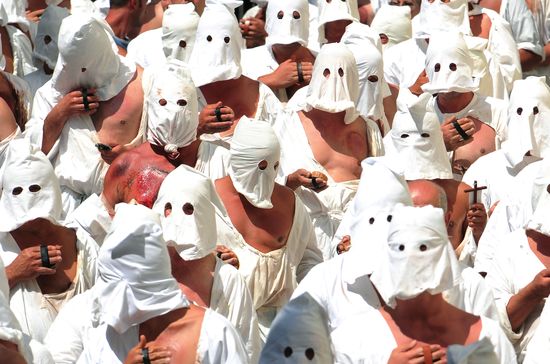
Christian penitents known locally as 'Battenti' beat themselves during a procession in honour of the Virgin Mary in Guardia Sanframondi, near Benevento south of Italy, on August 22, 2010. Around 1,000 penitents from across the world attended the procession which occurs once every seven years. By Mario Laporta/AFP/Getty Images.

Why Not Raise The Retirement Age? Ctd

by Patrick Appel

Bruce Bartlett makes some valid points:

[R]aising the normal retirement age won't do much good because 62 has become the de facto normal retirement age. We will have to raise the early retirement age if we want to save money this way.

There are two other points I didn't have space to make that are important. First, I think many people who take early retirement foolishly have a use-it-or-lose-it attitude; they don't realize that benefits rise the longer one waits. I think many also believe that their benefits will be bumped up when they reach the normal retirement age. But the lower benefits one gets when taking early retirement are for life. Consequently, I fear a crisis of poverty among the very old in the not too distant future.

Second, there is an important cost associated with early retirement in the form of restrictions on earned income. Social Security benefits are reduced $1 for every $2 earned above $14,160. That's like a 50% tax that discourages people from working once they have decided to take early retirement. I think this also contributes to poverty among the elderly.

Dropout Factories

by Patrick Appel

Leonhardt recommends The Washington Monthly's new college rankings system. In a related article, Ben Miller and Phuong Ly report on colleges with the worst graduation rates:

These colleges make up 15 percent of the total and disproportionately serve working-class and minority students. They are akin to the 15 percent of high schools Barack Obama and other would-be reformers have dubbed “dropout factories” for having scandalously low graduation rates — on average about 50 percent. But the average graduation rate at the 200 “college dropout factories” is 26 percent. America’s worst colleges, in other words, are twice as bad as its worst high schools.

Pseudovariety, Ctd

by Patrick Appel

A reader writes:

Hannaford is conflating a lack of choice in *producers* with a lack of choice in *beverages*.  That's stupid.  It's like saying there's no variety in Jelly Bellys because there's only one producer of Jelly Bellys.  And yet I stand there in front of the "Jelly Belly bar" at my local gourmet grocer's and see 30 or more varieties of Jelly Bellys, and that's with only a single producer and no effective competition within that market segment.  Choices in beverages  range from plain old Coca Cola to high-end sparkling waters to energy drinks to organic teas.  Competition amongst the three major producers is absolutely fierce, yet there's still room for specialty and niche producers to thrive (Jones Soda probably being the most prominent, but having moved to St. Louis a couple of years ago, I've been amazed at the number of local and regional soda producers, such as Fitz's, Dad's, and a variety of other specialty sodas).

There are plenty of problems caused by consolidation of control of a market segment to a few large producers.  We have effectively fewer significant producers of MP3 players than beverage producers, with Apple dominating the segment, Microsoft a distant second, and others that produce a vanishingly small percentage of production.  The cost of iPods has stayed significantly stable because of that.  Soft drinks, on the other hand, come in just about every flavor, form, and packaging option available, at extremely competitive price points.  A lack of choice in the beverage market is clearly not a problem.

Reihan has further criticisms.

Too Liberal For Cato?

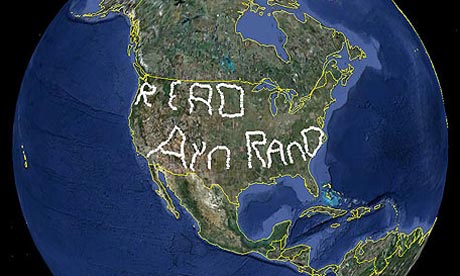
Read-Ayn-Rand-006

by Chris Bodenner

Weigel wonders why Brink Lindsey and Will Wilkinson are both suddenly leaving the libertarian think tank:

[Y]ou have to struggle not to see a political context to this. Lindsey and Wilkinson are among the Cato scholars who most often find common cause with liberals. In 2006, after the GOP lost Congress, Lindsey coined the term "Liberaltarians" to suggest that Libertarians and liberals could work together outside of the conservative movement. Shortly after this, he launched a dinner series where liberals and Libertarians met to discuss big ideas. (Disclosure: I attended some of these dinners.) In 2009 and 2010, as the libertarian movement moved back into the right's fold, Lindsey remained iconoclasticjust last month he penned a rare, biting criticism of The Battle, a book by AEI President Arthur Brooks which argues that economic theory is at the center of a new American culture war.

Did any of this play a role in the departure of Lindsey and Wilkinson? I've asked Lindsey and Wilkinson, and Wilkinson has declined to talk about it, which makes perfect sense. But I'm noticing Libertarians on Twitter starting to deride this move and intimate that Cato is enforcing a sort of orthodoxy. (The title of Wilkinson's kiss-off post, "The Liberaltarian Diaspora," certainly hints at something.)

With Lindsey and Wilkinson out, perhaps there's a chance for Nick Newcomen, the Rand fan who drove 12,000 miles with GPS tracking "pen" to scrawl the message above?  If nothing else, his ideological chops are unassailable.