So Many Choices

by Patrick Appel

Jonah Lehrer takes on choice blindness:

we are completely ignorant of how fallible our perceptions are. In this study, for instance, the consumers were convinced that it was extremely easy to distinguish between these pairs of jam and tea. They insisted that they would always be able to tell grapefruit jam and cinnamon-apple jam apart. But they were wrong, just as I’m wrong to believe that I would be able to reliably pick out the difference between all these different coffee beans. We are all blind to our own choice blindness.

Not An Onion Headline

by Chris Bodenner

Sharron Angle Campaigned Against Black Football Jerseys On Religious Grounds: Color is 'Thoroughly Evil'  Money quote:

The black uniforms were then confiscated and held under "lock and key" by the administration, which refused to compensate the team for the money they had spent acquiring the jerseys.

They must not have had access to an Ecto Containment Unit.

Pseudovariety

Softdrinks

by Patrick Appel

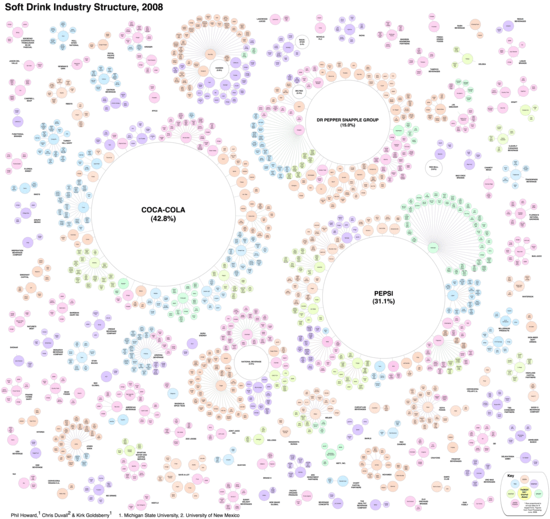
Philip H. Howard provides a visual:

Three firms control 89% of US soft drink sales. This dominance is obscured from us by the appearance of numerous choices on retailer shelves. Steve Hannaford refers to this as "pseudovariety," or the illusion of diversity, concealing a lack of real choice. To visualize the extent of pseudovariety in this industry we developed a cluster diagram to represent the number of soft drink brands and varieties found in the refrigerator cases of 94 Michigan retailers, along with their ownership connections.

A much larger version of the graphic is here.

(Hat tip: Flowing Data)

Did The Stimulus Work? Ctd

by Patrick Appel

Chait counters Manzi:

Private forecasters unanimously believe that fiscal stimulus can temporarily boost growth. They give no credence whatsoever to the various right-wing alternative models in which foscal stimulus does not boost growth. Moreover, in 2001, when the objective case for fiscal stimulus was much weaker, there was no real debate about the efficacy of fiscal stimulus. The fact that Republicans are fiercely contesting the merits of fiscal stimulus now, while almost nobody was doing so when the case was much weaker in 2001, suggests that the right's skepticism is a political phenomenon.

Faces Of The Day

Ape-faces

by Chris Bodenner

Alexis Madrigal explores them:

Photographer James Mollison reveals the variability of our uncanny human cousins in a stunning series of close-up portraits of the Great Apes. The tight focus of his photographs forces us to look right into the eyes of gorillas, chimpanzees, bonobos, and orangutans of different ages and personalities.

More here, including an explanation of how the photographer got the apes to look so intently. (Click on the image to enlarge. Go here for several individual close-ups.)

Virtual Guest

by Zoe Pollock

Are live video feeds the wave of the future for weddings? Miriam Kotzin of the Smart Set watches happily from the sidelines:

I watched friends and relatives greet the jovial groom, who looked not one whit nervous, and now the wedding procession was starting. And then the procession was over, and the ceremony began. The groom was beaming, the bride radiant.

Each close-up of the bride and groom as well as the soundtrack’s fading out during the address mimicked the shifting attention I would have experienced had I been sitting in the garden with the other guests. 

The effect of watching the wedding on the computer was much closer to the experience of actually being present than watching a typical wedding video, which is a formulaic highlighted treatment of a ritual.

The Age Of Paine

by Zoe Pollock

Commonweal's Cathleen Kaveny tracks early American snark. Here's John Adams' comment on the title of Thomas Paine’s The Age of Reason:

I am willing you should call this the Age of Frivolity, as you do, and would not object if you had named it the Age of Folly, Vice, Frenzy, Brutality, Daemons, Bonaparte, Tom Paine, or the Age of the Burning Brand from the Bottomless Pit, or anything but the Age of Reason. I know not whether any man in the world has had more influence on its inhabitants or affairs or the last thirty years than Tom Paine. There can no severer satyr on the age. For such a mongrel between pig and puppy, begotten by a wild boar on a bitch wolf, never before in any age of the world was suffered by the poltroonery of mankind, to run through such a career of mischief. Call it then the Age of Paine.

The Value Of Truth

by Zoe Pollock

Bill Vallicella takes a closer look at the philosophy of Hitch:

What would Hitch lose by believing?  Of course, he can't bring himself to believe, it is not a Jamesian live option, but suppose he could.  Would he lose 'the truth'?  But nobody knows what the truth is about death and the hereafter.  People only think they do. Well, suppose 'the truth' is that we are nothing but complex physical systems slated for annihilation.  Why would knowing this 'truth' be a value?  Even if one is facing reality by believing that death is the utter end of the self, what is the good of facing reality in a situation in which one is but a material system? 

If materialism is true, then I think Nietzsche is right: truth is not a value; life-enhancing illusions are to be preferred.  If truth is out of all relation to human flourishing, why should we value it?

Age Of Engagement

by Zoe Pollock

The Big Think hosts an interview with professor Matthew Nisbet, asking if atheists or believers are better bloggers:

In part the new atheist movement is almost a social movement within the larger scientific community.  Many of the people that are attracted to new atheist movement identify with science or are scientists themselves and certainly scientists have been online for a long time.  In fact, many of the most prominent bloggers, new atheist bloggers, they came about… they came up and they kind of honed their skills in internet discussion groups, mostly around the debates about evolution. So they have that natural consistency and that natural… the pre-existing experience with using online organizing and reaching people online that maybe some of the religious organizations do not.  The advantage that the religious organizations have though is they have real world communities.  They have networks of interaction through mega-churches, through traditional churches and one of the things that I’ll be blogging and writing about and taking a look at, at the Age of Engagement is how are traditional religious organizations and movements now using the online world to foster the communities, to build their communities or is the online world actually taking away some of their followers and distracting people who otherwise might commit to that particular religious faith or even attend church on a weekly basis.