An Era of Immaturity?

by Conor Friedersdorf

That's what worries James Poulos, who says maturity is the real dividing line between the two Americas. He's reacting to that New York Times piece that begins by asking, "Why are so many people in their twenties taking so long to grow up?" My guess is that changing social mores — that is to say, fear of divorce, higher rates of college attendance, and an ability to have sex before marriage sans stigma — are causing people to get married later. As a result, they're having kids later, thereby delaying the time when they're forced to reorient their priorities to reflect the fact that they're responsible for a helpless young life. This helps explain why young adults are moving back in with their parents more often. So does the increased cost of education and attendant rise in student debt, the increased cost of housing, family homes that are larger than they were a generation ago, and Baby Boomer parents who are much easier to live with than their WWII Generation parents would've been.

I am skeptical of the idea that kids today are less mature.
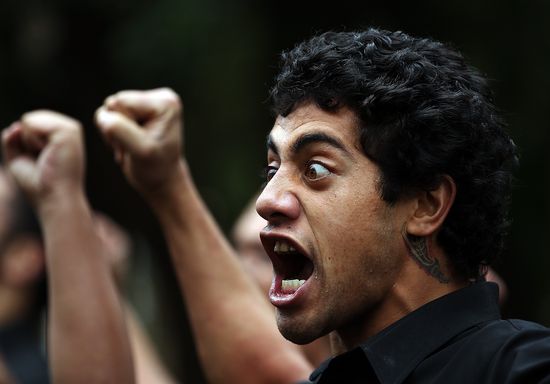
Face Of The Day

103468895

A Maori haka is performed at the coronation ceremony for the fourth year of rule of Maori King Tuheitia Paki at the Turangawaewae Marae on August 20, 2010 in Ngaruawahia, New Zealand. Paki succeeded his mother, Dame Te Atairangikaahu, following her death in August 2006, and was crowned and made successor the same day as his mother's funeral. By Hannah Johnston/Getty Images.

A Neutron Bomb In Reverse

by Patrick Appel

Daniyual Mueenuddin's article on the flooding in Pakistan in yesterday's NYT is well worth a read:

This disaster is not like an earthquake or a tsunami. In the 2005 earthquake in northern Pakistan, 80,000 people died more or less at one blow; whereas the immediate death toll from this flood is likely to be in the low thousands. The loss of property, however, is catastrophic. It is as if a neutron bomb exploded overhead, but instead of killing the people and leaving their houses intact, it piled trees upon the houses and swept away the villages and crops and animals, leaving the people alive.

Steve Coll chews over the politics of the situation. Dreher wonders about Islamic understandings of theodicy:

I see no intrinsic reason why great suffering should destroy one's faith in God, or why it should strengthen it. I think it all depends on the individual, and on the cultural context. The Black Death struck Europe in the 14th century, and killed far more people … but religious faith survived, and likely helped the survivors find hope amid the ruins. The 1755 disaster struck a very different Europe, as did the singular man-made catastrophe of World War I, with tragic results. In the case of modern Pakistan, I don't know enough about Islam as it's believed and practiced there, or the culture of the local people, to predict.

How Is Nobody Upper Class? Ctd

by Patrick Appel

A reader writes:

This reader seems to confuse the terms bourgeoisie and middle class. Regardless of the origins of middle class, it's not used in a modern sense as a synonym for bourgeois. Even in a strictly Marxist use, the equivalent would be petite bourgeoisie, not the ruling capitalist class. And it wasn't often that even the haute bourgeoisie out-earned the aristocracy, but rather a trend from the rise of mercantilism and the industrial revolution that eventually toppled the system of formal nobility as the primary factor in social class.

Gary Johnson, Ctd

by Patrick Appel

Bernstein weighs in on the Friedersdorf-Ambinder exchange:

The point is that Gary Johnson isn't a hopeless case because he's not good on TV; he's a hopeless case because his issue positions make him unacceptable to the most important groups within the Republican Party, and he doesn't bring anything to compensate for that.  Which no doubt stinks if you want a different GOP than the one that actually exists in 2010.  Now, it may be that Johnson can mobilize new groups to enter the Republican Party and start to change it…that sort of thing happens to American political parties all the time, in presidential and lower-level nomination battles.  But as of now, I'd say that the nomination process does a fairly good job of allowing parties to work together to nominate candidates who are responsive to who those parties are, and the problems that Johnson faces have to do with substance, not process.

This is true, but in order to become a standard-bearer for a cause it can be wise to advocate for a position before it is politically popular. I'm not a Ron Paul supporter, but his 2008 boomlet required a long bout of virtual invisibility. Paul preached the same sermon for decades and it only struck a nerve in 2008. His base of support wasn't large enough for him to win the nomination, but he proved a more viable candidate than almost anyone projected.

Creepy Ad Watch

Ratatat – Drugs from Blink on Vimeo.

by Patrick Appel

Aaron Kohn reviews the work of video director Carl Burgess:

Composed solely of stock footage typically reserved for the likes of corny law firm or pharmaceutical commercials, Burgess points to the absurdity of these kinds of images. Editing strategically distorting them at moments (with effects familiar to anyone who's ever used Apple's Photobooth) suggest how quickly the mundane turns sinister—well, at least in the eyes of the drugged.

Unfulfilled Potential

by Conor Friedersdorf

Graeme Wood reviews a book on Iran's Green Revolution:

The instant photo-uploads and breathless tweets from the protests thrilled many an observer outside Iran, because with unprecedented immediacy the world could watch events unfold almost in real time. Death to the Dictator!, however, is one of the first books that appears to be reported from the protests. Its potential is to reveal what the ill-fated revolution felt like from inside, and whether its participants have the character of a permanent, grinding insurgency, or of a movement destined to fade away.

Unfortunately, this potential goes mostly unfulfilled. The lack of focus on the technology of the revolt – the Facebook-organised mobs, the masked kids with Twitter-enabled smartphones in one hand and brickbats in the other – does seem to confirm that social media meant less to the protesters than to their observers and supporters abroad. Such details help illuminate the still-obscure history of the protests. What Moqadam’s account lacks is illumination of issues wider than the experience of Mohsen himself: how the protests happened, who orchestrated them, what the protesters sought to accomplish. The book tells the story less of the revolution than of one revolutionary.

That 20%, Ctd

by Chris Bodenner

A reader writes:

Allahpundit, along with many other commentators, seem to assume that everyone who calls Obama a Muslim is a conspiracy theorist. That isn't necessarily the case. From talking to and listening to various people who make this assertion, I've gotten the distinct impression that at least some of them know perfectly well Obama isn't a Muslim in a literal sense; they're just using the word as an insult, to express their hatred of him. I've had the experience of telling someone Obama is a practicing Christian, not a Muslim, and the person would then retort, "Well, he's got connections to radical Muslims" or "He's appeasing the Muslims," as if either of those things have some relationship with actually being a Muslim.

Now, there definitely are people who believe (or at least claim to believe) that Obama is literally a secret Muslim. But this recent poll doesn't prove that a fifth of Americans truly hold this belief. All it proves is that they are willing to call him a Muslim. Probably most of those people are speaking from contempt, not ignorance, and at least some of them may simply be trying to say they dislike Obama. I think some anti-Semites use the word "Jew" in this way, applying it to people they think are too "soft" on Jewish issues or "in bed" with Jews. In both cases, they're refusing to accept that the label constitutes simple religious or ethnic identification, and treat it instead as just a general slur for anyone they think resembles or is somehow close to the group in question.

Perhaps in the same way people use "gay" as a catch-all criticism.