I find it hard to carve a single passage from Colm Toibin’s quite astounding essay in the London Review of Books on the Catholic church and the homosexuality question. It’s beautifully crafted and honest and true and inescapably Catholic. It covers a lot of ground that this blog has covered, but its description of the crisis of moral authority in the hierarchy is particularly nuanced and fine. What Toibin conveys is the special love many homosexuals have had – for two millennia – for this institution and its mission; and the choice the hierarchy has had for several decades to move forward in hope with these Catholics or to move back in fear against them.
So far, tragically, fear has won. But Toibin also sees the potential for a reborn Christianity in the papacy of John Paul II – wrecked by the white-knuckled reactionary politics that grew under him and now defines the Vatican. Here is what I too found so mesmerizing about Wojtila – as Toibin describes an event in John Paul II’s native Poland in the spring of his papacy:
Twice Wojtyla spent long periods with his hands over his face. The crowd below watched him, fascinated. All the lights were on him. It was hugely dramatic and unexpected, the pope unplugged, as it were. He was offering an example of what the spiritual life would look like; his message was mysterious and charismatic. If you did not know anything about the religion he represented, you would say that it was one of the most beautiful ever imagined, wonderfully speculative and exotic, good- humoured and sweet but also exquisite and exalted. While he lost nothing of his strength and power, the glory of his office, Wojtyla seemed at times almost sad about his own elevated position, suggesting that his real life was the one he spent alone in prayer and contemplation, the one we had seen when he sat without moving, his face covered. He was offering this rich private life of his to the crowd as the life they could have if they followed him.
The choice between this kind of affirmation of spirituality and love and a politics of control and fear was what the church faced under John Paul II, as modernity pressed. Toibin puts it this way:
The first way the Church could go emphasizes the spiritual and the mysterious element in Christianity; the second emphasizes the Church’s interest in control.
The church under Wojtila and Ratzinger took both paths, but the one, alas, has slowly eclipsed the other – until the sex abuse scandal tipped the scales to a near total collapse of moral authority in so many places, Ireland most spectacularly. The pursuit of control is really a 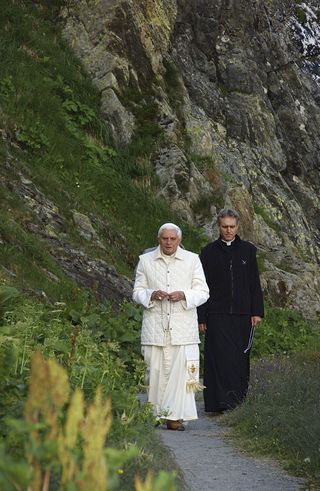 fear of scrutiny and transparency which, when added to the unspeakable crimes of the past, ineluctably led to the current meltdown in the West. The homosexual question is not in any way marginal to this; in fact, you could see it as a central challenge for a church caught between truth and power. The path is littered with might-have-beens. The hope I once saw in the 1975 document on gays and then the reactionary bitterness of the 1986 retreat and Ratzinger’s subsequent campaign against gay people and all gay priests, regardless of their conduct, encapsulates what has happened to the Catholic community in these years of crisis. (I cover all this ground in Virtually Normal.) And this collapse of authority rightly means that this Pope himself is no longer immune to the kind of scrutiny once deemed unimaginable.
The church, having been revealed to have concealed raw evil, now has little option but to allow the light in, or face sheer disbelief.
It seems pretty obvious to me – as it does to Angelo Quattrochi, whose book is reviewed by Toibin – that the current Pope is a gay man (just as it was blindingly clear that John Paul II was straight). I am not claiming that Benedict is someone who has explored his sexuality, or has violated his own strictures on the matter. There is absolutely no evidence of that, or of hypocrisy of any sort. But that does not mean that he isn’t gay. In fact, Ratzinger’s command that gay priests should actively lie about their orientation makes any public statement about this on its face lacking in credibility. But when you look at the Pope’s mental architecture (I’ve read a great deal of his writing over the last two decades) you do see that strong internal repression does make sense of his life and beliefs. At times, it seems to me, his gayness is almost wince-inducing. The prissy fastidiousness, the effeminate voice, the fixation on liturgy and ritual, and the over-the-top clothing accessories are one thing. But what resonates with me the most is a theology that seems crafted from solitary introspection into a perfect, abstract unity of belief. It is so perfect it reflects a life of withdrawal from the world of human relationship, rather than an interaction with it. Of course, this kind of work is not inherently homosexual; but I have known so many repressed gay men who can only live without severe pain in the world if they create a perfect abstraction of what it is, and what their role is in it. Toibin brilliantly explains this syndrome, why the church of old was so often such a siren call for gay men who could not handle their own nature. In Benedict, one sees a near-apotheosis of this type, what Quattrocchi describes as “simply the most repressed, imploded gay in the world.”
Toibin notes Ratzinger’s extremely close relationship with Georg Ganswein, his personal secretary, referred to by some priests I know as Gay.org:
Gänswein is remarkably handsome, a cross between George Clooney and Hugh Grant, but, in a way, more beautiful than either. In a radio interview Gänswein described a day in his life and the life of Ratzinger, now that he is pope:
The pope’s day begins with the seven o’clock Mass, then he says prayers with his breviary, followed by a period of silent contemplation before our Lord. Then we have breakfast together, and so I begin the day’s work by going through the correspondence. Then I exchange ideas with the Holy Father, then I accompany him to the ‘Second Loggia’ for the private midday audiences. Then we have lunch together; after the meal we go for a little walk before taking a nap. In the afternoon I again take care of the correspondence. I take the most important stuff which needs his signature to the Holy Father.
When asked if he felt nervous in the presence of the Holy Father, Gänswein replied that he sometimes did and added: ‘But it is also true that the fact of meeting each other and being together on a daily basis creates a sense of “familiarity”, which makes you feel less nervous. But obviously I know who the Holy Father is and so I know how to behave appropriately. There are always some situations, however, when the heart beats a little stronger than usual.’
Toibin dismisses the notion that any of this proves anything contrary to Benedict’s or Ganswein’s vows of celibacy, and he’s absolutely right to. And yet the psychological profile that Quattrocchi paints is a powerful one:
About ten years before he became pope, when age was beginning to take its toll and was maybe sharpening the secret internal rage, Ratzy [Ratzinger] met Don Giorgio [Gänswein]. And it was a spark of life amid the doctrinal darkness … So we can at least imagine how a pure soul becomes inflamed when it meets its soulmate, when a nearly 70-year-old prefect of the Congregation for the Doctrine of the Faith meets a brilliant 40-year-old priest from his native Bavaria who shares the same outlook on the world … When we see the photos, which we publish in this book, of Georg putting Ratzy’s little hat on for him, handing him his stole, watching his back, looking after him, accompanying him and helping him as he walks, we cannot help being moved.
I would like to return to the world where this kind of speculation was disgraceful, unnecessary and blasphemous. But when this Pope has already enabled the rape of children, has covered up the crimes of many priests, when he has responded by blaming gay men for the moral failings of his own church, when he has publicly demanded that gay Catholics remain in the closet, i.e. lie about themselves as a sacred duty … then such deference becomes much more difficult. Toibin again:
The problem is that, after all that has been revealed, many of us who were brought up in the Church now know that we once listened to sermons about how to conduct our lives from men 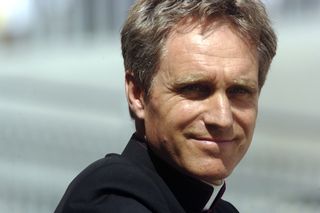 who were child molesters. And that senior members of the Church hierarchy protected these men, believing that the reputation of the Church was more important than the safety of children, and that Church law was superior to civil law. When they were found out, their sorrow was not fully credible. Thus, when we think of the Catholic Church, we think of secrecy, half-hearted apology, studied concealment.
This makes it difficult for Ratzinger, who is probably the most intelligent and articulate pope for many generations, to be heard properly when he speaks about matters of faith and morals. He wishes to make it clear, from a position that is starkly coherent, that moral values are not relative values, but absolute ones, that we must follow God’s will, and that the Catholic Church is in a unique position to tell us in some detail what this entails. However, rather than listening to this message or bowing our heads as he offers us his blessing, because of what has happened, because of a new suspicion which even the most reverent feel about the clergy, we will find ourselves examining Ratzinger’s clothes and his accessories, his gestures, and checking behind him for a glimpse of the gorgeous Georg with whom he spends so much of his day.
(Photos: 1. In a picture made available on July 20, 2006, by the Vatican newspaper L’Osservatore Romano, Pope Benedict XVI walks with his personal segretary Georg Ganswein, July 18, 2006 in Martigny, Switzerland. By the Vatican Pool/ Getty. 2. The Pope’s personal secretary Georg Ganswein smiles as he arrives in Saint Peter’s Square for the weekly general audience at Saint Peter’s Square, May 17, 2006 in Vatican City, Italy. By Franco Origlia/Getty.)

 The Dish