Extra Punishment

Adam Serwer on prison inmates with HIV:

Two states in the union, South Carolina and Alabama, segregate their HIV-positive inmates, a policy that is essentially a compound punishment on top of whatever sentence they've already received. They're forced to wear markers identifying their status, they're denied access to many of the same privileges and programs that inmates who aren't HIV positive have, including those that can contribute eligibility for early release. Being HIV positive means that they're forced to live under maximum-security conditions regardless of the severity of their crimes. A thief and a murderer are treated the same if the thief is HIV positive, where otherwise the thief might have been eligible for imprisonment in say, a medium-security facility. In addition to the individual rights violated by involuntary testing, an individual's status is also involuntarily disclosed to their friends and family members upon their placement in a segregated facility.

The Bipartisan Assault On Privacy

Tumblr_l3g68pewOa1qanb21o1_500

Glenn Greenwald writes in Cato Unbound on the rapid expansion of the digital surveillance state:

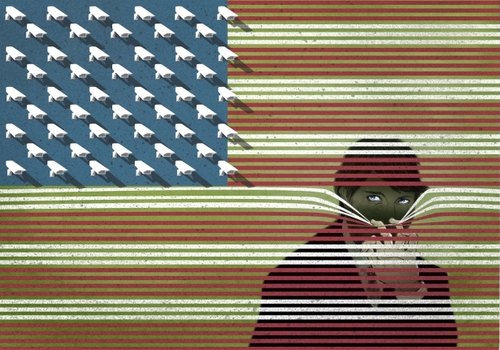
The spate of knee-jerk legislative expansions in the immediate aftermath of the 9/11 trauma — the USA-PATRIOT Act — has actually been exceeded by the expansions of the last several years — first secretly and lawlessly by the Bush administration, and then legislatively and out in the open once Democrats took over control of the Congress in 2006. Simply put, there is no surveillance power too intrusive or unaccountable for our political class provided the word “terrorism” is invoked to “justify” those powers.

The Unique Quality Of “Lifelong Heterosexual Monogamy” Ctd

A reader writes:

I disagree with probably 90% of what you post nowadays. I think you have gone unhinged on Palin and I think you give Obama way too much slack. Also, I come from a conservative Christian background, and for most of life opposing gay marriage has just been kind of something I believe without really knowing why; it just was. 

While my views have been shifting over the past few years, your post crystallized things for me in a way no New York Times essay ever could. Basically, I read your entry, then looked at your pictures and their corresponding captions. It almost made me cry. Throw out what I have personally felt about gay marriage, gay sex, etc.  Who am I, or anyone, to deny you and your family such happiness?  Why should I wish for you to be deprived of the gift of marriage?

Like I said, I often dislike your confrontational and personalized view of American politics. But I thank you for today's post. Getting past all the judicial, societal, and other arguments for and against gay marriage, the most powerful argument for marriage equality is that special day you documented in words and pictures.  I wish you and your husband all the happiness in the world.

I'm grateful that there are some things that are beyond politics. Or should be, anyway. God bless.

De-Personalizing Weddings, Ctd

Wtf-wedding-starwars1

A reader writes:

I'd love to be rid of the "It's My Day!" foot-stomping as well, but I don't think you need to go as far as de-personalizing the wedding. I think we can distinguish between personalizing a wedding and going overboard with extravagant flourishes as some kind of symbolism about how glamorous The Event is supposed to be.

I see the wedding day as the rare time when nearly all of the people you care about (and who care about you) are assembled in the same place and get the chance to experience who you are as a couple and to see how much you really care for each other. I don't see how those two things take away from the seriousness of a marriage. There's a time and place for the couple to receive a lecture about how much work a marriage takes (and it does) — that time is well before the wedding date, and that place shouldn't require all of your family and friends to fly across the country to sit through it.

Another writes:

Your post makes a great point.  What I like about the common Catholic wedding ceremony is that people all make the same vows.  My parents made the same vows as my sister-in-law.  It is a common bond even if their ceremonies took place decades apart.

My wedding was less traditional – an Elvis impersonator in Vegas. 

While it was different, we did not have an opportunity to read our own vows.  Instead, 'Elvis' asked us to adopt each other's hound dogs, never leave each other's blue suede shoes out in the rain, and to never have a Blue Christmas without each other.  Most everyone in attendance laughed. Yet, in the almost 10 years as a married couple, we take those promises quite seriously.Standing in front of family and friends, we promised to accept and embrace our individuality, treat each other with kindness, and never be apart for the days that matter most.  That's how I see it. 

I still have the vows I had hoped to read to my wife on our wedding day.  (I re-read them on Saturday, in fact.)  They are not as good as what 'Elvis' asked us to say.  Not even close.

Another:

I went to a friend's wedding in Germany, where the civil ceremony is independent of any religious ceremony and trumps it.  You can have a religious ceremony if you want, but first you have to stand before a bureaucrat and register your marriage with the state.  (I think it works this way in other countries, too.)  Great model, if you ask me.

So, we all met at the courthouse in their small-ish village.  My German isn't great, but the civil ceremony involved reading the parts of the German constitution verbatim and outlined the social bond the couple was entering.  They signed some papers; we went to lunch.  (The couple is not religious, so there was no religious ceremony.)  That's about as impersonal a wedding as you can get.  Still, there is that deep connection to society.

Incidentally, they were presented an official family tree that stretched back ages and showed their two lines connected.  And I think they got a list of approved baby names.  Gotta love Germans. French friends, on the other hand, have all signed up for civil unions and foregone marriage.  I suspect that here are a lot of 20- and 30-somethings in France who will never be "married."  Why should they?

Another:

I got married in August of last year in a beautiful, traditional Anglican service (my parents are Anglican clergy) with ancient prayers, wedding anthems with the words from the Song of Songs sung from the choir loft, our clasped hands wrapped around my father's stole as he blessed our union. The only mention of my wife and I as a couple came in the sermon, which emphasized the importance of a lifetime of charitable love in bad and good times.

I felt for a long time very similar to Andrew Brown on the subject on the importance of a traditional, de-personalized wedding ceremony, until this summer after I attended the wedding of one of my best friends in France. On paper, the wedding had all the hallmarks of a ghastly modern ceremony: humanist celebrant, and a specially written, personalized service all about the couple.

But far from being a cheesy, cringe-inducing, egotistical "let's rub it in your face about how awesome our relationship is" wedding, the ceremony – essentially a forty-five minute speech given by the celebrant based on the sentiments of the couple themselves – featured a very realistic, sober-minded appraisal of the travails of a life lived together, and included some of the very themes Brown alluded to, especially how the "problems and difficulties of marriage are universal."  The underlying theme of the service struck me as making particular the universal value of marriage alluded to in my own wedding. If anything it was more effective because it signaled just how thoroughly the couple had thought these things through beforehand.

Ultimately, the style of wedding probably doesn't matter, but tempering your expectation of what the wedding will "magically" entail certainly does.

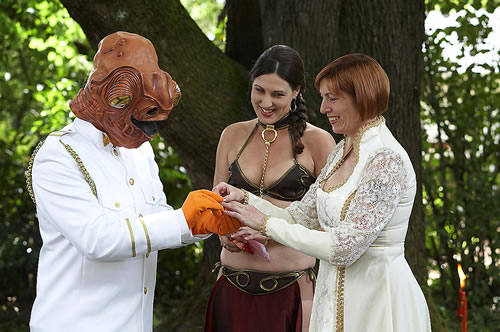
(Photo via Wedinator.  It's a trap!)
Leaving Afghanistan In 2011?

Bagramtwalls-660x495

The image above from Spencer Ackerman is the periphery of the massive new Bagram base for the new American empire in Southeast Asia. For some reason I don't believe the July 2011 deadline:

Step off a C-17 cargo plane, as I did very early Friday morning, and you see a flight line packed with planes. When I was last here two years ago, helicopters crowded the runways and fixed-wing aircraft were –- well, if not rare, still a notable sight. Today you’ve got C-17s, Predators, F-16s, F-15s, MC-12 passenger planes … I didn’t see any of the C-130 cargo craft, but they’re here somewhere.

More notable than the overstuffed runways is the over-driven road. Disney Drive, the main thoroughfare that rings the eight-square-mile base, used to feature pedestrians with reflective sashes over their PT uniforms carrying Styrofoam boxes of leftovers out of the mess halls. And those guys are still there.

But now the western part of Disney is a two-lane parking lot of Humvees, flamboyant cargo big-rigs from Pakistan known as jingle trucks, yellow DHL shipping vans, contractor vehicles and mud-caked flatbeds. If the Navy could figure out a way to bring a littoral-combat ship to a landlocked country, it would idle on Disney.

Expect to wait an eternity if you want to pull out onto the road. Cross the street at your own risk.

Then there are all the new facilities. West Disney has a fresh coat of cement –- something that’s easy to come by, now that the Turkish firm Yukcel manufactures cement right inside Bagram’s walls.

There on the flightline: the skeletons of new hangars. New towers with particleboard for terraces. A skyline of cranes. The omnipresent plastic banner on a girder-and-cement seedling advertising a new project built by cut-rate labor paid by Inglett and Stubbs International.

The US will be occupying Afghanistan for the rest of my life. If you think you have a say in the matter, think again.

Christianist Watch

"I think that it would be advisable [to prohibit gays from being foster parents]. I really do not think that we should have homosexuals guiding our children. I think that it’s a lifestyle that I don’t agree with. I realize a lot of people do. It’s my personal faith, religious faith, that I don’t believe that the people who do this should be raising our children. It’s not a natural thing. You need a mother and a father. You need a man and a woman. That’s what God intended," – Florida attorney general and gubernatorial candidate Bill McCollum.

The Conservative-Liberal Delusion?

A reader writes:

You’ve defined conservatism many times over the years as a “disposition.” The clip that you featured yesterday of Ted Olson on Fox News, defending his strong pro position on same-sex marriage, seems – to my mind – to be about as good an example of the true conservative disposition as one could hope for: principled, humane, calm, smart, broad-minded, pragmatic, courteous, inclusive and reality-based.

But the same could be said for David Boies, Olson’s liberal co-counsel partner and – since their days as opposing counsels in Bush v Gore – good personal friend.

So where exactly does the difference in “disposition” lie, in this case? It’s not in their positions on the issue, which are remarkable similar, if not identical. It’s not in their qualities of character, which are both exemplary. Is it possible that, at this level – the principled, humane, calm, smart, broad-minded, pragmatic, courteous, inclusive, reality-based level – there really is no difference between conservative and liberal? That once having ascended the peak to actual, functional intellectual, emotional and spiritual adulthood — to human maturity — the paths of liberal and conservative meet, as they say all spiritual paths do?

Maybe we are all both conservative and liberal all along. Ask yourself: if you won a new car on some game show, but could only have one of the following two options, which would you choose – brakes, or an accelerator? The answer, of course, is every car needs both, just as every person, and every polity, needs both brakes (conservatism) and accelerator (liberalism) – and hopefully, both in good working order.

So the seemingly endless fight between conservative and liberal in this country is endless because it’s a false choice, a fake war, ginned up by those who profit by that war. The real issue is not left or right. The real issue is maturity versus immaturity, selflessness versus selfishness, country versus party, disinterested truth versus power at any price. These are not left or right issues. These are developmental issues, issues of up or down, maturity or immaturity — as both Olson and Boies so clearly prove by example.

Following Oakeshott, I have long believed that the liberal and the conservative strands in Anglo-American political tradition and discourse are complementary. Oakeshott sketched these two ways of seeing the world – enterprise association (collectivism at worst, patriotism at best) and civil association (selfishness at worst, individualism at best) – and believed the genius of modern European politics and the Anglo-American tradition lay in using each resource as befits changing circumstances. There are moments in a country's history when collective action is required; ditto when a resurgence of individualism is necessary. The question is judging when, a matter of prudential judgment that true statesmen or women alone can discern.

That's why I see no contradiction between backing Reagan and Thatcher in the 1980s and Obama today.

1980 and 2008 are very very different times. One was at the end of collectivist gridlock; the other comes at the end of a reckless indifference to government revenues, military prudence and foreign policy finesse. Right now, I think we need some infrastructure help, need some tax increases, need some adjustment downwards in defense spending, need a new realism in foreign affairs, because the times demand it. Maybe I'm wrong, but accepting the role both traditions play is essential to keeping the ship of state on a steady keel. 

The point is balance. And oddly, I think, and wrote in Virtually Normal, that the arguments for including gay people as equals in our society are both liberal and conservative. And that's why it's so appropriate and even moving to see Boies and Olson defend this.

There's a right wing and a left wing, but only with both wings can we actually fly.

The Unique Quality Of “Lifelong Heterosexual Monogamy” Ctd

A reader writes:

I found this piece of yours very moving, and I want to add to the conversation on gay marriage my perspective as a child raised by a gay couple (a "homogenate" as I call us, for short) in the U.S. in the 1980s.

If I had been born in the '90s or the '00s in the right state instead of the '80s, perhaps my biological mother and her lover, Mollie, could have had a civil union. That would have made their relationship simpler from a legal standpoint, for sure. But still, what would I have told my friends who came over after school and asked innocently: "Why does that woman live with you?"

Would I have felt better telling them that she is my mom's "domestic partners" instead of the usual routine: blushing, averting my eyes and blurting out "She's my mom's friend" or "Uhh … she just lives with us" before frantically changing the topic.

Even if I was a pedantic 9-year-old willing to explain to my friends what a civil union is and how it is the legal equivalent to the (first or second) marriage of my friends' parents, that still doesn't address the fundamental problem in my opinion: Mollie could be my mom's friend, my mom's domestic partner, my mom's lover — but she could never be my anything. She could never be my stepmother.

Family names are generic things — mothers, fathers, sisters, brothers, and all their step-incarnations. It is the possessive that creates intimacy and a sense of family. And while our family would have had the same strains as any step-family even in the best of circumstances, I have no doubt that she and I would be closer today if I had grown up calling her and thinking of her as "mine" in some sense — even when I was angry with her, or I missed my father, or, yes, when I wished that she was just gone and my family was normal.

Let me add something that I experienced as well. My in-laws have always been supportive and loving and tolerant. They accepted me at Christmas and other occasions and were glad their son had found a partner. But it was not until we told them that we were "engaged" that something suddenly clicked. They finally had a way to understand us and our love because they had the linguistic architecture to make sense of it. I was going to be their son-in-law! With those words. I became family – not Aaron's friend, or roommate or boyfriend or lover or what-have-you. But his husband. And thereby their family as well.

There was and is something about these words – engaged, married, husband – even though they may contain a mountain of different experiences, that made us a family. I think conservatives should favor the unification and mutual love and support of families. And that means they must by definition favor the mutual love and support of the gay people in them.

This is not about creating something new. It is about making a home for people who have been here all the time for centuries. It is about making the human family whole.

Who Let The Dogs Out? Ctd

A reader writes:

Just an observation from your post yesterday, "Who Let the Dogs Out?" A key passage comes near the end, when you write of neoconservatism's "deeply hidden contempt" for the democratic West.

This really is where the intellectual connection to Leo Strauss is worth noting. The entire Straussian project is premised on a thoroughgoing critique of modernity — see especially LeoStraussfairuse Strauss's essay, "The Three Waves of Modernity." Modernity starts with Machiavelli and Hobbes and Locke, moves through Rousseau, and ends with Nietzsche (and implicitly Heidegger). That is, a nefarious break with "the ancients" occurred in the early modern period that set in motion a decline towards historicism, relativism, and nihilism. This is the theoretical backdrop to significant elements within neoconservatism; it is premised on this critique of modernity, on the possibility of impending doom, on the inability of "modernity" to sustain itself.

So neoconservatives, cynically and instrumentally, tend to defend and deploy "pre-modern" virtues and institutions — the military, war, and martial virtue; and reactionary religion ("Biblical religion"). These push against the trajectory of modern life, and thus (supposedly) stave off the decline they are convinced is always already underway. They do not try to sustain modernity from within, to reconcile, say, faith and modernity, but rather see modernity as something that needs counterweights, that needs to be pushed back against at every turn. So you purposefully cultivate certain elements that are in reaction to modernity — you push for war to fend off the decadent "softness" of modern liberals, and you make alliances with the religious right.

You can see why Irving Kristol, as editor of the CIA-funded magazine, Encounter, rejected an essay from Michael Oakeshott. The essay? "On Being Conservative." Neoconservatism, especially at its most Straussian, is in every important way un-Oakeshottian. Your writings of late bear this out, I think. In a way, you are re-enacting a quarrel between two of the great political philosophers of the 20th century.

I sure am. The Oakeshott-Strauss divide is the core faultline in conservatism. As an Oakeshottian, I'm a believer in modernity's strengths and endurance, just as I believe that religious faith can and will integrate and come through modernity's challenges. Straussians tend not to trust modernity, and many feel contempt for it; they always feared that the West was too decadent to defeat Nazi Germany or the Soviet Union, just as they are deeply doubtful that the West can outlast Islamism. And the point of the West, for them, is not the freedoms it provides the masses (how crass) but the space it affords the philosophic elites.

Hence their instrumental belief in war as a virtue, in torture as a Machiavellian necessity, in primitive forms of politicized Christianity as a ballast against Islam. They are almost all value-free atheists who long for an ancient world that can never return. I'm a believer who lives for the future and is perfectly happy in a fractured, diverse, multi-cultural present. Not just that: I think that system is stronger than all the rest.

If we do not lose faith in it.