On That Iran Policy Briefing

Joe Klein got the same memo days ago:

The powerful bazaari community has been shocked not just by the universal support for the sanctions, but also by their comprehensive nature. Iranian ships are sitting at their docks because they international community is refusing to insure them. Banks that have done business with Iran in the past are refusing to do so now because the UN sanctions–that's right, those "weak" UN sanctions–target them as well. The Iranian economy, a stagflation fiasco before the sanctions, is cracking.

As a result, the Administration has been receiving all sorts of feelers–public and, for the first time, private–from the Iranians about resuming the negotiations on the nuclear program.

What Will Justice Kennedy Do?

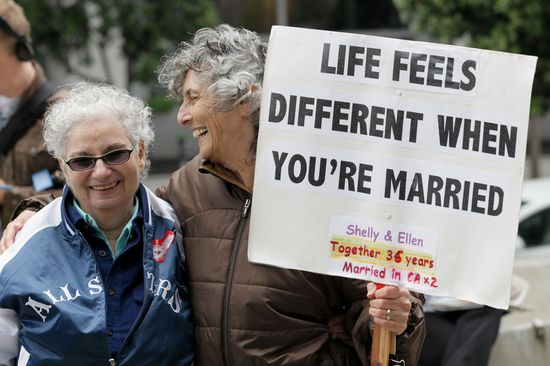
PROP8LESBIANJustinSullivan:Getty

Silver tries to weigh the intangibles:

I'm not qualified to analyze the merits of Perry v. Schwarzenneger point of view from a legal positivist point of view, I will deign to take a crack at it from a legal realist frame. It seems to me that most of the "intangibles" bear upon Justice Kennedy in ways that favor his finding Constitutional protection for same-sex marriage. For one thing, he'll be 75 or 76 by the time the SCOTUS hears this case, and will probably be thinking about his legacy. Given that, in 50 years' time, American society will almost certainly regard the plaintiff's position (the Constitution does not permit discrimination in marriage on the basis of sexual orientation) as the right one, that legacy would be better served by casting the decisive vote in favor of the plaintiffs.

(Photo: Same-sex couple Shelly Bailes (L) and Ellen Pontac celebrate the ruling to overturn the ban on gay marriage outside of the Philip Burton Federal building August 4, 2010 in San Francisco, California. By  Justin Sullivan/Getty Images)

The Facts, Ctd

Orin Kerr responds to a Dish reader:

The question is, how much will those factual findings matter on appeal? 

If the Supreme Court agrees to hear the case, I don’t think the factual record will matter very much. I think that for three main reasons. First, the Justices will know that this case presents a defining moment for their respective tenures on the Court. This will be one of the biggest decisions of their careers, and its importance transcends a single trial before a single judge with a particular set of witnesses. These sorts of mega-big-picture cases tend rest less on the details of the factual record than other cases. Second, the Justices will certainly recognize the same point that Dahlia Lithwick and the Sullivan commenter made — that is, Judge Walker was trying to use his facts to make an argument designed to persuade the Justices to agree with him. For better or worse, I suspect a majority of the Justices will respond to that dynamic by significantly discounting those facts.

Kerr has further thoughts on the ruling here and here. What he seems to be saying is that the facts behind the arguments do not matter in the face of cultural politics. I'd say they have to matter, when adjudicating the rationality of a law that deprives a minority of core rights.

A Maximalist Decision?

Dale Carpenter is carefully reading the Prop 8 ruling:

My concerns about this decision outweigh what I see as its merits. In reading so far, I think a notable feature of Judge Walker’s decision is its judicial maximalism — a willingness to reach out and decide fundamental constitutional questions not strictly necessary to reach the result. It is also, in maximalist style, filled with broad pronouncements about the essential characteristics of marriage and confident conclusions about social science. This maximalism will make the decision an even bigger target for either the Ninth Circuit or the Supreme Court. If that’s right, it magnifies the potential for unintended and harmful consequences for gay-rights claims even beyond the issue of marriage. Think of a possible (but milder) anti-SSM version of Bowers v. Hardwick, which had consequences far beyond the constitutional affirmation of sodomy laws…

The decision, as I read it, relies directly or indirectly upon every prominent constitutional argument for SSM. One could say this is a strength of the decision. If a higher court doesn’t like one reason, it might accept another. But it is also a weakness of the decision, from a gay-rights litigation perspective, since it invites a higher court to address them all if it decides to reverse the result. A sweeping victory becomes a sweeping defeat.

I understand Dale's worries and his post is well worth reading closely. But even he believes a truly minimalist position would not have worked. And look: if the Supreme Court does not find a right to civil marriage for all citizens in the Constitution on equal protection or due process grounds, then we will be back to the state legislatures. What I think Dale under-estimates is the educative merits of this process, the reason that lies behind it, and the simple fact that this kind of inequality is incompatible, in my view, with a republic that treats equal protection and rationality seriously. And since this is our shared view, why not speak it?

Conviction matters. Conviction changes the world. Conviction has changed the world. If we had more of it, we could change America.

Iran: Are Sanctions Working?

The president thinks so:

The sanctions were designed to exploit Iran's over-reliance on its paramilitary force, the IRGC, for ways to evade the sanctions, and to prevent its oil industry from obtaining the foreign investment necessary for development. A U.S. official said that Iran was recently forced to abandon an effort to develop an oil field because the IRGC didn't have the expertise and the country could find no subcontractors who were willing to risk the penalties imposed by the sanctions.

"By continuing to expose their evasions and deceptions, we create the dynamic of a private sector reticence to do business with them," another official said, as well as disquiet within Iran's business community and its middle class. 

The fact that Russia and China are on board and the Europeans have beefed up their sanctions must also weigh on the coup government's calculus. And there are signs of small progress in Iran. Ignatius notes:

Officials said these signs include the strike last month by Tehran bazaar merchants who are unhappy about the battered economy, as well as recent signals through various channels that the Iranians want to come back to negotiations… What came through in Obama's upbeat presentation was the administration's view that for all Tehran's bombast, the United States and its allies have the upper hand.

One reason for this confidence is that Iran appears to be having serious technical problems with its enrichment process — due to bad design, bad luck or deliberate sabotage. A senior official said that only 3,800 centrifuges were now operating at Natanz, at only about 60 percent of their design capacity, with another 4,000 in reserve to cope with breakdowns.

And so Obama, again, is offering an open hand to the coup regime to open its nuclear sites for effective and genuine international inspection, and to move toward shared anti-Taliban goals in Afghanistan. This may come to naught, but it turns the tables on Ahmadi on the international stage. And in the end, this matters. By tightening sanctions while keeping an open hand, Obama avoids the appearance of America being the bully, and prevents cooptation of national pride by the regime. The alternative – a military strike by Israel or the US – would unite Iran's opposition and regime, unleash a global religious war, intensify Shiite-Sunni polarization, kill countless civilians in the West, put US troops in an untenable position in Iraq and Afghanistan, and add turbo-charged gasoline to the Islamist brush-fire. 

None of the current policy is emotionally satisfying or risk-free. But the real alternative is so much worse we should hang in, and hope. That's called pragmatic, realist government. And it's a relief to see it at work again in America's corridors of power.
Basil Marceaux For Governor, Ctd

Allahpundit grins at Marceaux’s official campaign ad:

And so, after a months-long trek up the slope of a mountain of zany campaign ads, we finally reach the summit. Nothing will top it, my friends; even Dale Peterson’s Winchester can’t compete with the next governor of Tennessee mumbling his policy platform while misspelled graphics (“vegitation”?) fill the screen. My only question: Is this just Marceaux being Marceaux or is he actually winking at his own goofiness here? I want to believe it’s the latter, but…

And yet the wonderful thing about Marceaux is that he does represent a core constituency. Aren’t his views on gun-control identical to Glenn Reynolds’? Isn’t his nostalgia for the Jim Crow south one strand of Southern conservatism that now dominates the GOP? Aren’t his views part of what Palin calls the “real America”? It seems to me the right cannot have it both ways. If this man’s views make him a joke, then why isn’t the GOP as a whole a joke?

Geriatric Release?

Serwer analyzes prisoner demographics. The inmate population is getting older:

Obviously you don't want any Lockerbie Bomber type situations where dangerous inmates or those who have committed heinous crimes are getting a pass just because they're old, but by the time you're 55 you're pretty much past crime-committing age. According to the U.S. Sentencing Commission, offenders over 50 have a recidivism rate of only 9.5 percent. Compare that to offenders under 21, who have a recidivism rate of 35.5 percent. Until states start using their geriatric release programs more often and study the effects, it's hard to know whether geriatric release would save money overall or just in corrections budgets. But it's important to remember that being as punitive as we are in the U.S. costs real money.