“What I intend to do is uphold a standard of intellectual seriousness on the right. They should be written in a way that they are serious, soberly argued, well researched, and make a respectable case — agree or disagree,” – Adam Bellow, publisher of Sarah Palin's "Going Rogue" and Bill O'Reilly's "Pinheads and Patriots."
Month: September 2010
Moore Award Nominee
Rep. Alan Grayson does the full Kos:
Ed Morrissey fights back:
I seem to recall how Democrats used to shriek hysterically about having people impugn their patriotism for opposing the wars in Iraq and Afghanistan. Now, suddenly, quoting either Ephesians 5 or Colossians 3 makes one the equivalent of a terrorist group that is our enemy in the field? TPM avoids taking any kind of a principled stand on this smear, noting only that “reporters and partisans argue about dubbing a Congressional candidate a member of the Taliban[.]“ Do they really “argue” about it? Which reporters, or even rational partisans, think that calling a candidate “Taliban Dan” is somehow both instructive and reasonable?
The Genesis Of A Good Idea, Ctd
The gist of Steven Johnson's talk is now available in animated form. It's an ad for his new book:
It Gets Better, Ctd
A commenter on Slog counters McArdle's niggling:
I'm mildly put off by the people who want to include 'many other teens' in this message. Yes, it's true that lots of kids get harassed and bullied, not just gay kids. But the problems faced by gay kids is far worse. GLBT teens are 4 times more likely to kill themselves than straight teens. Hard fact. And in a lot of places, it is perfectly acceptable to harass gay kids, even while administrators discourage bullying of other kids. Gay kids often can't seek support at home from their own homophobic family. So I think it is important that this campaign is directed specifically to GLBT kids, and not just generally to kids that get bullied.
A Dish reader put it more succinctly:
The United Negro College Fund – what about Asians?
Another writes:
Of course lots of kids get bullied, but most fat kids, etc. have family who at least know their kid's situation, they see other fat people all over the place, and perhaps their parents are fat. I've never heard of a teenager having to say "Mom, Dad, I'm fat." And for gay teens who are afraid of telling their parents, sometimes the parent is part of the problem, maybe a father who's always yelling at his son to "stop acting like a sissy" or a religious mother who always drags them to a gay-hating sermon every week. For many gay teens it's less the bullying than the feeling that they're all alone, nobody understands, and nobody can help them.
Another:
I don't agree with your characterization of Megan's post as niggling. She effusively praises the project and thinks that even more young people could benefit from this type of effort. I saw no denigration in her comments.
Another:
Megan McArdle misses the point of the "It Gets Better" project. I'm one of the straight kids she talks about who was horribly bullied as a teenager (mostly in middle school). I was miserable for years and seriously contemplated suicide several times. But I got through it because I had something that many queer kids don't have: role models who had gone through the same things and come out of it okay.
People who lived through bullying as teens and went on to become happy adults are pretty common. But happy, out, queer adults who went through the same things are in much shorter supply, especially in rural areas. And queer teens are constantly being told that they are different from everyone else – unnatural or sinful or doomed to live a miserable life because of a basic fact of their identity – so they can't assume that what worked for straight kids will work for them. Many queer teens won't (knowingly) meet a happy gay adult until they graduate, leave home, and go someplace with a sizable gay population. Until then, Dan Savage's project will help.
The Petraeus Syndrome – And Its Pernicious Effects, Ctd
Serwer adds more context:
[I]t's not the military's job to make troop decisions, it's the president's job. But because the military is popular and trusted while politicians are not, there's a political incentive for politicians to use the military against their political opponents. That further erodes trust in civilian leadership while entrenching the notion that the president's job is to rubber-stamp the decisions made by his military advisers.
The thing is, politicians aren't the only ones who worry about their image. To the extent that there's been a "canonization" of Petraeus I'd argue the media is more responsible than Petraeus himself. The incentives to find a central hero in a sprawling narrative of war, the media's own desire to align itself with a popular figure in a time of conflict, and the general trend towards shoehorning complex events into simple stories all contributed to the current circumstances.
Chart Of The Day
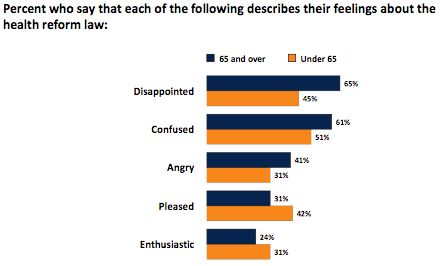
A summary of Kaiser's September health care tracking poll:
Six weeks from the contentious midterm elections, confusion over the new health law has risen to its highest point since April, with 53 percent of Americans saying they are confused about health reform, up 8 percentage points from August. Misperceptions about the law also persist: for example, three in ten seniors believe the law will permit government panels to make decisions about end-of-life care for Medicare recipients (often referred to as "death panels").
When Plush Seating Began
Joan Dejean delves into the history of furniture:
After so much build-up, sofas naturally provoked some extreme reactions. Some people went sofa-mad and had them in every room of the house, often several to a room. German visitors to the French court, on the other hand, complained that “it no longer looked like a court” because you saw people “stretched out full-length on sofas.” When Horace Walpole quipped that sitting on a sofa was like “lolling in a péché mortel” — a mortal sin — he was poking fun at some of his fellow countrymen, who worried that overly plush seating might prove a dangerous thing.
Today, some dismiss sofas as banal and overused, while the decorator Nate Berkus says that every living room should be built around the perfect sofa. More than 300 years after Europeans discovered it, the sofa thus remains the one piece of furniture that never simply disappears …
Talking To The Oldest Man On Earth
An interview with Walter Breuning, who celebrated his 114th on September 21st:
Nir Barzilai of the Institute for Aging Research studies centenarians:
"There is no pattern… The usual recommendations for a healthy life – not smoking, not drinking, plenty of exercise, a well-balanced diet, keeping your weight down – they apply to us average people… but not to them. Centenarians are in a class of their own." He pulls spreadsheets out of a drawer, adjusts his glasses and reads out loud: "At the age of 70, a total of 37 percent of our subjects were, according to their own statements, overweight, and 8 percent were obese; 37 percent were smokers, on average for 31 years; 44 percent said that they only moderately exercised; 20 percent never exercised."
But Barzilai is quick to point out that people shouldn't start questioning the importance of a healthy lifestyle: "Today's changes in lifestyle do in fact contribute to whether someone dies at the age of 85 or already at age 75." But in order to reach the age of 100, says the researcher, you need a special genetic make-up. "These people age differently. Slower. They end up dying of the same diseases that we do – but 30 years later and usually quicker, without languishing for long periods."
(Hat tip: Dan Zak for video and Norm Geras for article)
RIP Willy Loman (Again), Ctd
Doug Mataconis has few tears to shed for out-of-work salesmen:
I’m not sure whether I’d call it a “tragedy” like Ledbetter does. What we’re seeing here is really nothing more than the continued, ongoing evolution of the economy. In the days before the Internet, it made sense for companies to hire armies of salesmen, like Willy Loman, who spent their time trying to convince business owners to buy their wares. In later years, the sales trip was replaced with the cold call, but it was really the same idea. Now, there’s virtually no need for that and, on the whole, the economy is better off for it. Technology has reduced the transaction costs between customer and seller (or manufacturer) to nearly zero, and it just doesn’t make sense to pay a guy to travel the country with a big suitcase full of stuff.
Nicotine’s New Boom Towns
Last week Canada's National Post launched a surprising series:
 The Dish