What happened at Harvard yesterday.
Month: September 2010
Encased in Soundproof Glass
David Cole reviews two new books on the atrocities at Guantanamo, and draws out this depressing fact:
Even the physical design of the Guantánamo courtroom is shaped by the desire to conceal our own abuses. A soundproof glass wall separates the onlookers from the trial participants, so that the only way an observer can hear what is going on is through headphones with a forty-second delay. The reason, according to Denny LeBoeuf, an ACLU lawyer advising on the defense of several detainees, is “the Rule: detainees are forbidden from speaking about their torture.”
Remarkably, the US government has declared “classified” anything that the detainees say about their torture, and has required the lawyers, as a condition of access to their clients, to keep secret all details of their clients’ treatment at the hands of their interrogators. But of course, the US cannot compel the detainees themselves not to speak of the unspeakable. The only way it can keep them from telling their stories is by keeping them detained, behind bars, behind glass, silenced.
Quote For The Day
“If Obama has proven one thing beyond a shadow of any hypothetical doubt since taking office, it is that he is anything but a radical. On domestic policy he is barely to the left of center. On foreign policy, he is actually to the right of center. His two years in office has, if anything, been devoted to stubbornly refusing to try to move the country to the left. The problem for conservatives, as I have said time and time again, is that they cannot attack Obama for his policy mistakes because most of his policy mistakes are mistakes because they have continued the bad policies of Bush or focused too much on reaching compromises. So they have to go to the outer limits of crazy to find criticisms — he's a Muslim, he's a terrorist sympathizer, he's the next Adolf Hitler, and so forth,” – Ed Brayton, responding to Daniel Larison, reacting to Jonah Goldberg.
Conway vs Paul
A surge in support for the Kentucky Democrat, especially among women. The last poll had Paul 15 points ahead. The latest shows a 2 point lead, within the margin of error. Harbinger or outlier?
Why The Health Insurance Reform Is Unpopular
According to a new AP poll, because it did not go far enough.
“Never hung poison on a fouler toad.”
An assessment of one the most repulsive human beings in contemporary political life: Dick Morris.
Another One?
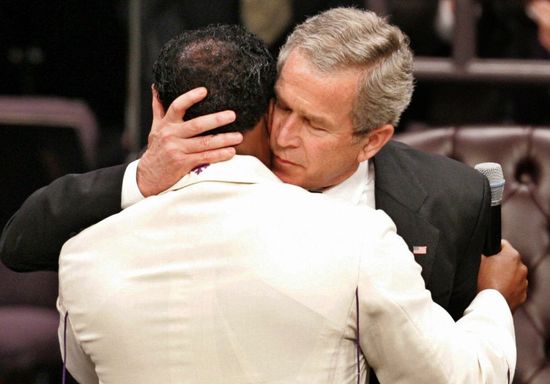
Yet another anti-gay religious right figure is seriously accused of abusing his authority to get young men to have sex with him. He did not fully deny it this morning. This is not on a par with the Catholic church's abuse of minors, because the men were (just) of legal age. But the now almost constant revelations of gay religious leaders preaching and campaigning against themselves, while finding it impossible to live a life without love and sexual intimacy that is real to them, reveal the tragedy of homophobia, especially in religious life where so many gay people find themselves drawn, and where many do great and important work – but are simultaneously asked to destroy their own psyches and lacerate their own souls. For the record, Ted Haggard has come out in defense of Long.
There is only one way out: to embrace gayness as part of God's creation, to find a way to bless gay relationships, to celebrate the diversity of humankind, and to love one another, instead of hating ourselves. There is in the NYT story a wonderful quote that cries to heaven on this:
“It’s like hot milk now, sitting on the curb, getting sour.”
How much more evidence will we have to absorb before this obvious answer becomes unavoidable? How many lives have to be wrecked before we get beyond this lie?
(Photo: President George W. Bush embraces Bishop Eddie Long during the funeral for Coretta Scott King on February 7, 2006 at the New Birth Missionary Baptist Church in Lithonia, GA. By Ric Feld/AFP/Getty.)
“Nothing Else Needs To Be Said”
Copyranter points to "the most powerful domestic violence awareness advertising I've ever seen":
“Locating Agency Everywhere”
Jacob T. Levy writes at Cato Unbound on the philosophy of James Scott's Seeing Like A State, and the libertarian lessons therein:
Like our social contractarian forbears, we too easily imagine the modern state as natural and unquestionable. We moreover too easily assume away the information and knowledge problems that — in very different ways — have so preoccupied Hayek, Foucault, and Scott. We ask what states should do without wondering what they would have to know in order to do it, or how they would gain that knowledge, or what the effects would be of their attempts to do so. The combination of Seeing Like a State with The Art of Not Being Governed reveals a world in which states are particular kinds of social projects, not natural preconditions for social order; in which states’ knowledge and penetration of their societies comes in degrees; and in which states’ activities may create their own limits by provoking those being governed.
The first conservative insight is epistemological: how do we know what we think we know?
Poem For Autumn
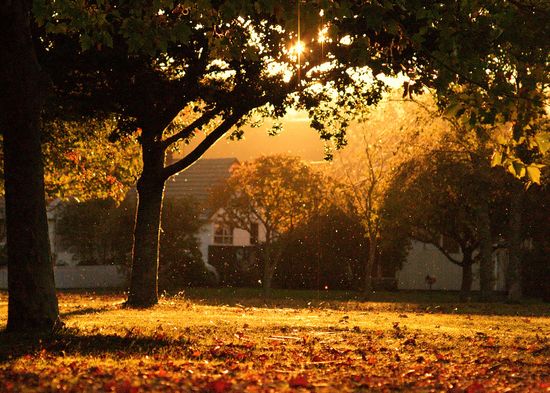
"Autumnal" by Oliver Wendell Holmes first appeared in The Atlantic in December, 1868:
Can this be sadness? this forebode decay?
Are these the vestments of funereal woe?
Sure, hues that pale like these the dawning’s glow
The rather deck some dryad’s festal day!
Hail, radiant hour! thrice welcome, gladsome ray,
That kindling through these boughs, with golden flow,
Streams joy and summer to the shades below!
And thou, brown-dappled Oak, and Maple gay,
In rippling waves of many-tinted flame,
Lithe Birch gold-hued, thin Ash, whose dyes might shame,
The trodden vintage reeking on the lees,
And ivied Beech with sanguine cinctures fair: —
As in the long days past, fraternal trees,
With you, whate’er your gladness, let me share!II.
O’er banks of mossy mould how lightly strewn
All the wan summer lies! The heedless tread
Awakes no sound; and, had not pale leaves fled,
As soft it came, the low wind were not known.
How strange the sharp and long-drawn shadows thrown
From lank and shrivelled branches overhead
While from their withered glories, spoiler-shed,
The earthy autumn-scents are faintly blown!
Ah! reft and ravaged bowers, the garish day
Flaunts through the hidings of your dewy glooms!
And thou, in leafy twilights wont to be,
Shy maid, sweet-thoughted Sadness, come away,
And here beneath this hemlock’s drooping plumes
With pensive retrospection muse with me.III.
Why holds o’er all my heart this dreamy hour
A sway that spring or summer never knew?
Why seems this ragged gentian, wanly blue,
Of all the circling year the fairest flower?
Whence has each wandering leaf this mystic power
That all my secret being trembles through, —
Or sounds the blackbird’s note more human-true
Than all the songs of June from greenwood bower?
Deep meanings haunt the groves and sunny glades,
Strange broods along the hazy slopes,
A brave but tender awe my breast pervades,
That hints of shadowy doubt, yet is not fear;
While musing quiet stirs with drowsy hopes,
And Nature’s loving heart seems doubly near.(Image by Flickr user: EssjayNZ)
 The Dish