A Country’s “Other”

Anderson Cooper does what a tough journalist ought to do: no ideology, just hard, insistent questions. He gets better and better:

Timothy Egan connects France’s treatment of its Gypsies to the treatment of Muslims and illegal immigrants in the U.S:

[P]erhaps the best way to judge the health of a nation’s heart is by how it treats the shunned. Plagued by low poll numbers, France’s President Nicolas Sarkozy this summer set out to dismantle Gypsy camps and deport the people to Romania and Bulgaria. It has proven to be a popular move at home, but prompted a stinging rebuke from the European Union’s justice commissioner, Viviane Reding; she compared the expulsions to ethnic cleansing by the Nazis.

Unexpected Miracles

Judy Berman has selected the juiciest bits from the A.V. Club's interview with the Insane Clown Posse's Violent J:

“We’ve always had deeper songs and more emotional stuff on our music. The whole idea of what ‘Miracles’ is to me sums up the band. It’s like, of course these things we’re talking about aren’t real miracles, according to what a miracle is in Webster’s Dictionary or whatever. But anybody that can stand there, looking at a rain forest or something and not think that’s a miracle — I mean, that’s their loss. Anybody that can sit there and look at shooting stars or a fucking full moon when it’s red and hanging over the city and not sit there and think, ‘That looks awesome, and that’s a miracle that we get to see that and have that on this earth and all this shit,’ you know, that’s their loss. Instead, everybody just makes fun of us because we said it. It’s like, that’s fucked up. We will say it, and we’ll continue to say it, and think that.”

And so will I.

“In Praise Of Dead White Men”

Lindsay Johns makes the argument that the western literary canon should be taught to everyone:

But here’s the rub—and the main reason why I come to praise dead white men, not to bury them: the overwhelming majority of black thought and literature of the last 400 years, by simple dint of the painful exigencies of human history, is devoted to chronicling man’s inhumanity to man.

Naturally, if someone has me in shackles, is holding a gun to my head and denying me my basic human rights because of the colour of my skin, I would choose to firstly devote my intellectual energies to addressing that injustice. But it is undeniable that man’s inhumanity to man is only one part of the human condition.

The dead white men never had to face the evils of slavery or the physical and emotional oppression of racism. Thus their minds were freer to range over the great philosophical questions, metaphysical quandaries and cosmological dilemmas. In short, they have been allowed to address man in relation to the macrocosm, as opposed to just the microcosm.

In Search Of Silence

A reader writes:

There is another kind of nature recording going on out there.  I have found most nature recordings to be too loud and/or too busy.  One exception is the work of Gordon Hempton, who is dedicated to finding that rare instance of natural sound unencumbered by distraction.  I found his recording “Old Growth” over twenty years ago, and it has been a steady companion in my quest for moments of effective meditation. Here is a clip from a documentary about Hempton entitled “Soundtracker,” which clearly shows how his philosophy affects how he records.

Visionaries like Hempton are not in it for the money.  He has even founded a non-profit organization to attempt to preserve one particular location in Olympic National Park which he has identified as “silent”.

The Elegant Simplicity Of Agnosticism

Agnostic

Robin Le Poidevin argues for the continuing importance of doubt:

When the philosopher Gottfried Wilhelm Leibniz opined that God had created ‘the best of all possible worlds’, his view was mercilessly lampooned in Voltaire’s satirical novel Candide. ‘Best’ here, however, does not mean most agreeable, but rather where the greatest variety is produced by the simplest laws. And indeed it is a requirement on scientific explanation that it not involve needless complexity. Elegant simplicity is the ideal.

Perhaps God is like that: his understanding and capacities may be infinitely complex, but the underlying nature that gives rise to that complexity may be relatively simple. If so, then it isn’t a given that the probability of such a being is enormously improbable. And if God is not clearly improbable, then atheism is not the default position. Rather, agnosticism is. If, before we start to look at the evidence, the hypothesis that God exists is initially no less probable than the hypothesis that he doesn’t, that neither atheism nor theism has a head start, so speak, then we should keep an open mind, rather than be atheists until presented by overwhelming evidence for God.

So what is the point of agnosticism? That it stands for open-mindedness, for a willingness to consider conflicting perspectives, for tolerance and humanity. It may even be the basis for a religious life.

“To The End Of The Land”

Marc Tracy compares the personal tragedy of Israeli author David Grossman (subject of George Packer's most recent profile and an emotionally searing review by Colm Toibin in the NYT Book Review today) to another iconic Jewish narrative:

The tragedy, if I may resort to it, of Fiddler on the Roof is that many of the characters—and the tailor Motl is the prototypical member of the younger generation—would just as soon stay in Anatevka, despite its difficulties. Many people, like Grossman, don’t have a burning desire to live in history. But for many, including Grossman, history comes and finds them anyway.

The Unified Mind

David Weisman rails against the idea of a soul, in the face of neurological damage that can render a patient unable to recognize his or her own left arm and unable to know that anything is wrong:

Now consider yourself. Consider your own left arm. It feels perfect, under your control, a part of you, exactly where it should be. But this unified perception relies on neuronal machinery humming in the background, far beneath conscious awareness. Your sense of unity, only perceptible to you, is a sheen on the surface, not a deeper layer of reality.

Where does this leave the soul?

Does the soul make any sense in the face of a brain and mind so easily fractured by ischemia? A soul is immaterial, eternal, a little god, impervious to injury, able to survive our deaths. Yet here we see one injured, tethered so close to the injured brain that there is no string. We see a hole, and through it we get a glimpse into the brain’s inner workings. One part is damaged; another part falsely thinks it is whole. How does the idea of a unified soul make any sense in the face of this data?

Face Of The Day

104349169

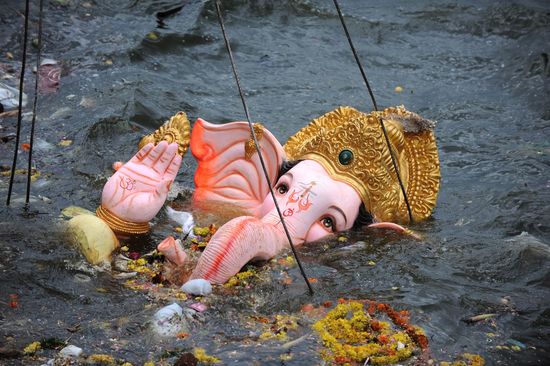
An idol of the elephant-headed Hindu god Lord Ganesha is hoisted by a crane into Hussainsagar Lake in Hyderabad on September 22, 2010. Hindus bring home and also offer prayers in temporary temples built for idols of Lord Ganesha in order to invoke his blessings for wisdom and prosperity during the Ganesha Festival, which culminates with the immersion of the idols in bodies of water. By Noah Seelam/AFP/Getty Images.