Which Way The Wind Blows

A new study proves that wind could have helped Moses part the waters:

The model requires a U-shaped formation of the Nile River and a shallow lagoon along the shoreline. It shows that a wind of 63 miles per hour, blowing steadily for 12 hours, could have pushed back waters 6 feet deep.

Wired's Brandon Keim has more:

Han and Drews, who hosts a website dedicated to the compatibility of science and Christian faith, don’t consider the Exodus narrative to be literally true, but rather “an interesting and ancient story of uncertain origin.” Others have been similarly intrigued, suggesting that a rare phenomenon called wind setdown could have created dry passage across the Red Sea’s narrow northern tip. A wind setdown is essentially the flip side of a storm surge; when strong, steady winds cause water to rise dramatically in some areas, it necessarily drops in others.
Faithful Dissidence

Father Joseph A. Komonchak has collected his musings on Cardinal Newman into a serious, longform rumination in Commonweal's latest issue:

Today we appear to be undergoing, in as painful a form as any in our history, one of those moments that Newman anticipated, when grave scandals by church leaders are once again hiding from large numbers of people “the real sanctity, beauty, and persuasiveness of the church and her children.” Newman himself never permitted his own encounters with incomprehension, stupidity, and downright wickedness among his fellow Catholics, including among their leaders, to allow his own “admiration, trust, and love for Christ and his church” to diminish. That is not the least reason for being glad that with his beatification, Newman’s real holiness is being honored by the church.

My thoughts on Newman and Ratzinger here. One of my favorite Newman quotes:

"I shall drink to the pope, if you please — still, to conscience first, and to the pope afterward."

Ratzinger’s Self-Serving Omissions About Christianity And Nazism

  Dcpic

Susannah Heschel refutes Pope Benedict's attack on exclusive atheistic complicity in Nazism, and finds fault with a Christian complicity:

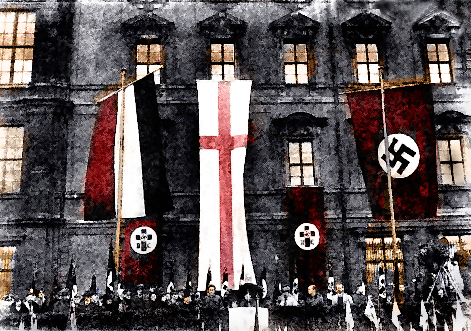
Christian theologians, Catholic and Protestant, reassured Germans that Nazism was in full accord with Christian principles. This was not a marginal effort; at the 1934 Oberammergau passion play, watching Jesus being hoisted on the cross, the audience saw a parable of the Third Reich, calling out: “There he is. That is our Führer, our Hitler!”

Hitler became Christ, the redeemer of Germany, thanks to a reinterpretation of the Gospels: Jesus was not a Jew, but an Aryan who came to redeem them from the Jews who sought their destruction. Karl Adam, the prominent German Catholic theologian, affirmed in 1933 that Hitler was the one “prophesied by our poets and our wise men” who suffered in his fight for Germany’s salvation. Adam continued in 1941: “Christ’s teaching was entirely anti-Jewish in its tenor (that is why he was crucified).” …

Pope Benedict could gain the respect of world opinion by acknowledging what historians have amply demonstrated: that well-intentioned, pious Christians—and not just atheists—committed heinous acts. Christian teachings are no guarantee against atrocity and, in the context of the Third Reich, actually came to justify the Holocaust.

My own review of the way in which Christianity created anti-Semitism and bears some, but not all, responsibility for the Holocaust, is here. More background on the Nazi Deutsche Christen movement here. And here. The fusion of faith and dictatorship has never been an exclusively Islamist invention.

The Need For Confession

Miranda Celeste Hale rails against her childhood memories of Catholicism, while acknowledging she can't escape its guilt:

As a child, I obsessively recorded in a little notebook anything that I had said or done that could possibly be considered sinful. Then, when the time came for confession, I would recite this list to the priest, my head hanging in shame, my cheeks burning. I’d do my penance and be absolved. For a fleeting, blissful moment, I would feel light and pure and holy. But soon I would sin again, the guilt would return, the little notebook would be filled up with a record of my indiscretions, and I would return to the confessional and repeat the process over and over again.

Although I left Catholicism fifteen years ago, on occasion I still catch myself wondering what I need to do in order to rid myself of the guilt, shame, and feeling of dirtiness that, in one form or another, is almost always my companion. I sometimes find myself feeling frustrated: why, I wonder, can’t someone just tell me what penance to do? I obviously no longer think in terms of sin or feel the need to go to the confessional, but the desire for absolution remains, like an itch that cannot be scratched.

The Atheist And The Believer

Prayer_footprints

Francis Collins, director of the National Institutes of Health and subject of this New Yorker profile a couple weeks ago, admits he's praying for Hitchens, but along very different lines:

[M]y prayer is not so much for a supernatural intervention – as a physician I have not seen evidence for such medical miracles in my own experience. Instead I pray for myself and for Christopher along the lines of James 1:5 – "If any of you lacks wisdom, let him ask God, who gives generously to all without reproach, and it will be given him."

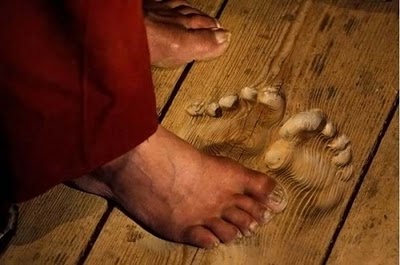
(Image via World Of Technology: 70 year-old Buddhist monk Hua Chi has been praying in the same spot at his temple in Tongren, China for over 20 years. His footprints, which are up to 1.2 inches deep in some areas, are the result of performing his prayers up to 3000 times a day. Now that he is 70, he says that he has greatly reduced his quantity of prayers to 1,000 times each day.)

What Hipsters Drink

Andrew Rosenblum analyzes the history of malt-liquor and beer advertising:

The resuscitation of Pabst Blue Ribbon offers the best example of how subtle the Don Drapers of today can be. P.B.R. went from a beer known for being cheap and bland and in seeming terminal decline in 2001, to a brand known for being cheap and bland that has increased sales by over 25% since 2008, in spite of raising prices in the middle of a recession. That’s on top of a roughly 60% increase in sales between 2001 and 2006, due to a stealth marketing campaign astutely analyzed by Rob Walker in his book Buying In.

As Walker shows, P.B.R. grew precisely because of the lack of overt marketing. …

When Kid Rock’s lawyer noticed the young, hard edged drinkers drawn to P.B.R., and thought that that his client might make an excellent spokesman, the company rebuffed his overtures. Instead, P.B.R. continued its unobtrusive promotions, like skateboard movie screenings, art gallery openings, indie publishing events, and the "West Side Invite,” where Portland messengers drank beer and played “bike polo” together – but without pushing the brand using ostentatious posters or signs.

The Unintentional Provocateur

Susannah Hunnewell interviewed French author Michel Houellebecq on the art of fiction. The entire conversation is worth reading. On his controversial sex scenes:

What shocked people was that I depicted sexual failure. I wrote about sexuality in a nonglorifying way. Most of all I described a basic reality: a person filled with sexual desire who can’t satisfy it. That’s what people don’t like to hear about.

When Analysis Clouds Meaning

Morgan Meis stops trying to understand Fellini and learns to love the oddity of it all:

What makes La Dolce Vita realism is that it gives you the strange straight up, in the same way that we do, in fact, experience strange and extraordinary things all the time. The events of our lives always fail to resolve themselves into tidy explanations.

In the last scene of La Dolce Vita, Marcello and a band of misfit revelers and partygoers wander out onto the beach where a giant, squid-like creature has washed up to shore. Everyone gawks at the creature for a little while and then goes away. The scene is arresting and disturbing, just like the rest of the movie. When you step away from the scene in the attempt at analysis, it fades away. So don't. Just watch in stunned silence at the dead empty eyes of the beast, and the dead empty eyes of Marcello as he wanders off — dashing, handsome, and utterly unsure about what he is supposed to do with what he has just seen.