Bruce Schneier fearsattempts to make all internet communication wiretap-ready:
These laws are dangerous, both for citizens of countries like China and citizens of Western democracies. Forcing companies to redesign their communications products and services to facilitate government eavesdropping reduces privacy and liberty; that's obvious. But the laws also make us less safe. Communications systems that have no inherent eavesdropping capabilities are more secure than systems with those capabilities built in.
Any surveillance system invites both criminal appropriation and government abuse. Function creep is the most obvious abuse: New police powers, enacted to fight terrorism, are already used in situations of conventional nonterrorist crime. Internet surveillance and control will be no different.
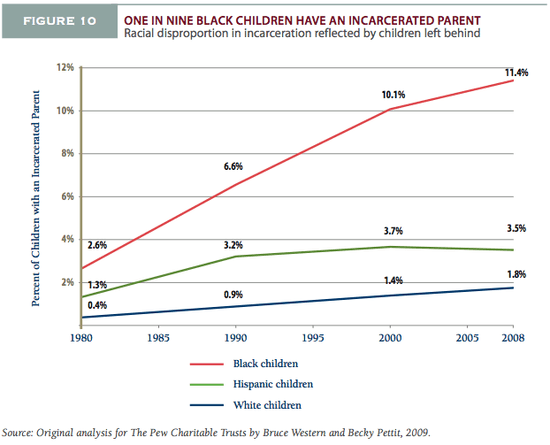
[O]ne way to think about the cost of incarceration is that every person who is in jail or prison is someone who is not just out of the labor force but an active ward of the state. Incarcerating people doesn't just cost the money required to house and feed the incarcerated; it costs the money they would otherwise be making if they were a productive member of society. But that impact gets even larger when you consider that 1.2 million of the 2.3 million people behind bars are parents of children under the age of 18, and the cost of an incarcerated parent to a family isn't just a matter of the absence of a second income stream or the emotional toll of an absent parent but also what it costs to maintain contact with someone who is far away.
Once these parents get out, they're dissuaded from legitimate employment not just by prior associations with criminally inclined social networks likely broadened while in prison and the increased difficulty of finding a job with the stigma of prior incarceration, but a number of potential financial obligations like court fees and child-support payments that may make them less likely to get licit work. Also, just speaking generally, the kind of social skills one develops to survive in prison are directly antithetical to holding a low-wage job in a service economy.
You shouldn't be so coy in responding to your readers on the Derry/Londonderry debate. Both are correct (even being Catholic, I'd argue if the submission came saying Londonderry, it's Londonderry), but your compromise was spot on.
The UK has just begun the process of having a 'City of Culture' and the inaugural city will be nominated as 'City of Culture 2013'. There was a competition to see which city in the UK would get the title, which is designed to attract tourists and increase spending on cultural activities. Birmingham, Sheffield, and Norwich were beaten out by a hard-fought campaign by that city in Northern Ireland. Part of the branding of the campaign was that the hybrid name Derry/Londonderry was used (as can be seen by this BBC headline). Alternatively, you could just use the common nickname 'Stroke City' (a play on the English football team 'Stoke City') because of the backslash involved in the compromise.
As a sad PS, this pseudo civil war is not as certainly confined to history as we had previously hoped – things are looking precarious again in Northern Ireland, and there is a real challenge for the media as to how to neither ignore, nor destabilise the peace process by affording undue coverage of, the riots and terrorist attacks of the last couple of months/years. Things are much better than they were, granted, but far, far from being resolved. The threat from the Real IRA is nothing like as great as it was from the PIRA, but is considered serious compared to other sources of terror.
Another writes:
There is a Derry/Londonderry in New Hampshire. The east side of I-93 around Exits 4 and 5 is Derry and the west side is Londonderry. Apparently, Derry was part of Londonderry until they broke off. Seems the story goes that the merchants in old Londonderry wanted to have a separate town and when one day the Londonderry farmers (who opposed the secession) did not attend a town hall meeting, they passed the law to split the town.
Another:
I know there are a thousand or so more pressing matters in 2010, but this surprised me: does the Dish really have no opinion about the conflict in Northern Ireland? Boston-Irish-Catholic-by-heritage that I am, I've always found it hard to sympathize with the view that the British have any kind of right to rule Northern Ireland, but I understand that intelligent people disagree.
But no opinion?? Mr. Sullivan, a diehard Catholic, Irish blood and English heart, vociferous critic of Israeli oppression, has no opinion on the troubles in Northern Ireland? I just can't imagine that's true.
About 20% of the country is unhappy with both sides- and they're leaning strongly toward the GOP. … The voters who hate everything and everyone are a key part of the electorate this year- and their support of the GOP is a big part of why the party's headed for a big victory.
Voters are only marginally more interested in GOP control of Congress than they are in retaining Democratic control of Congress, but they're passionately into the idea of destroying the Congress they have right now.
Among California’s likely voters, 52 percent favor the proposition to legalize marijuana. Strong majorities of independent (65%), Democratic (63%), and Latino (63%) likely voters support Proposition 19 when read the full ballot title and label, as do those age 18–34 (70%). Half of voters (49%) say the outcome of Proposition 19 is very important, with those opposed to the initiative feeling stronger about the outcome: 65 percent of those who plan to vote no say the outcome is very important, compared to 42 percent of likely voters who plan to vote yes.
So we have another enthusiasm gap, with the angry minority determined to vote, and a 52 percent majority less motivated than the 41 percent minority. For goodness's sake, wake up, guys. This election matters. Prop 19 could be a watershed against Prohibition if you can get off your couch and vote. Check out the website here. Registration info here.
Earlier Jamelle Bouie argued that atheists, Mormons, and Jews know more about religion than Christians because as "a matter of simple survival, minorities tend to know more about the dominant group than vice versa." Ilya Somin differs:
In the case of atheists/agnostics and Jews, their main knowledge advantage over Christians comes from their much higher levels of knowledge about non-Christian “world religions” (mainly Judaism, Islam, and Hinduism). Jews got an average of 7.9 questions out of 11 in this category, atheists/agnostics 7.5, and Christians a mere 5.0 (the Mormon average was 5.6). While Jews, atheists and agnostics also outscored Christians on knowledge of Christianity, the margin was much smaller. Thus, the main knowledge advantage of these three religious minorities came on questions that had little if any connection to “survival” as religious minorities in an overwhelmingly Christian society.
I hope it's ok to write to you – I wanted to say something about my brother, Jack. He was the smartest, kindest, most decent person I've ever known, and he was gay. He was subjected to the type of bullying described above through his first two years of high school (1960s). I always tried to help him; I was a freshman and the boys picking on him were usually junior and senior jocks, but that didn't stop me from trying to pound them or kick them in the shins.
Instead of being helped by school authorities, who always took the side of the bullies, he was made an example of. We were all called into the auditorium one day, and when I looked up at the stage, I saw my brother standing there. The principal proceeded to lecture us on the evils of being a homosexual, using Jack as an example. He was 14 years old.
Within a few days he was sent away to Auberle (in Pittsburgh), which was a place for troubled kids. I begged my mother not to allow that to happen – to send him to live with relatives in Michigan instead. She said she was too afraid of the cops and school authorities, which may have been true, but I think secretly she wanted him to be 'cured' too.
I visited him the next day and found him sitting crouched down in a corner of his dormitory crying. He had been beaten up and told me that he had been repeatedly raped the night before by the so-called 'straight kids' in his dormitory. I will never forget how I felt that day. Thinking about the things that were done 'for his own good' still makes me cry.
He died in 1993, and I miss him every day. He was such a good guy and the one person in the world I could absolutely count on no matter what. And he gave me Patrick, my brother-in-law, who I'm great friends with and love very much. They were partners for over 25 years.
It’s clearly not easy, being Larry Summers. For all his millions, he still needs to travel from A to B, and keeps on finding himself stymied… As an economist, Summers should know that it makes perfect sense for great resorts to spend enormous amounts of energy on the kind of quality he’s talking about: that’s their comparative advantage, the very heart of what they’re selling. Meanwhile, Summers isn’t really even the customer of the airports he’s passing through: the airlines are the customers, and the passengers are the goods being transported. So the airport doesn’t have much in the way of economic incentives to ease Summers’s way.
I’m sure that Summers has encountered lots of shiny new airports in his travels around the world, in comparison to which US airports look decidedly crumbly. But a lot of that is simply a function of age… More to the point, a lot of the money spent on shiny new airports around the world is simply wasted, from an economic perspective. National governments, especially in developing countries, like to show off when it comes to the airports where luminaries like Summers arrive. But all that expense isn’t really necessary for the smooth functioning of the airport.
Given the ubiquity of electronic devices, and the importance of airports to business travelers, we could probably enhance national productivity quite a bit if so many airports didn’t force travelers to spend their wait times fighting each other for the one electrical socket located behind an out-of-order ATM machine. The ridiculous security theater procedures which have queues stretching out towards the long-term parking lot could be streamlined. And whatever engineer designs monstrosities like Heathrow’s 40-minute walk-time from security line to gate should be tracked down and . . . um . . . reeducated, or something.
Of course, raising the minimum age for joining the military is an extremely impractical proposal. It would probably require a significant raise in pay to recruit enough soldiers if 18-year-olds could no longer join. Adults tend to find recruitment campaigns based on macho athletic fantasies and evocations of the World of Warcraft experience somewhat less convincing than teenagers do. But for a military that expects to spend much of its time drinking tea and building collaborative relationships with local community leaders, rather than blowing things up, that's probably a plus.
 The Dish