Development Is Hard

The Global Alliance for Clean Cookstoves is $60 million project intent on the adoption of cleaner cookstoves in 100 million homes:

Exposure to smoke from traditional stoves and open fires – the primary means of cooking and heating for 3 billion people in developing countries – causes almost 2 million deaths annually, with women and young children affected most.  That is a life lost every 16 seconds.

Alanna Shaikh patiently explains why similar initiatives have failed in the past.

It Gets Better, Ctd

Above is a video by Dave Holmes for Dan Savage's new project. From Dan's call for videos:

It would be great to get some more videos that include more than one person. Gay couples, groups of friends, straight people and their gay friends. And we have lots of videos from folks who are focusing on what they suffered—which absolutely should be touched on. But it would be great to see some more videos that give young gay kids a picture of the lives they could make for themselves if they just hang in there. It can be hard sometimes to talk about the good in our lives, what gives us pleasure and joy, because it seems braggy and jinxy. And knowing that not everyone finds pleasure and joy in the same things can make us self conscious. But I think it would really help for LGBT kids who don't know any LGBT adults to see—with their own eyes—that we are leading happy and rewarding lives. So if you decide to make a video… don't just share your pain. Share your joy too.

Face Of The Day

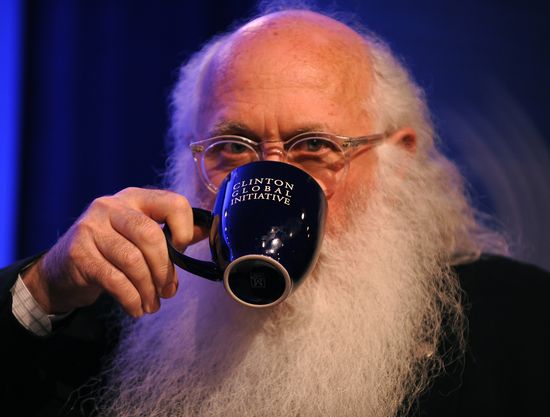
104360251(2)

Howard-Yana Shapiro, Global Staff Officer of Mars Inc, during the annual Clinton Global Initiative (CGI) September 22, 2010 in New York . The sixth annual meeting of the CGI gathers prominent individuals in politics, business, science, academics, religion and entertainment to discuss global issues such as climate change and the reconstruction of Haiti. By Timothy A. Clary/AFP/Getty Images.

Calling Out The “Culinary Luddites” Ctd

Kate Hopkins tackles Rachel Laudan's logic:

[She] leaves my head strained from the sudden shift from "the rejection of Industrial Food ethics" and equating that to "the rejection of technology". Dear Ms. Laudan, it is perfectly acceptable to respect the scythe yet loathe the one who wields it. In fact, in looking at the major food movements of the past generation, this is primarily what is going on. From the natural food movements of the seventies, to the Slow Food movement today, the underlying philosophy of these endeavors is the belief that we had put the faith of feeding our nation in the hands of corporations, and the best that they could come up with was food that was over-salted, over-sugared, and over-oiled. All of which was done by sacrificing regional diversity, flavors that many of us hold dear, and even basic nutrition.

Dissents Of The Day

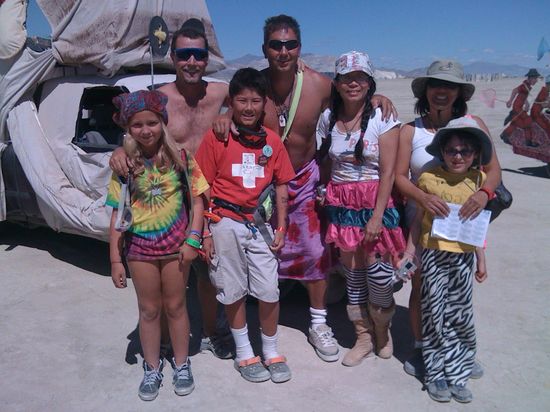
IMG_1736

A reader writes:

With all due respect, Andrew, you are talking completely out of your ass on Burning Man and I imagine you're getting flooded with e-mails after that cavalier post.

I’ve been 11 times, 7 of them with my wife and (now) 11-year-old child. Did you know the largest camp at Burning Man is called “Kidsville,” and is comprised of hundreds of individuals with kids in tow? Burning Man is not a bunch of “hippies", but professionals with jobs (it costs almost $300.00 for a single ticket) and families. There are artists, craftsmen, bohemians, old people, young people, millionaires, minimum wage earners, gays, straights, and somewhere in-betweens. There are art projects large and small, cars so creative you wish they were in your neighborhood, and people so fucking friendly you’d think you landed on some alternate earth somewhere.

Another writes:

This statement is fundamentally wrong: "[I]gnoring the pot, ecstasy, shrooms and acid that make it what it is is like discussing a Tea Party convention as if there were no white people there." I have ONLY done Burning Man sober. The reality is, there are plenty of people who do not do drugs for the entire event. 

Many of them are sober addicts and alcoholics: there are three sober camps (Anonymous Village, Camp Stella and Hokey Pokey) and meetings every two hours.  But there are also plenty of non-recovering addicts who also do not take drugs at the event.  You have Buddhists and rabbis, parents and children, health nuts and yogis, and while many (hopefully not the children) do partake, many do not. I met several women this year, at various events, who do not take drugs at all, for reasons of health.  Where I met them gives you a window into what the event is truly like

– One I met at the Madonnathon dance party at the Pickle Joint (which serves pickels)
– One I met at a workshop on self-compassion done by the HeeBee GeeBee Healers
– Another I met at a morning chant at the Jewish camp Sukkat Shalom
– Another was on a unicycle and challenged me, on my bicycle, to race down the street

Burning Man is more about de-commodification than it is about drug use.  Burning Man is more about radical self-expression and self-reliance than it is about drug use.  Burning Man is more about temporary communities than it is about drug use.  Yes, there is drug use!  Yes, there is drinking!  But saying Burning Man without drugs is like the Tea Party without white people is just like saying the gay rights movement without crystal meth is like the Tea Party without white people: it's dead wrong.  And idiotic.  Does crystal meth exist in the gay community?  YES!  Does it exist outside the gay community? YES!  Does it define who we are in the gay community?  Absolutely not!  And I think you would agree with me here.

In closing, I think I know the answer to my question about whether or not you went this year.  I think anyone who's gone to Burning Man, and done even ONE thing other than dance all night at Opulent Temple, or Nexus, and then sleep all day, knows that Burning Man is NOT just about drugs.  It's about bonding.  And impermanence.  And creation.  And art.  And experimentation.  And connection.  And gifting.  And immediacy.

Come along next year.  You'll see for yourself.  I think you'll really like it.
Getting Ugly In California

Barbara Boxer takes out the knives:

Republican challenger Carly Fiorina's ads are as brutal. Silver gives Boxer a 78% chance at keeping the seat. His prediction on the Senate more generally:

Over all, the Senate picture is more fluid than a week ago, and somewhat better for Republicans. But were the election held today, they would probably not win the contests in California and Washington, and that would prevent them from accumulating enough seats to take over the Senate (even if they were to win other close races like Illinois, Nevada and West Virginia). Thus, Republicans probably need some additional momentum to claim the Senate, whether in individual states like California or nationally.

How Graphic Should War Coverage Be? Ctd

A reader writes:

As a combat vet, I'm all for more graphic coverage. I was with the Army's 1st AD in Ar Ramadi in '06 and '07 during some of the heaviest fighting. I don't want the public to live in ignorance of what we're doing over there while at the same time sitting as transfixed sheeple in front of American Idol. I want to rub the people's collective nose in it.

"You see what you're sending us to do? You see who is dying because you support a war in a part of the world you know nothing about?" The ignorance of the population is so vast that when I was deploying to Iraq and (thankfully) coming back, as I passed through Atlanta-Hartfield, people would congratulate me and my fellow servicemembers, shake our hands, say thanks, etc., and all I wanted to do was scream at them, "Get educated you ignoramus! This isn't a great thing; it's futile!" I've calmed down a lot since then, but the ramp up in Afghanistan is getting me spooled up again. America still has no clue, and doesn't want a clue, about what we're doing over there.

Tea With Tequila

Tim Cavanaugh argues that protestors in Bell, California are kindred spirits to the tea partiers, though they don't fit the stereotype:

The Bell activists are Latino Democrats, largely Spanish-speaking, less than fully marinated in small-government sensibilities and inclined to believe, as activist leader Cristina Garcia puts it here, that "for the most part the government works."

Yet there they are, protesting not just excessive taxation but excessive spending.

They are exercised about the very same thing — being preyed upon by a self-enriching public-sector bishopric — that motivates the Tea Partiers. And with the city government facing a massive general fund shortfall and destroyed credit, they can't avoid the deadly question "What will you cut?"

Speculating about why most Californians are immune to the Tea Parties, despite the dysfunction in the Golden State, he posits, "The weather’s nice, there’s abundant high-quality weed, and if you don’t have to think about politicians why would you?"  He isn't alone in thinking so.