David Broder and Bob Woodward are still buck-raking like the good old days.
Month: September 2010
Playing The Race Card In Spanish
Rep. Loretta Sanchez targets her Vietnamese opponent in a TV appearance:
The Pledge To America Reax II: An Unserious Party Unready For Government
Jonathan Bernstein is dumbfounded:
[W]hat really struck me as I went through it the first time was the foreign policy section, which is…how should I say this…amateurish and pathetic. What's the current Republican foreign policy? Stripping out the immigration stuff from that section of the document, what remains is (1) Gitmo; (2) Missile defense; and (3) threatening Iran. That's it. Iraq and Afghanistan are referred to once, in passing. There's nothing at all about what the United States should do in those nations. Nothing about Pakistan. Nothing about Russia, or China (China at least gets one mention, in the context of the deficit). Nothing about Europe. The rest of the world? Obviously not.
[W]ith all of the huffing and puffing we have heard – and indeed continue to hear – from conservatives about Obama's "appeasement" of Iran, are these same critics thus satisfied by a short and simple pledge to enforce "tough sanctions against Iran"? I believe this demonstrates just how easy it is to be one of the two main political party on the outs in the United States. Ideological rigidity, or, in the specific case of Iran, radical statements about preparing for a regime change, make for good soundbites and exchanges on the Sunday morning shows, but they don't resemble, as far as I can tell, the actual Republican plan for governance regarding the Islamic Republic – and that's a good thing. All this could change, of course, in 2012 …
Had the Republicans been able to produce a more substantive governing document, they would have made it harder for Democrats to demagogue.
There's one bright spot in the GOP's "pledge." No where are their any promises, euphemistic or otherwise, to ensure that torturous "enhanced interrogation techniques" are used again. Although having attacked Obama for months over ending torture, it begs the question of why, if torture is so important to national security, Republicans haven't put it in their policy platform. It's almost as if they were willing to lionize torture just to make the administration look bad.
I wish I could be so confident that they're that cynical. Cohn focuses on the health care section. Chait looks at the risible fiscal measures:
Republicans keep running on platforms consisting of specified measures to increase the deficit and unspecified pledges to reduce it. Inevitably, they fail to reduce it. Then the party faithful decide the problem was leaders who lacked true conviction, and so the new leaders promise to mend their ways. Then they do the same thing all over again.
To be honest, this document is designed to make GOP base voters happy, which is fine as far as that goes. It is, after all, a campaign pamphlet (granted, a long one). It is not, however, a real blueprint for policy. Instead it amounts to pledges for themes popular with the base: tax cuts, vague spending cuts, repeal of health care reform, and symbolic (not to mention bogus) promises to read bills and ensure their constitutionality
“All Faggots Must Die” Ctd
Yes, it's now confirmed that the online comment made in the wake of the collapse of the repeal of Don't Ask, Don't Tell, came from Senator Saxby Chambliss's office. The particular person has yet to be found. Chambliss is on record as saying that openly gay soldiers would lead to "alcohol use, adultery, fraternization and body art," and that "the presence in the armed forces of persons who demonstrate a propensity or intent to engage in homosexual acts would very likely create an unacceptable risk to those high standards."
It will be interesting to see what the consequences are for the staffer who posted the comment.
How Dumb Do They Think We Are?
Fire Solmonese Now.
By the way, the one actual piece of legislation passed, apart from the HIV Travel ban, which was supported by president Bush and Republicans, was the Hate Crimes Bill. Not a single prosecution of an anti-gay hate crime has occurred under the law in the year since it was passed.
The Palin Model, Ctd
Sharron Angle makes a mockery of the media:
[Fundraising's] going really well. …[H]ere’s the deal: when I get a friendly press outlet — not so much the guy that’s interviewing me — it’s their audience that I’m trying to reach. So, if I can get on Rush Limbaugh, and I can say, “Harry Reid needs $25 million. I need a million people to send twenty five dollars to SharronAngle.com.” The day I was able to say that [even], he made $236,000 dollars. That’s why it’s so important. Somebody…I’m going on Bill O’Reilly the 16th. They say, “Bill O’Reilly, you better watch out for that guy, he’s not necessarily a friendly”…Doesn’t matter, his audience is friendly, and if I can get an opportunity to say that at least once on his show — when I said it on Sean Hannity’s television show we made $40,000 before we even got out of the studio in New York. It was just [great]. …
And so you can just watch it; it just rolls like this. In fact, with Rush Limbaugh we put it all down. We couldn’t take the ticker going fast enough. And we’ve pulled in over [3,000,000] dollars just from that kind of a message going out.
What HRC Could Learn From The Tea Parties
Steinglass presents a strategy:
Gay voters can’t realistically express anger at Democrats by turning to the Republicans who just voted to retain DADT. And staying home on election day doesn’t work as a way of encouraging political parties to prioritise your issues; if anything, it takes your constituency out of the equation.
There is, however, a way for gay voters to exert influence on the priorities of the Democratic Party.
It’s the same way the tea-party movement has successfully influenced the priorities of the Republican Party. They can mount and back primary challenges to Democratic candidates seen as insufficiently supportive of gay rights. For that matter, they could try mounting and backing primary challenges by libertarian-leaning Republican candidates who do support gay rights, but those seem less likely to succeed. In any case, this is the way you influence political priorities in a two-party system: through the primary process. There are lots of gay Americans, they are relatively well-educated and affluent, and they should be able to make their concerns felt as strongly as anybody else’s, if they apply pressure in ways that are effective.
The GOP’s Fiscal Fraudulence
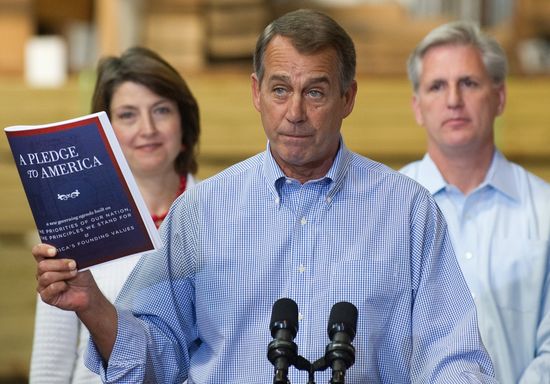
One tiny part of me hoped that after the GOP spending binge of the Bush years, and the alleged Tea Party commitment to turn the page on growing government, the Republicans, like the Tories in Britain, would run on a clear platform of massive spending cuts to reassure the markets of long term fiscal stability. Everyone knows where the money is: Medicare, Social Security, defense. Discretionary spending is largely irrelevant; as is pork – although, of course, it would be a good thing to examine the former very closely for savings and cut down on the explosion of earmarks in recent years.
So drum-roll please for the spending cuts:
With common-sense exceptions for seniors, veterans, and our troops, we will roll back government spending to pre-stimulus, pre-bailout levels, saving us at least $100 billion in the first year alone and putting us on a path to balance the budget and pay down the debt. We will also establish strict budget caps to limit federal spending from this point forward. We will launch a sustained effort to stem the relentless growth in government that has occurred over the past decade.
By cutting Congress’ budget, imposing a net hiring freeze on non-security federal employees, and reviewing every current government program to eliminate wasteful and duplicative programs, we can curb Washington’s irresponsible spending habits and reduce the size of government, while still fulfilling our necessary obligations.
This is a joke. The stimulus is already disappearing; the bailout of the banks may even make a profit. More importantly, without tackling entitlements, none of this matters a jot. And a good rule of thumb is that when you hear politicians saying they are going to "eliminate wasteful and duplicative programs", you know they are bullshitting you on fiscal responsibility. I echo the memorable words of Nick Gillespie this morning:
Dr. Newt Gingrich, who is to the Republicans what Dr. X is to Queensryche's Operation: Mindcrime, is on the recent record as holding Medicare and Social Security spending even holier than the Ground Zero Burlington Coat Factory (It's not just coats!).
Taxes? They will rescind the sunsetting of the Bush tax cuts (a sunset that was passed by Republicans), including those for people earning over $250,000 a year, adding something like $700 billion to the long term debt, starting now. So the only place left to look is defense. There is nothing there – except a plan to retain Gitmo, exempt the national security state from any cuts at all, maintain the Afghanistan and Iraq wars (I assume, because they go unmentioned), add new spending for missile defense, and on and on.
Given the gravity of the debt crisis, this is the most fiscally irresponsible document ever offered by the GOP. It is to the far right of Reagan, who raised taxes and eventually cut defense, and helped reform social security to ensure its longterm viability. It is an act of vandalism against the fiscal balance of the US, and in this global economic climate, a recipe for a double-dip recession and default. It is the opposite of responsible conservatism.
(Photo:Saul Loeb/Getty.)
Yglesias Award Nominee
"No I don’t. I don’t want [Palin] to come down [to campaign for me]. She’s represents — she’s an entertainer," – Jeff Perry, a Tea Party-backed GOP congressional nominee in Massachusetts.
The Pledge To America Reax
TPM has the whole document. Outside the Beltway has a good summary. Nick Gillespie reminds us why skepticism is warranted. Reihan looks at what it means for the GOP's agenda on health care. Other reactions below. National Review:
The Contract with America merely promised to hold votes on popular bills that had been bottled up during decades of Democratic control of the House. The pledge commits Republicans to working toward a broad conservative agenda that, if implemented, would make the federal government significantly smaller, Congress more accountable, and America more prosperous.
Their policy agenda is detailed and specific — a decision they will almost certainly come to regret. Because when you get past the adjectives and soaring language, the talk of inalienable rights and constitutional guarantees, you're left with a set of hard promises that will increase the deficit by trillions of dollars, take health-care insurance away from tens of millions of people, create a level of policy uncertainty businesses have never previously known, and suck demand out of an economy that's already got too little of it.
Yes, yes, it is full of mom tested, kid approved pablum that will make certain hearts on the right sing in solidarity. But like a diet full of sugar, it will actually do nothing but keep making Washington fatter before we crash from the sugar high. It is dreck — dreck with some stuff I like, but like Brussels sprouts in butter… Overall, this grand illusion of an agenda that will never happen is best spoken of today and then never again as if it did not happen. It is best forgotten.
Here is the GOP cruising to a handsome election victory. Did you seriously imagine that they would jeopardize the prospect of victory and chairmanships by issuing big, bold promises to do deadly unpopular things?
But if the document is unsurprising, it’s also unsurprising that Erickson and those who think like him would find it enraging. The “Pledge to America” is a repudiation of the central, foundational idea behind the Tea Party. Tea Party activists have been claiming all year that there exists in the United States a potential voting majority for radically more limited government.
The Republican “Pledge to America” declares: Sorry, we don’t believe that.
The Pledge is a much more radical document than the Contract With America was. I mean that in a positive sense: the Contract was a collection of micro-issues that polled overwhelmingly well–for example, that Congress should be subject to the same employment laws that it inflicts on the rest of us. But those were more placid times. This year's Pledge is a ringing statement of first principles. It deliberately echoes the Constitution and, especially, the Declaration of Independence.
 The Dish