Intellectual Communion

Anthony Grafton paints a portrait of the Last Supper in art and religious history. Below, Paolo Veronese defends his Last Supper portrayal before the Venetian Inquisition in 1573:

"We painters use the same license as poets and madmen, and I represented those halberdiers, the one drinking, the other eating at the foot of the stairs, but both ready to do their duty, because it seemed to me suitable and possible that the master of the house, who as I have been told was rich and magnificent, would have such servants."

This appeal to artistic license did not satisfy the Inquisitors: “Does it seem suitable to you, in the Last Supper of our Lord, to represent buffoons, drunken Germans, dwarfs, and other such absurdities?” They ordered Veronese to erase the halberdiers and replace the dog who looked up at Jesus with Mary Magdalene. Veronese complied, in his own way. He left the painting as it was but retitled it Feast in the House of Levi—a scene less freighted with theological significance.
Poem For Sunday

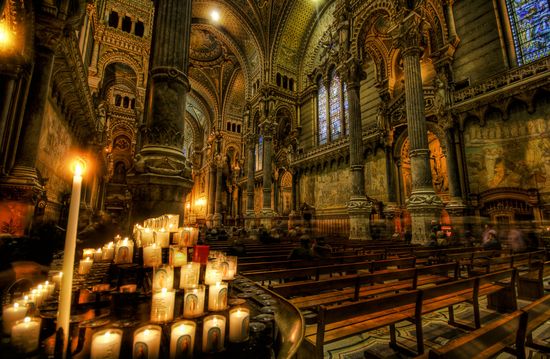
3085063015_66f45d088b_b “The Gift Of Tritemius” by John Greenleaf Whittier was originally published in The Atlantic Monthly in November, 1857:

Tritemius of Herbipolis one day,
While kneeling at the altar’s foot to pray,
Alone with God, as was his pious choice,
Heard from beneath a miserable voice,–
A sound that seemed of all sad things to tell,
As of a lost soul crying out of hell. Thereat the Abbot rose, the chain whereby
His thoughts went upward broken by that cry,
And, looking from the casement, saw below
A wretched woman, with gray hair aflow,
And withered hands stretched up to him, who cried
For alms as one who might not be denied. She cried: “For the dear love of Him who gave
His life for ours, my child from bondage save,
My beautiful, brave first-born, chained with slaves
In the Moor’s galley, where the sun-smit waves
Lap the white walls of Tunis!” “What I can
I give,” Tritemius said,–“my prayers.” “O man
Of God!” she cried, for grief had made her bold,
“Mock me not so: I ask not prayers, but gold;
Words cannot serve me, alms alone suffice;
Even while I plead, perchance my first-born dies!”

“Woman!” Tritemius answered, “from our door
None go unfed; hence are we always poor.
A single soldo is our only store.
Thou hast our prayers; what can we give thee more?”

“Give me,” she said, “the silver candlesticks
On either side of the great crucifix;
God well may spare them on His errands sped,
Or He can give you golden ones instead.”

Then said Tritemius, “Even as thy word,
Woman, so be it; and our gracious Lord,
Who loveth mercy more than sacrifice,
Pardon me if a human soul I prize
Above the gifts upon His altar piled!
Take what thou askest, and redeem thy child.”

But his hand trembled as the holy alms
He laid within the beggar’s eager palms;
And as she vanished down the linden shade,
He bowed his head and for forgiveness prayed.

So the day passed; and when the twilight came
He rose to find the chapel all a-flame,
And, dumb with grateful wonder, to behold
Upon the altar candlesticks of gold!

(Image from Flickr user Stuck in Customs)

Religion Without Religion

Kelefa Sanneh decodes Rhoda Byrnes' bestselling self-help books:

The creed promulgated by “The Secret” and “The Power” is finally noteworthy not for its audacity—many religions promise more—but for its modesty, its thinness. In distilling a spiritual message that claims to be compatible with all religious traditions, Byrne has had to bracket all possible points of disagreement, discarding anything that might seem, as Winfrey put it, “weird.” The result is a pair of religious books curiously devoid of ancient lore and esoteric beliefs, history and holiness—curiously devoid of religion itself. Byrne’s hope is that this minimalist creed will be enough for her readers. But surely some of them will notice that it doesn’t seem to be enough for her.

“Proof Positive”

Daniel Tomasulo explains that though "we are hardwired from birth to be happy when we get salt, fat, sweet things and sex," true happiness stems from somewhere deeper:

It is the goodness of social relationships that truly makes us happy. Good relationships are the foundations for almost every measure of well being. Our immune system, our incidental sense of peace and joy, and our optimism for the future is better when we feel good about our daily social relationships. The better we feel in the social network of others in our life, the happier we are. With poor or nonexistent relationships we cannot flourish…

Choosing who we want to be with, and talk to, and spend time with sounds like a no-brainer. But the truth is most people simply don’t do it. We feel obligations and play politics, and in doing so lessen the time we spend with people who make us happy. More than this, consider those with little or no choice — those placed in foster homes, prisons, institutions, group homes, rehabs, hospitals, and yes, even college dorms. Why are there so many interpersonal problems in these settings? [Jacob Levy] Moreno would argue that the lack of sociometric choice is the culprit.

And we wonder why the ancients placed so much emphasis on the virtue and centrality of friendship.

The Great Dissembler

Cardinal_sinister_lead_image_0

Gary Willis argues that the Pope's beatification of John Henry Newman misrepresents him "as a docile believer in papal authority, an enemy of dissent, and a rebuke to anyone who questions church authority":

Benedict was once a scholar and now claims to be infallible in matters of faith or morals. But on the clearest facts of history he is a dissembler and disguiser. Were Newman alive to hope for preventing this distortion of his history, would he hope for the pope’s demise, as he hoped for Pius IX’s death before he did such damage to the church by claiming “tyrannical” powers?

(Image, found opposite of Royal Albert Hall: Cardinal Sinister by Nick Walker)

What Qu’ran Burning And Crucifixion Have In Common

Eric Reitan turns the Terry Jones debacle into a lesson on religious sacrifice:

[A]t least one theologian—S. Mark Heim—has taken up Girardian themes to argue that the crucifixion is best understood as a potent repudiation of sacrificial scapegoating… If Heim is right about this, then Jones and Phelps and their respective congregations are symbolically enacting the very thing that the passion stories central to Christianity were intended to repudiate. Where they are called to see the crucified Christ in those who are being symbolically burned at the stake, they instead see a righteous sacrifice to God. Where they are called to identify with the victim of sacrificial scapegoating, they become the practitioners.

Just Not Understanding The Offense

Atheist Razib Kahn is "not sickened by the burning of a Koran, or any book":

I don’t extrapolate my own psychology to others. I think there is something somewhat off about people like me, at least in relation to the modal human. The readers of this weblog are mostly nonbelievers in gods, and also of a libertarian bent. The set of these individuals tend to be overwhelmingly male, and often of a technical orientation. We’re not representative humans, and extrapolation after introspection is a dangerous game for the likes of us. Dangerous at least if we want to model how the world of human psychology and sociology is as opposed what we’d want it to be. We are the sort who are not gifted with the full range of powerful visceral emotions that others are.

Self-awareness is the important thing, I suppose.

Poem For Saturday

Studied-love

"I Studied Love" by Yehuda Amichai (1924 – 2000) translated by Chana Bloch and Chana Kronfeld first appeared in The Atlantic in July of 1998:

I studied love in my childhood in my childhood synagogue

in the women's section with the help of the women

behind the partition

that locked up my mother with all the other women

and girls.

But the partition that locked them up locked me up

on the other side. They were free in their love while I

remained

locked up with all the men and boys in my love, my longing.

I wanted to be over there with them and to know their

secrets

and say with them, "Blessed be He who has made me

according to his will." And the partition

a lace curtain white and soft as summer dresses, and

that curtain

swaying to and fro with its rings and its loops,

lu-lu-lu loops, Lulu, lullings of love in the locked room.

And the faces of women like the face of the moon behind

the clouds

or the full moon when the curtain parts: an enchanted

cosmic order. At night we said the blessing

over the moon outside, and I

thought about the women.

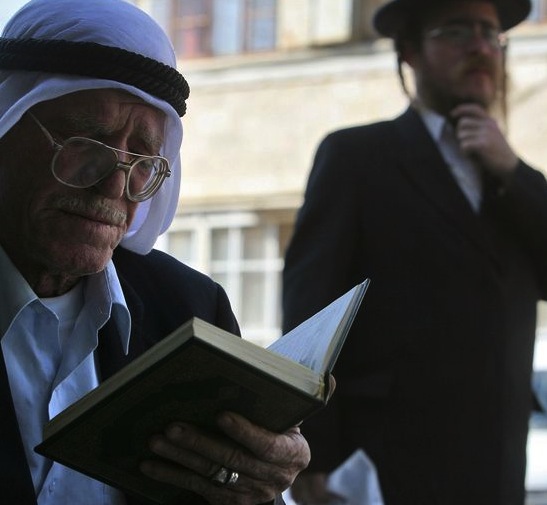
(Photo: An Ultra Orthodox Jewish man looks at a Palestinian shop owner reading the Muslim holy Koran outside his shop near the Ibrahimi Mosque, or Tomb of the Patriarchs, in the divided West Bank city of Hebron on September 15, 2010. By Hazem Bader /AFP/ Getty Images)

Except For That Horrible Detail

Richard Brody memorializes French New Wave director Claude Chabrol, who died last Sunday:

Interviewed in Libération in 1995 about being in his sixties, he said, "Except for the fact that one fucks much less than at twenty—except for that horrible detail, everything is better" …

He was plus bourgeois que les bourgeois, but cavalier about it and unproud of it; he took his pleasures gleefully and without dissimulation, ostentation, or bien-pensant respect for the trappings of respectability, and he filmed the same way.

Woody Allen is even bleaker:

Q. How do you feel about the aging process?

A. Well, I’m against it. I think it has nothing to recommend it. You don’t gain any wisdom as the years go by. You fall apart, is what happens. People try and put a nice varnish on it, and say, well, you mellow. You come to understand life and accept things. But you’d trade all of that for being 35 again.

I’ve experienced that thing where you wake up in the middle of the night and you start to think about your own mortality and envision it, and it gives you a little shiver. That’s what happens to Anthony Hopkins at the beginning of the movie, and from then on in, he did not want to hear from his more realistic wife, “Oh, you can’t keep doing that — you’re not young anymore.” Yes, she’s right, but nobody wants to hear that.

I do not want to abandon the notion of wisdom and age. And I think the decline of testosterone and the vibration on the train tracks of death can lead to a more dispassionate understanding of the world, and, perhaps, thereby, a greater and deeper relationship with God. Maybe that's what separates me from these men's views: faith. And the sense that less need for sex is some kind of relief, not a curse, however one misses the perpetual hardons of youth.

But it still requires adjustment. Just as it took me about a year or two to throw out the Rogaine and deal with being bald, so I've now thrown out the Just For Men on my beard.