The Unconscious And Reading

Steven Berlin Johnson contemplates the structure of books:

[T]he real question–a question I don’t have the answer to–is what happens in our minds when we enjoy something like a book or song, without being fully aware of what makes it enjoyable. On some level, there is something like an unconscious processing of the information, but it’s not an unconscious that looks anything like the Freudian version.

Our brains unconsciously process external information all the time, of course, but usually these are hard-wired skills, more nature than nurture. But a chord progression or a chapter from a non-fiction book are pure works of culture; our brains didn’t evolve dedicated resources designed to appreciate their subtle arts. Yet somehow we appreciate those deep structures, even as they fly beneath the radar of our consciousness.

The funny thing is that people will reliably perceive that deep structure in one context: when we get it wrong. Mangle the chords in a popular song and the background will suddenly become foreground.
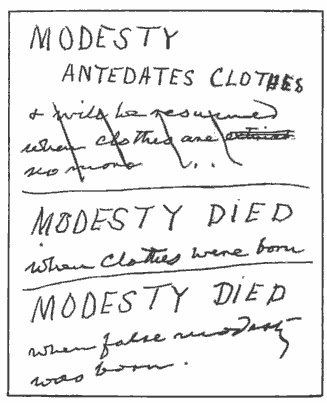
Dude Diaries

Twain_modesty
The Art of Manliness expands on an earlier post by providing the pocket notebooks of 20 famous men:

Twain kept 40-50 pocket notebooks over four decades of his life. He often began one before embarking on a trip. He filled the notebooks with observations of people he met, thoughts on religion and politics, drawings and sketches of what he saw on his travels, potential plots for books, and even ideas for inventions (he filed 3 patents during his lifetime). Many of his entries consist of the short, witty, pithy sentences he is famous for. He felt that if he did not write such things down as they came to his mind he would quickly forget them. He would also record little snippets in his notebooks of what had happened that day, such as what he had eaten and who he had seen. And finally, he wrote dirty jokes in the back of them.

(Image: A page from Twain's book.)

Struggling To Give Away Billions

Dayo Olopade wonders if the Gates Foundation approach is effective:

The Gates method brings to philanthropy what the Powell Doctrine brought to war: overwhelming force. But the eye-popping figures on the foundation's balance sheets raise not just the question of how best to give away billions but whether such sums should be given away at this pace. Buffett's donation, for instance, requires that the foundation hand out at least $1.5 billion annually — which is "harder than you think," former foundation CEO and current senior adviser Patty Stonesifer admitted to the Seattle Post-Intelligencer in 2008.

Eurovision And Freedom

This year's Junior Eurovision Contest, where "seven of the 14 countries that will compete at Minsk are ex-Soviet republics," is being hosted by Belarus. Peter Savodnik reports:

The cynic’s view of Junior Eurovision 2010 is that, like parades and pyrotechnics, it is being used by the vlast, or state power, to distract viewers from the grayness of everyday life in the surreal netherworld that is Belarus, where opposition leaders and reform-minded journalists still sometimes disappear. “With this, the power can say it has real, flesh-and-blood evidence that it supports young talent, to show that it cares about the future of the country,” says Dmitri Podberezski, a music critic at the Web site experty.by, which focuses on the independent music scene in Minsk.

Hosting Junior Eurovision doesn’t quite amount to Westernization, but it does point to an openness inconceivable a few years ago. It’s hard to imagine Burma, say, or North Korea hosting a weeklong fiesta that includes hundreds of Western journalists and millions of international viewers.

Chains Of Love

Yglesias defends chain restaurants from a public health standpoint:

Since they have scale and standardization, you can get them to disclose nutritional information and many already do so to at least some extent voluntarily. What’s more, there’s nothing impossible in principle with the idea of a chain serving organic food—I get salads from these guys all the time. And with large chains and brands it’s actually feasible to monitor the claims people are making about their supply chain. It’s pretty well known at this point that a lot of “big organic” stuff is in many ways fraudulent, but the whole reason we know that is that we’re talking about large-scale producers whose operations people took the time to look into.

Sure, McDonald's, Chili's, The Cheesecake Factory, and countless other chains disclose their nutritional information – and their customers ignore it. Meanwhile, they're serving enormous portions of relatively unhealthy food. The public health benefits seem rather theoretical.

Parenting A Pre-Homosexual

Jesse Bering explores the science behind identifying childhood behaviors as gay. Some advice to concerned parents:

[It’s] important to stress that since genetic success is weighed in evolutionary biological terms as the relative percentage of one’s genes that carry over into subsequent generations—rather than simply number of offspring per se—there are other, though typically less profitable, ways for your child to contribute to your overall genetic success than humdrum sexual reproduction.

For example, I don’t know how much money or residual fame is trickling down to, say, k.d. lang, Elton John and Rachel Maddow’s close relatives, but I can only imagine that these straight kin are far better off in terms of their own reproductive opportunities than they would be without a homosexual dangling so magnificently on their family trees.

The very thought of making love to a blood relative of Michelangelo or Hart Crane, irrespective of anything else about that person save his heritage, makes me strangely and instantly aroused—and I’d imagine such a person would be eminently desirable to heterosexually fecund women as well. So here’s my message: Cultivate your little prehomosexual’s native talents and your ultimate genetic payoff could, strangely enough, be even larger with one very special gay child than it would if ten mediocre straight offspring leapt from your loins.