The End Of The Tea Parties? Ctd

Steinglass believes that they may flame out. On the other hand:

It’s possible that the tea-party movement will have a more lasting impact than parties like Mr Perot’s, which fizzled by the late 1990s, or Mr Fortuyn’s, which flamed out of existence within a year or two of seizing some of the largest vote totals in the country. For one thing, the tea-party movement has made the smart move of organising as a faction within the Republican Party, evading the eternal doom that befalls third parties in the American system. For another, it is not too closely tied to a single charismatic personality, though a split between Sarah Palin and any large segment of the movement might do some damage. And third, it runs no risk of actually wielding power for several years.

I don’t see why a recession-era anti-incumbent fervor couldn’t sweep a lot of “tea-party” candidates into the Congress, where they will dominate, with the help of Fox, the entire Republican agenda, and make any sane compromise with Obama on critical fiscal issues, for example, impossible. In my book, that’s called wielding power.

The question becomes whether this stalemate would lead voters to rally again to the Dems in 2012 to break the deadlock. It’s perfectly possible Obama wins in this scenario, as the only moderate adult in the room. But the forces we are seeing – an endless, crippling recession as many working class whites slip further into poverty, a xenophobic, anti-Muslim, anti-Obama culture war, and the promise of a civilizational war against Islam – could easily sweep a Palin close to power. Then add in a humiliating retreat from Afghanistan and a terror attack … and you know how shameless these D’Souzaites can be. Remember 2004 when all the exit polls suggested a Kerry win for a few hours? What no one foresaw was a huge turnout of exactly the hurting, white, rural Palinites who did not show up last time around. They’re still there and my sense is that we will be surprised at the magnitude of their victory this fall.

I think, in other words, normal political predictions are at sea in this economy. Anything can happen. What appears to be the mood is virulent anti-incumbency (can Rick Perry seriously be in any danger?) without regard to actual policies. So who is the most un-Obama of the Republicans?

Yep, she is. And they love her, even if the wider public finds her repellent.
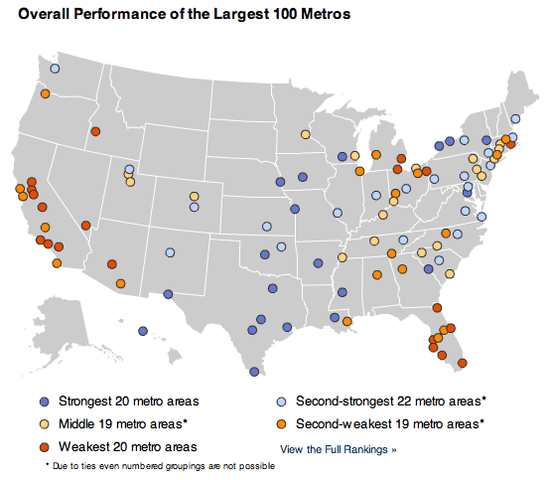
Map Of The Day

MetroAreas

Derek Thompson talks with Brookings fellow Howard Wial about the think tank’s new Metro Monitor:

Housing is not overpriced in most large metro areas, if it ever was. You look at the bubbles in California and Florida and in the northeast, and you think the housing bust is shared nationwide. But in the middle of the country, housing prices grew in line with employment, wages and interest rates. That’s one big reason why the Midwest is doing relatively well.

The Unstoppable Sarah Palin, Ctd

Contra Chait, Drum figures her chance at the nomination is fairly remote:

[T]he only real winning scenario I see for Palin is one in which nobody credible really feels like running and Palin ends up getting the nomination by default as sort of a suicide run against an incumbent who's going to crush her. But I don't really see that either. I happen to believe that Obama is probably unbeatable in 2012, but there are hardly any Republicans who agree with me. They all think Obama is a dead man walking and they're almost certainly going to want to nominate someone who can beat him. Palin just isn't that person.

Frum checks out the competition:

If TARP is a deal killer, then Romney is finished. If it’s unacceptable to acknowledge climate change, then Pawlenty is done. Many of my friends are rallying to Mitch Daniels. I like and admire Daniels too, but it’s hard to escape the feeling that he is the Bruce Babbitt of the GOP: the best nominee we never had.

Ben Smith evaluates her chances based on how well O'Donnell does.

The Daily Wrap

Today on the Dish, Palin took on and ousted Rove; and Andrew answered Glenn on what differentiates the Tea Party from the rest of the right-wing. O'Donnell's lesbian sister believed in Wicca and the "starfish" Tea Partiers might have a plan. O'Donnell retreated into the Palin school of media; and the inevitable pile-on gained momentum here, here and here.

Fallows and Bob Wright offered insight into Marty's hypocrisy; and Kinsley proposed the price for the Boomers' legacy in America. Americans hated the stimulus because it trickled in; Cash for Clunkers was a clunker, and our ability to feel rich depended on where we live. Childish Americans were still drawing lots of disability insurance and big agriculture wasn't going anywhere. Democrats still weren't selling health care reform; crying for a murdered parent meant you had to get drug-tested in Texas; and McCain wasn't going green again.

Britain became a third world country and atheism is the new Nazism according to the Pope's PR. Afghanistan remained difficult; and the UK figured out how to stay Tea Party-free. France may actually be home to Islam's new McCarthyism; "Draw Mohammed Day" put its pioneer in the witness protection program; and Nazis tortured but Americans don't. Yglesias award here; VFYW here; MHB here; and FOTD here.

The internet owed a thank you to Craigslist; Zuckerberg needed to learn some IM-etiquette; and Australia outlawed speaking out against illegal things.

–Z.P.

The Boomers’ Parting Gift To The Country?

Kinsley puts only one item on the registry – cash:

The biggest peril Americans now face isn’t Islamo-fascism. It’s our own inability to live within our means. It would be nice to give our country the wisdom and self-discipline to stop running up the credit card. And we should try. But it’s unlikely that we can remake the national character (including our own) in 19 years. What we can do is offer a lecture and a fresh start. We should pass on to the next generation an America that’s free from debt. Instead of ignoring it, or arguing endlessly about whose fault it is and who should pay for it, Boomers as an age cohort should just grab the check and say, “This one’s on us.”

Fair? Of course it’s not fair. That’s the point. If it was fair, the gesture would be meaningless. Boomers are not primarily responsible for America’s debt crisis. Blame goes mostly to the World War II generation, which in this regard was not so Great. They’re the ones who notoriously want to “Stop the Government from messing around with our Medicare,” and Boomers are the ones who have been paying to support the last vestige of old-fashioned fee-for-service medicine—for the old folks. The Boomers themselves and their children are more likely to go to an HMO.

But that’s okay. You won World War II, so we are going to take care of your debts, cover your extravagances, and go along with your little pretense that you paid for it and are entitled to it.

Kinsley wants a new estate tax, one that "reaches far more people – essentially anyone who inherits any significant amount of money – but at a much lower rate." Bruce Bartlett has another idea: have "governments to act like universities and actively solicit private funds to pay for public works and programs":

I think there are lots of Americans who chafe at the burden of taxation who would nevertheless be happy, at death, to leave something to the governments that served them during their lives. They already leave vast sums to public universities, so why not extend the principle to other public institutions? I think it's really only a matter of making it possible for people to do so and encouraging them through recognition and honor for their gifts just the way universities and other public charities do now. It's not rocket science; there are already thousands of people working in the philanthropy field who know exactly how to do it.

McCain’s Dull Penny

Darren Samuelsohn wonders whether McCain will revive his flirtation with environmentalism. Dave Roberts thinks not:

The shiny penny of climate change isn't shiny any more and McCain won't pick it back up. The stakes are too high; it's too risky. It requires too much courage and too little misty romanticism.

Climate is probably dead in the Senate for at least four years. If anything happens to change that, it will be something urgent and sweeping, something that will fundamentally alter the political calculus. Whatever the result, McCain won't be what he palpably wants to be, the essential man in the middle. Without that it holds little interest for him. Which is fine by me. Like most greens I know, I'm sick of the guy.

Big Ag Isn’t Going Anywhere

Ezra Klein defends agricultural industrialization:

Whether industrial farms are "good" or "bad," I've seen very little evidence that makes me believe we're going to move away from them. As I asked in the post, is there any example of a sector de-industrializing?  … I'm increasingly less convinced that small and big are, in the overall scheme of things, terribly useful dividing lines for the future of agriculture. Whether one could hypothetically imagine feeding the world using decentralized production methods, I don't see much reason to believe it will happen. At the same time, small farms can be run wastefully and large farms can be run sustainably.

America’s Mood

Joe Klein is on the road:

Ten days into my cross-country road trip and I'm not finding much of the fist-shaking, Tea Party anger that you see on television. People are freaked out, though. They're frustrated and anxious. They're not too thrilled with Barack Obama's policies — although even his detractors see him as sincere and trying his best to turn things around — and they're not at all convinced that the Republicans are prepared to offer anything better, but the anti-incumbent, anti-Establishment mood is palpable. They can diagnose the problems, but they don't have any strong ideas about solutions.