Let The Pundits Play Chess

Spurred on by Andrew Sprung's criticism of Tom Friedman, Jonathan Bernstein argues for another understanding of sacrifice:

[E]veryone understands that a sacrifice in chess is self-interested. There is no moral or character component to sacrificing a piece; it's a good idea if it helps the player win, and a bad idea otherwise. No one analyzes a chess game by saying that the player lost, but at least she was willing to sacrifice her rook, or that he didn't deserve to win because he was unwilling to sacrifice anything.  It seems to me that we'd be better off if pundits talked about sacrifice in that way, rather than in the morally loaded fashion (which I think is similar to the misguided way that sacrifice is discussed in baseball) that Friedman favors.  Oddly enough, I think that the chess model of sacrifice, even though it appears to be cold, calculating, and cynical, would yield a much more healthy view of the collateral costs in human suffering often involved in Friedmanesque calls for sacrifice.

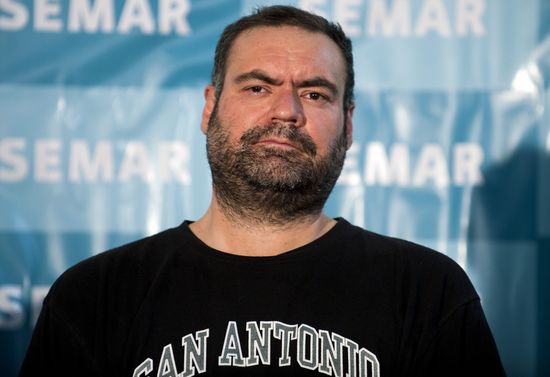
Face Of The Day

104049015

Sergio Enrique Villarreal (aka "El Grande") of the Beltran Leyva drug cartel, one of Mexico's most wanted men, is presented to the press at the Mexican Navy headquarters in Mexico City, on September 13, 2010. Mexican authorities had offered a reward of up to 30 million pesos (2.2 million dollars) for information leading to his arrest. By Alfredo Estrella/AFP/Getty Images.

The Manufactured Misfit? Ctd

A reader writes:

Paglia’s criticism that Lady Gaga is nothing more than a manufactured misfit echoes a similar complaint she has leveled against Obama in the past, for “trying to act more casual and folksy to appeal to working-class white voters" – a demographic she is forever claiming to speak for (namely by nattering on in her essays about her exposure to the urban proletariat during her childhood in Philadelphia). So, Gaga – and, presumably, Obama – are to be condemned as “manufactured personalities,” while right-wing radio hosts like Rush Limbaugh are heralded by this salt-of-the-earth cultural critic as the “embodiment of the American dream,” and Sarah Palin is fawned over for her “fresh, natural, rapid fire delivery.”

Camille Paglia’s work has devolved into a boring parlor trick consisting of lazy contrarianism, arbitrary administrations of her authenticity sniff-test, and compulsive hymns to another performer – Madonna – whose performances have grown almost as stale as hers. Also, sentences like “Gaga’s fans are marooned in a global technocracy of fancy gadgets but emotional poverty,” just make her sound … well, old. 

The Case For Modesty In Afghanistan, Ctd

Justin Logan, who participated in the Afghanistan Study Group report, defends his work:

I cannot find evidence that either Foust or Exum recognizes strategic thought. Both appear to believe that they are engaging in it by picking nits with various aspects of the report’s analysis, but none of their critiques of the smaller claims does anything to knock down the report’s conclusion: that America has limited interests in Afghanistan; that those interests are actually reasonably easy to achieve; and that our current efforts there are at best wasteful and at worst counterproductive.

(Hat tip: Compass)

Hiker Released

A glimmer of good news from Iran:

Iran freed Sarah Shourd, 32, after a $500,000 bail was paid to win her freedom [following a year-long imprisonment]. However, the case that has deepened strains between the U.S. and Iran was still far from resolved. …

"I want to really offer my thanks to everyone in the world, all of the governments, all of the people, that have been involved, and especially, particularly want to address President Ahmadinejad and all of the Iranian officials, the religious leaders, and thank them for this humanitarian gesture," Shourd told Iran's English-language Press TV at the airport before she boarded her flight out. "I'm grateful and I'm very humbled by this moment," she added.

Iranian President Mahmoud Ahmadinejad has said Shourd was being released on compassionate grounds because of health reasons. Her mother says she has serious medical problems, including a breast lump and precancerous cervical cells.

Her release is bittersweet, however; fiance Shane Bauer and their friend Josh Fattal are still imprisoned. Robert Mackey is all over the story and provides video, statements from the family and officials, and several updates. Rasha Elass fumes:

Shame on Iran for putting Sarah Shourd's family and friends through so much heartache. First it was the ecstatic news of her pending release just a few days ago, only for that to be cancelled and then — surprise — a demand for "bail." Call it what you will, but is it not increasingly beginning to sound like a ransom?

Merely A Copy, Ctd

A reader writes:

As chair of a religious studies department, I can speak with a little authority on this topic. I think Hertzberg's rather romantic statement – like Frances Widdowson's more cynical statement on Canada's national broadcaster this weekend (she called the Qur'an a book just like any other book) – fails to recognize the uniqueness of the Qur'an, theologically speaking.  It is scripture par excellence – the literal word of God (not necessarily subject exclusively to literal interpretation).  And as such, each and every manifestation of it is itself sacred. No one is free to treat as cavalierly as most Christians could treat the Bible if they wished. Nobody was ever offended by the fact that the Bible I used for university courses is dog-eared and dirty, but my many Muslim students treated them with a fair degree of care.

So to burn the Qur'an is to cut deep.

Reaction to the idea could be construed as the insecurity of subaltern and not-so-subaltern Muslims, but it's much more, and I don't think it entails a profound fear of the destruction of Islam by the Great Shaitan.  It's as great an offense as can be imagined. Failure to understand this reveals a basic difference in religiosities.

I suspect Terry Jones planned to burn a stack of Penguin "Korans," ie. translations, which theologically speaking are not Qur'ans at all. The special status of the Qur'an means that it cannot even be translated and retain the same ontological status. I can't say for sure, but while protests in the Islamic world have entailed the burning of effigies of American presidents as well as the flags of the US and Israel, I doubt you'd find any protests where Muslims burned Bibles or Torahs.  They have a passionate understanding of what burning things means, and burning scripture, even corrupted ones for Christians and Jews, is verboten.

An Electoral Pact?

Bagehot keeps tabs on Nick Boles, "founder of the modernisers' favourite think tank, Policy Exchange, and now a freshly-minted Conservative MP":

[T]here are big hitters in both coalition parties who think that the era of one party rule in Britain may well be over, at least for the Tories. It is fair to say that an awful lot of MPs and certainly party members accept nothing of the sort. They would probably accuse Mr Boles of being an outrageous opportunist, seizing his chance to steer the Conservative party onto a centrist, liberal-conservative course that was his dream all along. Perhaps they are right that Mr Boles is an opportunist. I would venture that a more interesting question is whether Mr Boles and his fellow Cameroons are right or wrong that an earthquake and floods are imminent. If they are right, then radical change will not be a question of choice or ideological preference. It will be a matter of survival.

Massie thinks talk of a pact is slightly off the mark:

[W]hether there's a formal pact or simply an informal arrangement (ie, not trying too hard to win in some seats) the fact is that the Lib Dems are lashed to the Conservatives anyway. They cannot run against their own record without looking unusually ridiculous. Whether they like it or not they will stand or fall with the Tories.

Beyond Winning The Round

Matt Yglesias ponders intellectual honesty. This prompts Noah Millman to make a distinction between pundits who make arguments that they think are true and pundits who make arguments according to political affiliation. Julian Sanchez illustrates the difference:

Back when I debated for NYU, I was always honest: I would not knowingly assert factual falsehoods. But I was often intellectually dishonest, because my job in those particular contests was not to engage in an impartial search for Platonic truth; it was to win the damn round… I certainly wouldn’t volunteer my own doubts about my arguments, or acknowledge responses I thought had hit home—unless strategically, as a prelude to a stronger counter.

Sanchez wants writers to give "the full and sincere engagement of their brains, including all the doubts and reservations, rather than the most vigorous defense they can offer of a position." But in my view, that often is the most vigorous defense. If you can include the obvious counter-points, acknowledge their strengths and still argue forcefully against them, you are much more persuasive.

When I was a debater at the Oxford Union – in other words, when it really was a game in some post-adolescent sense – my own decision was often to pick what would likely be the losing side. I enjoyed trying to hone the best case for an unpopular position. In three years of debating, I think I was on the winning side of the debate once.

For some reason, I'm feeling nostalgic these days and I was thinking yesterday of exactly one of those 06-the-oxford-union-debating-chamber-pic-courtesy-rajiv-dabas-2 debates when my side lost decisively – and how it resonates in my mind still. The motion was "There is no moral difference between the foreign policies of the United States and the Soviet Union." It was a big event which, as president I had originally set up – between then US defense secretary Caspar Weinberger and E.P. Thompson, the Marxist historian. I picked Thompson's side, which was a little shocking to my Oxford peers given I was a paid-up Thatcherite and Reaganite who actually welcomed the arrival of Pershing missiles in Britain with a bratty champagne party. But it wasn't only perversity and the thrill of making a case I knew would lose that drew me in. Looking back, the argument I made is one that has actually dominated this blog these past few years.
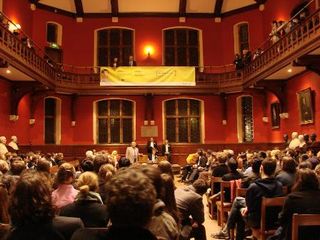
My point was that America's democracy did not exonerate it from moral judgment in its conduct of foreign policy; and that the use of military force, directly or by proxy, had to obey universal moral norms that were not suddenly exempted because one side was a dictatorship and one a democracy. The use of violence was the use of violence; war crimes were war crimes even if the side which committed them was more generally benign than the other; warfare and realpolitik – whether exercized by the US or the UK or the USSR – were to be judged by universal standards. In other words, my speech was a Tory critique of American exceptionalism. I recall looking directly at Weinberger and uttering this neoconservative heresy (I paraphrase from memory):

"You are just another country; just another republic in the history of the world. You are subject to the judgment of history, not exempt by the fact of merely being America."

Later, I interrupted Weinberger's speech at one point with the simple question, decrying his logical dependence on the internal democratic system of the US as the core reason its actions were always morally superior to the Soviets:

"Does an immoral act become less immoral because we have the right to choose to do it or not?"

I have been accused of inconsistency, idiosyncrasy and God knows how many things over the past decade as my revulsion at neoconservative hubris has deepened. But that teenage debater was onto something. And I cling to it still.