
Tucson, Arizona, 2.43 pm
Tucson, Arizona, 2.43 pm
Rick Hertzberg connects two kinds of political burning:
[Y]ou can’t burn “the” flag, and you can’t burn “the” Koran, either. The flag is a Platonic ideal. As such, it is fireproof. Any particular flag is merely a copy, and you can’t destroy the flag by destroying a flag any more than you can destroy (or even harm) the Constitution by destroying a copy of it. Nor can you destroy the Koran by destroying a copy thereof, or any number of copies. But I can’t claim to understand the emotions involved, really; where religion is concerned, I’m an infidel. So I don’t want to push the point.
The editor of the Missoulian, the daily newspaper in western Montana, is sick of Sarah's smears:
Contrary to former Alaska Gov. Sarah Palin’s warning to the standing-room-only crowd at this afternoon’s Teen Challenge fundraiser in Missoula, the media did not “sneak in” to her speech. We were not there as “moles,” in her words. … I only mention this because that sort of talk – “Be careful. There may be some media that sneaked into the room.” – is intended to create distrust of the professional journalists in this city and all across the country who take their jobs very seriously and work hard to accurately and fairly report the news.
(Hat tip: Palingates)
A different way to see the city:
Brad Laner – Eyes Close from Josh Laner on Vimeo.
Christina Agapakis updates her fascinating post by linking to another by Christie Wilcox. In it, Wilcox explains how some fig species fight back against freeloading wasps that try to use the plant without pollinating it:
First off, the figs carrying cheater offspring were aborted more frequently. When a fig aborts a larvae-containing fruit, it kills all of the larvae inside. One active species only kept around 3% of the number of figs that the passive pollinated species did. But to punish them even more, the fig also manipulated the conditions within the growing fruits which contained cheating larvae – per fruit, fewer cheater adults emerged than non-cheating ones. In one species of fig, almost no cheaters survived to adulthood – just 5% of the number that emerged from passively pollinated figs. How exactly the fig changes the condition of the fruit to harm the growing larvae isn't yet known.
In response to Craigslist's censorship of sex ads, sociologist Sudhir Venkatesh takes aim at five myths surrounding prostitution:
I've been studying high-end sex workers (by which I mean those who earn more than $250 per "session") in New York, Chicago and Paris for more than a decade, and one of my most startling findings is that many men pay women to not have sex. Well, they pay for sex, but end up chatting or having dinner and never get around to physical contact. Approximately 40 percent of high-end sex worker transactions end up being sex-free. Even at the lower end of the market, about 20 percent of transactions don't ultimately involve sex.
Figuring out why men pay for sex they don't have could sustain New York's therapists for a long time. But the observations of one Big Apple-based sex worker are typical: "Men like it when you listen. . . . I learned this a long time ago. They pay you to listen — and to tell them how great they are." Indeed, the high-end sex workers I have studied routinely see themselves as acting the part of a counselor or a marriage therapist.
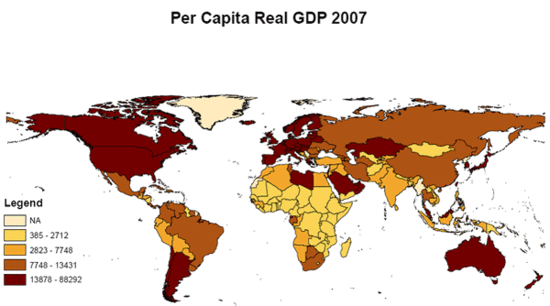
At Aidwatch, Bill Easterly argues that the beauty of a fractal – a shape which has the same amount of “jaggedness” or “unevenness” at every scale – mirrors the levels of inequality in the world.
Huge disparities of wealth can be seen between the U.S. and sub-Saharan Africa (above, where red is rich and yellow, poor). But looking closer, the same patterns appear on the national and local levels within the US. There is a similar inequality of wealth between Appalachia and the greater DC area, and even on the smallest scales, in different neighborhoods in Manhattan (after the jump):

(Hat tip: Christopher Shea)
This David Frum article is getting some push back. The most quoted paragraph:
Remember how there was supposed to be a surge of rage against the governments who fought the Iraq war? Yet the worst violence occurred in France, which did not join the war. And even in France, Islamic extremist violence has abated since 2005, contained and defeated by effective police work.
Kevin Sullivan counters:
This strikes me as an incredibly simplistic – not to mention shortsighted – analysis of the still to be determined byproducts of the Iraq war. A 90 percent drop in what was once a rather rare and distant occurrence in the lives of most Iraqis must bring little comfort and solace to those whom have lost friends and loved ones over there due to the invasion.
And a decrease in terrorist attacks – which, at one point, numbered in the thousands each month (pdf) – seems like a rather weak metric for success or failure in Iraq.
Greg
In 2003, 2004, 2005, and 2006 there was a sharp increase in terrorist attacks – both inside Iraq and around the world. In 2007 and 2008 those numbers fell, but they were still way above the pre-Iraq war levels.
Larison points to Madrid, London, and Iraq itself.
Camille Paglia exposes Lady Gaga on the cover of Sunday Times Magazine:
Although she presents herself as the clarion voice of all the freaks and misfits of life, there is little evidence that she ever was one. Her upbringing was comfortable and eventually affluent, and she attended the same upscale Manhattan private school as Paris and Nicky Hilton. There is a monumental disconnect between Gaga’s melodramatic self-portrayal as a lonely, rebellious, marginalised artist and the powerful corporate apparatus that bankrolled her makeover and has steamrollered her songs into heavy rotation on radio stations everywhere.
Cohn does some crystal ball reading:
While the judge has decided that DADT is unconstitutional, she hasn’t said what, exactly, the government has to do in response. If she says the government has to stop enforcing DADT, then Justice has to appeal, for the reason I said. But, based on what I've seen, it sounds like it’s possible that she would just order the reinstatement of the plaintiffs in this case. If so, then it is barely possible–unlikely, but imaginable–that the government would just drop the case. That is because a decision by a district court does not establish a precedent binding on anyone. I could imagine the government saying that it’s not worth spending the time and money on an appeal when the case establishes no precedent and just requires the reinstatement of a couple of service-members.
 The Dish